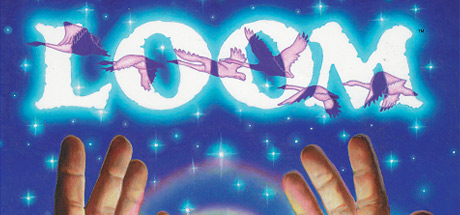
Loom is a distinctive and quietly ambitious graphic adventure developed by LucasArts and published by LucasArts, Lucasfilm, and later Disney, standing apart from many of its contemporaries through its tone, mechanics, and narrative philosophy. Unlike the comedic, dialogue-heavy adventures the studio later became famous for, Loom embraces a more restrained, fairy-tale-like atmosphere that prioritizes mood, symbolism, and mythic storytelling. Even decades after its original release, it remains a fascinating example of how experimental design and emotional subtlety can leave a lasting impression.
The story is set during the “Age of the Great Guilds,” a time when powerful organizations shaped the world through specialized crafts. Loom centers on the Guild of Weavers, whose mastery of weaving has transcended textiles and evolved into the manipulation of reality itself. You play as Bobbin Threadbare, a young Weaver cast out from his homeland under mysterious circumstances after a series of ominous events. As Bobbin journeys beyond the island of the Weavers, the narrative slowly unfolds into a tale of loss, destiny, and transformation. The story is deliberately sparse in direct exposition, instead allowing players to piece together the world’s history and significance through visual cues, recurring symbols, and quiet moments, giving it a dreamlike quality rarely seen in adventure games of its era.
What truly defines Loom is its radical departure from traditional point-and-click mechanics. Rather than relying on verb lists, inventories, or complex object combinations, the game introduces a musical magic system based on short melodies known as drafts. These drafts are sequences of notes played on Bobbin’s distaff, each producing a specific effect on the world, such as opening pathways, altering objects, or revealing hidden truths. As the game progresses, players learn new drafts organically, often by observing their effects in the environment rather than being explicitly instructed. Some drafts can even be reversed to produce opposite results, reinforcing the game’s thematic focus on balance and duality. This system transforms puzzle-solving into a process of pattern recognition and experimentation rather than trial-and-error item use.
The puzzles themselves are generally more approachable than those found in many classic adventure games, emphasizing intuition and observation over opaque logic. Loom’s design intentionally avoids frustration, offering a more linear and guided experience that keeps the narrative moving at a steady pace. While this makes the game accessible to newcomers and those less interested in complex puzzle chains, it also means the overall challenge level is relatively light. The game is short and focused, often completed in a single sitting, which reinforces the sense that Loom is closer to an interactive storybook than a sprawling adventure epic.
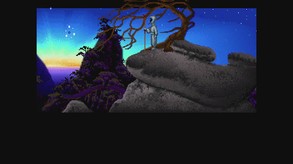
Visually, Loom carries the hallmarks of early 1990s PC graphics, but its art direction gives it a timeless charm. Characters and environments are simple yet expressive, with silhouettes, color choices, and animations doing much of the storytelling work. The game’s aesthetic leans heavily into fantasy and folklore, reinforcing its mythic tone without relying on excessive detail. Later versions, including the one available on Steam, introduced enhanced visuals and full voice acting. While these additions make the game more accessible to modern audiences, they also subtly alter the pacing and tone compared to the original text-heavy release, which some longtime fans prefer for its quieter, more contemplative feel.
Music plays a central role in Loom, both mechanically and thematically. The soundtrack draws heavily from Tchaikovsky’s Swan Lake, adapted into MIDI form and woven throughout the experience. This choice reinforces the game’s sense of melancholy and elegance, while also tying directly into the musical draft system at the heart of gameplay. Sound is not merely background decoration here; it is a storytelling tool and a puzzle mechanic, making Loom one of the earliest examples of audio-driven interaction in games.
Viewed today, Loom stands as a bold experiment that prioritizes atmosphere, emotion, and innovation over complexity or length. Its willingness to break away from established adventure game conventions makes it feel surprisingly fresh even now, though its brevity and simplicity may leave some players wishing for more depth. Rather than aiming to overwhelm, Loom invites players to slow down and absorb its world, offering an experience that feels intimate and carefully composed. For fans of classic adventure games, interactive storytelling, or game design history, Loom remains a memorable and influential title that demonstrates how restraint and creativity can be just as powerful as scale and spectacle.
Rating: 8/10