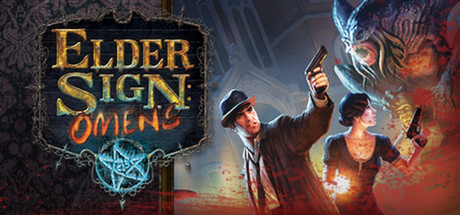
Elder Sign: Omens is a digital version of the popular board game by Fantasy Flight Games. Build a team of unique investigators and fight to keep an all-powerful Ancient One from invading our world! Explore museums, oceans, deserts and more for the arcane Elder Signs that will help seal the Ancient One away.
Modeled estimate, not a reported figure. How we estimate →
Media

About
Stats
All-time low is the lowest price we've recorded for this game since we started tracking it.
Languages: English**languages with full audio support
Engagement
Hours played at review time, across 40 reviews with recorded playtime.
Reviews
Themes across 40 recent reviews and how positive each mention is. A keyword signal, not full sentiment analysis.
positive critical· bar length = how often the theme comes up
Reviews
I was feeling nostalgic and almost installed and launched this again for old times' sake, but just before I did, I remembered the issue with this adaptation: Since you can only play it single-player, its locked into the optional 'solo play' variant rules that come with the physical board game. Unfortunately those rules make the game nigh-impossible to beat because Fantasy Flight was somehow under the impression that playing alone is easier than playing as a group (and I don't know why, because when you're playing as a group the difficulty of challenges is determined by the number of characters on the board, not the number of players) and imposes a pretty severe handicap that the game won't let you turn off.
I dunno, it feels like the game was made harder than the real board game.
[code] [url=https://store.steampowered.com/curator/36948155-Card-Game-KING/] FOR MORE CARD AND BOARD GAMES FOLLOW US [b]CARD GAME KING [/b][/url] [/code] Elden ring, err, Elder Sign is a digital adaptation of the board game in which you control 4 investigators trying to seal a great evil before it destroys the world. No pressure. The main mechanic is rather straightforward, visit places with various task that need to be assigned certain dice faces. Complete all of them and you get closer to winning the game. Lose, and your sanity might suffer. The game's relative simplicity is the biggest draw. There is planning, but not overwhelmingly so. There is risk management but you don't need to calculate the odds. The scenarios are also fairly quick to complete (under 1h). However, if you are new to the game, the in-game tutorial is not the best and would recommend looking up the official game overview videos. The main criticisms of the game many bring up, is the luck factor. You set yourself up for success only to fail due to bad luck. While this can and will certainly happen, I didn't feel bad luck was more impactful than careful planning and I've initially expected a far larger reliance on luck. I've beaten the game 5 times with random investigators, including the 'very difficult' Cthulhu scenario, and most of them on the first try (Cthulhu took 4 attempts). The game offers a good amount of investigators and bosses, although the latter do feel a bit same-ish. Thankfully, there are a few mini campaigns that add some twists to the usual gameplay. Overall, I was happy with the variability and replayability. Regarding balance, it feels right although it's fair to mention that big failures are difficult to recover from. If you go unto a difficult adventure with good odds of success, then proceed to lose all items and fail, it can be extremely difficult for the investigator to recover from this blow, and they become mostly reliant on luck for future success until they stabilize. I will also add that the feeling of dread and encroaching madness typically accompanying Cthulhu themed games, isn't quite there. Monsters are surprisingly easy to beat, and in fact, monster hunting can be a viable strategy. But this is a minor complaint. Overall, I had fun with Elder Sign and will keep this one on my desktop to jump in from time to time. [h1][b]The positive[/b] [/h1] + Good variety and replayability + Relatively simple and straightforward gameplay while still rewarding efficient planning. [h1][b]The neutral[/b][/h1] * Some animations feel unnecessary. It only slows down the game by a small amount so it's a minor grievance. * While proper planning is much more impactful, occasional bad luck can ruin even the best of plans * In game tutorial is not the best way to learn the game. Thankfully, there are official game overviews that are quite short and explain the game better. [h1][b]The negative[/b][/h1] - Big failures can be difficult to recover from. Thankfully, you have other investigators to pull the weight. [h1][b]Conclusion:[/b] [/h1] Decent solo board game that's relatively easy to pick up with good replayability. While luck plays a role, a well formed strategy remains crucial for winning games. Recommended. [code] [url=https://store.steampowered.com/curator/36948155-Card-Game-KING/] FOR MORE REVIEWS ABOUT CARD GAMES, CHECK OUT OUR CURATOR PAGE: [b]CARD GAME KING [/b][/url] or [url=https://twitter.com/TheCardGameKing][b]TWITTER[/b][/url][/code]
game is rather hard even on easy
Well designed game, but it 100% cheats, 3 attempts at a 3 required dice adventure using the yellow dice and I failed each time. (needed 3 terror, game only gave me 2 in 3 attempts with 7 dice) that is 84 dice rolls and I got a combined total of 5 terror symbols (1 in 6 chance) statistically speaking that should have been almost 3 times that chance. so play at your own risk.
It's too RNG dependent. Skill is not a factor. You're 100% at the mercy of the luck of the draw, and 99 out of 100 times, you just don't get any way to progress.
I've watched to YouTube videos, read the Help, and after playing for 3 hours I cannot even come close to beating it on easy. It's more frustrating than a souls game. I can't tell if this is by design or poor design. I want to like it but it's almost impossible to advance in the game. If you want a game that makes you lose a lot by all means check it out. Not fun although I wanted it to be. Sometimes a turd is just a turd no matter what you what you shape into being.
A nice adaptation of the Elder Sign board game. There are a few differences especially in the expansion campaigns but it's a nice way to experience the game without having to take the box off the shelf. There's an element of randomness in the game. Much more depends on strategy and planning than the die rolls, though. Sure you can get a horrible die roll streak that just screws your perfect strategy, but this happens very rarely; most of the time the randomness just keeps things interesting and exciting and the game will be won or lost mainly based on the decisions taken.
Elder Sign: Omens is a digital adaptation of Elder Sign, a cooperative dice-and-card board game rooted deeply in the mythos of H.P. Lovecraft and published by Fantasy Flight Games. The tabletop version itself was released in 2011 and situates players as investigators racing against time to prevent the awakening of an Ancient One by collecting Elder Signs, all while contending with the creeping doom that has become synonymous with Lovecraftian horror. In bringing that experience to screens, Omens seeks to replicate the tabletop’s tension and randomness with a digital package that eliminates setup friction and automates bookkeeping — a welcome advantage for solo players and those without regular gaming groups. The digital edition sits within a lineage of Fantasy Flight board-to-digital conversions, aiming to preserve both mechanics and atmosphere while leveraging the audiovisual strengths of interactive media. At its core, Elder Sign: Omens is an exercise in risk management, probability, and escalating tension. You build a team of unique investigators, each bringing special abilities, and send them through a series of ‘Adventure’ scenarios across settings like museums, oceans, and deserts. Victory hinges on gathering a set number of Elder Signs before the Doom track — a measure of cosmic corruption — fills up and triggers the apocalypse. Mechanically, the gameplay mirrors its board game origin: success in Adventures is resolved by matching glyphs — symbols that represent different dice outcomes — against those required by the scenario. In the physical game, this is realized with specialized dice; in Omens, it translates to digital symbol draws and dice rolls with rerolls and special actions, including item usage and investigator abilities This approach preserves much of the tabletop’s strategy: choosing which Adventures to attempt, determining when to reroll or ‘focus’ to hold desirable glyphs, and allocating limited resources. Experienced board gamers will recognize this as the same push-your-luck decision-making that made the physical game accessible yet tense. The game deploys richly detailed 2D art that evokes the classic high-fantasy horror of the Arkham universe without overwhelming the interface. Icons, glyphs, and character portraits are both thematic and functional, making complex game states readable at a glance. Sound design complements the visuals with ambient audio and thematic music that surfaces at key moments rather than continuously, reinforcing tension and pacing without fatigue. Cutscenes — complete with voiceover narration — bookend sessions and deepen immersion beyond what most digital board game adaptations attempt. Together, these elements consistently earned praise in early critic reviews for crafting atmosphere and mood, even in a game that can otherwise feel abstracted from narrative drive One of the most discussed aspects of Elder Sign: Omens — and a key point of critique — is its reliance on luck. Many scenarios hinge on matching specific combinations of symbols, and the digital implementation retains the board game’s dice-like randomness. While strategy comes into play with item management and investigator choice, the outcome of any given Adventure can rest heavily on the roll of the metaphorical dice. For some players, this unpredictability evokes the original board game’s tension; others find it frustrating or even demoralizing, with success feeling as much about lucky draws as intelligent play. Online discussions and user feedback highlight instances where nearly ideal tactical decisions still result in failure due to unfavorable rolls — especially at higher difficulty or in chained Adventure sequences. This “luck-first” design can diminish the sense of mastery for players who prefer goal-directed problem solving over probability management. Critics note that while seasoned players might mitigate randomness through smart use of rerolls and items, complete control is impossible, reinforcing a push-your-luck feel that may alienate tactically oriented gamers. The learning curve of Elder Sign: Omens is steep, especially for players unfamiliar with the board game. The digital adaptation includes tutorials and on-screen information, but the layers of rules, special abilities, and glyph interactions can overwhelm newcomers. Patience and repetition are often required before players feel competent enough to minimize the sting of randomness with strategic decisions. Once understood, however, the game offers substantive depth and replay value — a sentiment echoed in critic reviews that highlight its lengthy scenarios and wide variety of investigators and Ancient Ones. The fact that the Steam edition bundles expansion content further enhances this. Once understood, however, the game offers substantive depth and replay value — a sentiment echoed in critic reviews that highlight its lengthy scenarios and wide variety of investigators and Ancient Ones. The fact that the Steam edition bundles expansion content further enhances this. However, its heavy reliance on luck — at times bordering on arbitrary outcomes — means that emotional payoff depends as much on chance as it does on strategic choices. This aspect will delight those who enjoy tension driven by randomness, yet frustrate players who expect measurable skill progression within tactical frameworks. In essence, Elder Sign: Omens is a compelling adaptation with superb audiovisual craft and deep replayability, but it remains a game where fate often outweighs calculation — a trait both true to its tabletop roots and a potential stumbling block for some players.
It's great, just learn the rules and don't expect to win very often and you'll be fine.
Related
Related
Trends
Modeled estimate over time, reconstructed from Steam's monthly review histogram.
Momentum
Pace estimated from the game's recent review growth (our daily snapshots) at its own sales-per-review ratio — a momentum signal, not booked sales.
Audience
Estimated from the language of this game's reviews — a proxy for where players are, not official Steam demographics.
Related
| Factorio | $140.6M | 232.2K | 98% | $35.00 |
| House Flipper | $65.8M | 110.8K | 94% | $24.99 |
| Balatro | $55.5M | 195.3K | 98% | $14.99 |
| The Scroll of Taiwu : Beyond The Dome | $62.2M | 69.6K | 66% | $29.99 |
| Tabletop Simulator | $42.2M | 73.8K | 96% | $19.99 |
Related
| Bunny Hop League | $84.9K | 700 | 71% | $5.99 |
| Coal Mining Simulator | $84.9K | 182 | 35% | $14.99 |
| Dead Man's Draw | $84.9K | 438 | 84% | $6.99 |
| FLASHOUT 2 | $84.8K | 224 | 57% | $9.99 |
| The 7th Guest Remake | $84.8K | 224 | 87% | $19.99 |
| Adaptory | $84.8K | 110 | 78% | $19.99 |