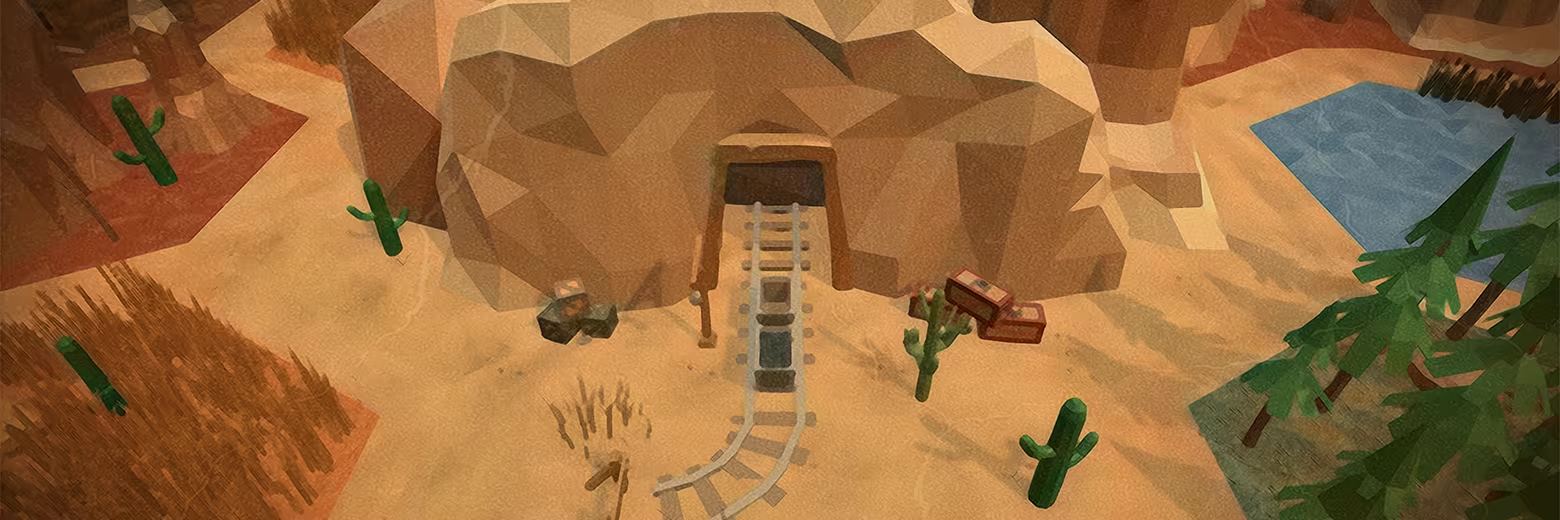
The First Mine is a turn based building, strategy and puzzle game. You need to run a productive gold mine by placing, grouping and upgrading various resource tiles without being distracted by different tasks and random events.
Modeled estimate, not a reported figure. How we estimate →
About

The First Mine is a turn based building, strategy and puzzle game. You need to run a productive gold mine with your population by placing, grouping and upgrading various resource tiles without being distracted by different tasks and random events.
Place, group and upgrade various tiles to collect resources
Run a productive mine with your population to mine gold
Don't let tasks and game events distract you
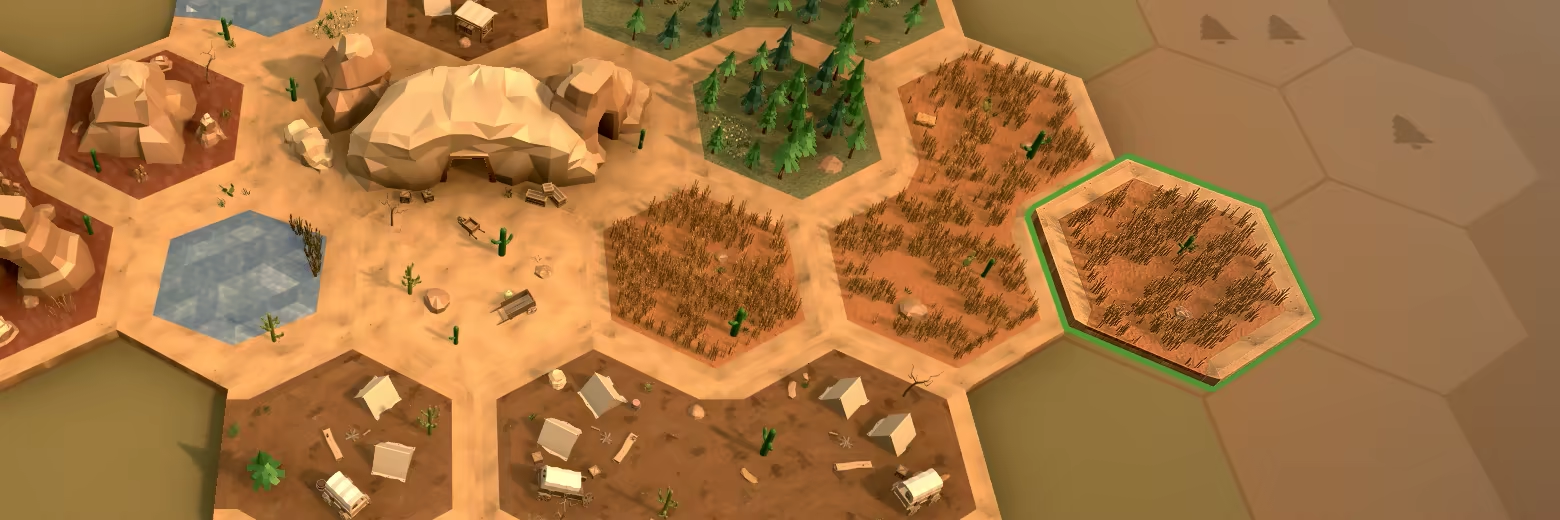
The goal of The First Mine is to mine as much gold as possible to achieve a high score at the end. There are different game sizes and difficulty levels to choose from, as well as several characters with unique traits for varied gameplay.
Each round you have to cleverly place and group a new random resource tile and upgrade your existing tiles as needed. Placing a new tile end the current round, mine gold in your mine and collect resources like wood, stone, wheat and fish.
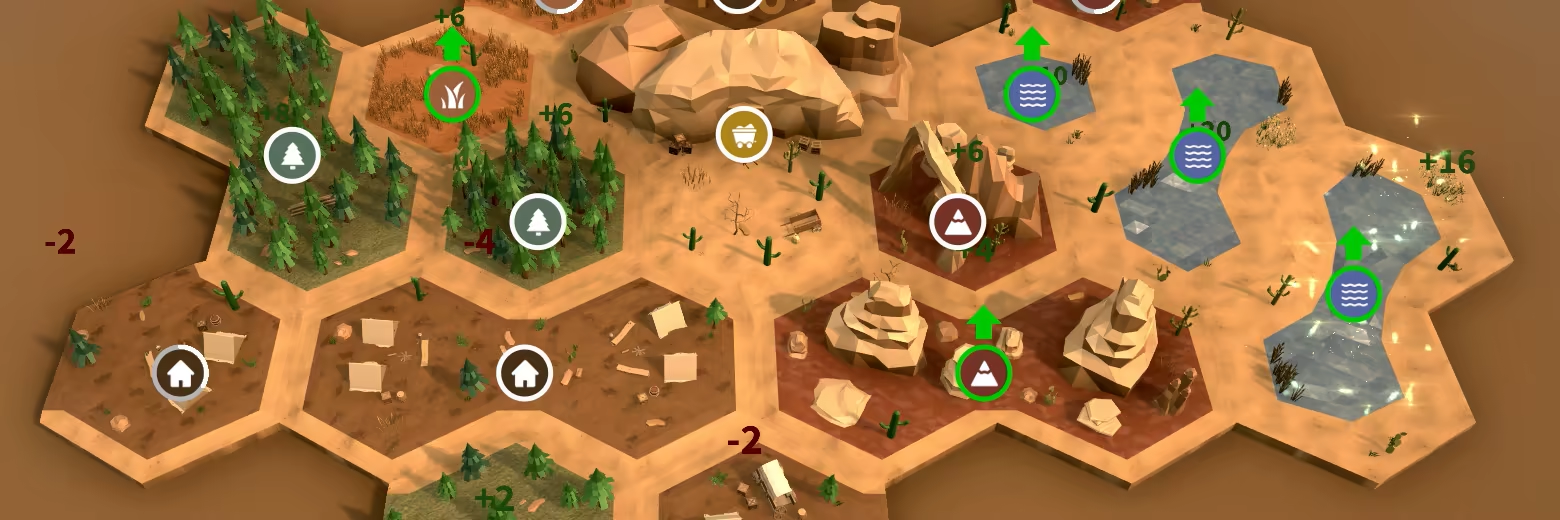
To mine gold, you need people in your villages. To keep them, you need to provide enough wheat and fish each round. More people and a higher level increases the amount of gold produced per round. You need wood and stone to upgrade the level.
In order to increase your yield per round, you can observe different requirements and tasks when placing resource tiles. In addition, there are random game events like trade, raids or natural disasters that can influence the game in a positive or negative way.
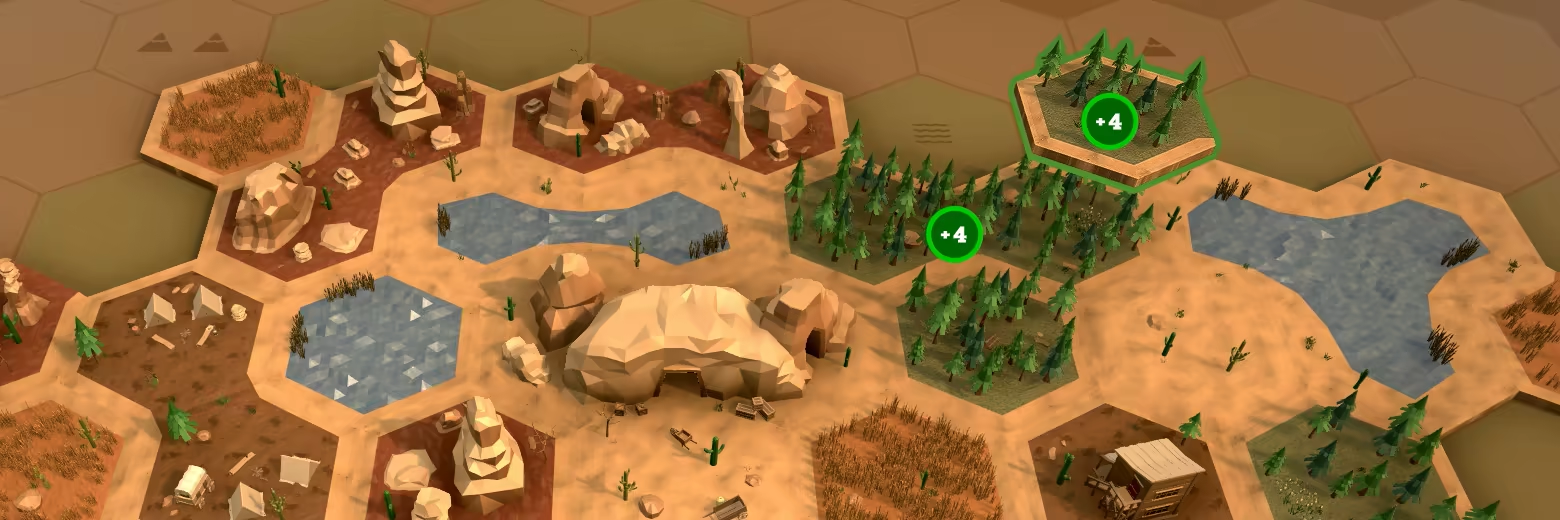
What The First Mine offers:
Mix of strategy, building and puzzle mechanics
Different tasks and simple resource management
Random game events like trade, raids or natural disasters
Achievements, highscores and leaderboards
What The First Mine does not offer:
4X strategy
Citizen simulation
Advanced resource management
Advanced trading system
Combat and violence
Genres
Stats
All-time low is the lowest price we've recorded for this game since we started tracking it.
Engagement
Reviews
[i]The First Mine[/i] is a more simplistic, yet still solid, Dorfromantik clone where you build a village on a hex grid by placing tiles one by one from a stack, matching their types to form clusters. There are a few notable differences between The First Mine and Dorfromantik. Tile placement here is much more restrictive: tiles have only two types of openings, limiting clusters to just two or three tiles of the same kind. Where Dorfromantik has you plan for a snake of one type of tile to stretch far across the map, here the objective is to close a group of two or three tiles of one type and then to upgrade their output to balance your resource production. Tiles can only be placed next to two other tiles, which restricts the overall shape of your settlement into more of a compact, centered mass rather than spreading it out in different directions. Your central gold mine generates gold that scales with population. All other tile types generate resources (wood, stone, wheat, or fish), while house tiles increase the village population, which consumes some of these resources. Furthermore, certain map locations provide bonuses when the right tiles are placed on them, and some biomes impose adjacency penalties. In [i]The First Mine[/i], clusters of identical tiles can be upgraded to yield extra resources, and some tiles trigger random events—unfortunately, usually to your detriment. Before each run, you can choose the map size (small, medium, or large), which influences the number of tiles in your stack. Difficulty modes also modify factors like tile placement time or resource income. Additionally, players can select from different classes, each offering perks that boost gold generation based on your production choices. Visually, Dorfromantik remains superior, with its intricate landscapes, rivers winding through forests and bustling towns. In contrast, [i]The First Mine[/i] emphasizes strategic tile placement and resource management over visual elegance. [quote]💜 If you like this review, please consider following [url=http://store.steampowered.com/curator/11354094]Lilly's Corner Curator page[/url] 🌸 [url=https://lillycorner.com/]Website[/url] [/quote]
Media

Related
Related
Price dynamics, follower growth, revenue and sales trajectories with interactive tooltips
This and every other Pro feature is free until October 20, 2026. A free account is all it takes.
Languages: English, German
Hours played at review time, across 25 reviews with recorded playtime.
If you’re looking for a seemingly simple, highly addictive, and relaxing game, you don’t have to look far. After just a few minutes of playing, you’ll find yourself thinking, ‘okay, just one more tile and I’m done.’ The AI-generated artwork on the start screen is a bit off-putting, but the game itself is very easy on the eyes and ears. Super satisfying and really affordable - highly recommended! I really hope it continues to be developed, because I think it has a lot of potential!
Casual puzzle where you mine gold by strategically placing hex tiles to gather resources, upgrade tiles, and maximize production to climb the leaderboards. The objective of each run is to gather as much gold as possible by strategically placing hexagonal resource tiles. Every game begins with a central mine, which serves as the starting point. From there, you build outward by adding tiles one by one, either adjacent to the mine or to other tiles already in play. Placement follows strict rules: two of the tile’s six sides must connect directly with an existing tile, so you cannot simply drop a piece anywhere on the board. Tiles are drawn randomly from a deck, and each time one is placed, a round concludes. At the start of the next round, every tile on the board generates its resource. Different types of tiles yield different materials—forest tiles provide wood, water tiles produce fish, mountains generate stone, fields supply wheat, and villages create villagers. Your chosen character at the start of a run can slightly alter production. For example, a farmer boosts wheat and fish yields. Tile placement is crucial because tiles often feature one or two open sides. By carefully linking two or three tiles of the same type and filling all their openings, you earn a bonus resource. However, there are restrictions. You cannot merge different resource types, nor can you position a tile in a way that blocks an opening. Similarly, a tile with one opening cannot sit against a tile with two openings, even if they share the same resource type. To complicate things, certain empty spaces on the map may be marked with a random resource. Placing a matching tile over one of these marked spots grants you an extra bonus, but it can also disrupt your carefully planned layout. You may find yourself forced to connect a village tile to a cluster of water tiles, which would not normally be ideal for your strategy. Resources you collect can be spent to upgrade tiles. Each tile can be upgraded twice, with the second upgrade costing double the first. Connected tiles are more expensive to upgrade. As you progress, random events occur, adding unpredictability. These events can be helpful or harmful, ranging from temporary bonuses to surprise trader visits, or even attacks. Occasionally, you’ll be given a choice on which event to pick. Ultimately, the sole purpose of the game is to maximize your score and climb the leaderboards. Once you run out of tiles and finish a run, you can begin another by selecting the run size, difficulty level, and character.
I want to start by saying this is a fantastic game. About 75% of the achievements are fairly easy to earn, while the remaining ones require a solid amount of dedication and grinding. If that kind of progression and challenge appeals to you, this game is a perfect fit. Its repeatable, board game–inspired style makes it incredibly replayable, and I can easily see myself coming back to it again and again. There’s also a surprising amount of strategy involved in achieving a successful run. It definitely challenges you—but in all the right ways.
While I haven't sunken an awful lot of time into this game just yet, partly because it's so easy to finish a quick round and come back at a later time, I can already tell it's a fun one. It's not super deep or anything (new tiles would be awesome), but it has some variation between each game. I do wish we could set up custom games with our own rule sets. Not sure why even the easy difficulty has to have a time limit, for instance. But even without, it's a good time, although I will admit combat feels kind of lopsided and rarely worth the risk. Endless mode would be cool. The rules could be based on running out of a resource, perhaps most logically losing a settlement, or population pool as a whole. Not sure what the best implementation would look like, but this could be a fun grind to hop in and out of for 30 minutes to an hour at a time. While I appreciate the addition of some meta progression, I wouldn't mind some more, so people can feel a bit more invested. As someone who found the listing for this game a long time before its release, I'm glad I've finally had the chance to give this title a try, as it looks and feels neat. Just wish the in-game music sounded more like the title screen music, which is more western-esque than the almost jungle-sounding music playing when actually in a game.
Bei The First Mine muss man sich nicht lange fragen, woher die Inspiration kommt. Das Spiel schreit aus allen Löchern: "Dorfromantik!" Aber das muss ja nichts Negatives sein. Gut kopiert ist halb gewonnen. Die Frage ist nur: Ist es auch gut kopiert? Für mich ist das schwierig zu beurteilen, weil ich das grosse Vorbild nie gespielt habe. Ich kann also nur isoliert The First Mine betrachten. Und was man hier bekommt, ist ein kleines Strategiespiel, in dem man möglichst geschickt Plättchen anlegen muss, um aus einer Mine Gold abzubauen. Dafür braucht es verschiedene Ressourcen, die man durch passende Plättchen erhält. Das funktioniert grundsätzlich rund und macht auch durchaus Spass. Es ist eine einfache Formel mit einem gutem Loop, welcher durchaus motivieren kann. Allerdings hat das Spiel auch ein paar klare Schwächen. Das beginnt beim Tutorial, das vieles zu wenig gut erklärt. Vor allem die Upgrade-Funktion der Plättchen muss man sich selber zusammenreimen. Das ist in meinen Augen nicht gut gemacht. Ebenfalls nicht gut gemacht ist die fehlende Optionsvielfalt. Das einzige Ziel ist es, Achievements zu sammeln und den Highscore zu knacken. Ich sehe nicht, wie hier echte Langzeitmotivation aufkommen kann. Genau das ist für mich die grösste Schwäche: Nach ein, zwei Partien droht das Ganze bereits öde zu werden. Ja, mit genug gesammeltem Gesamtgold kann man sich zwei dauerhafte Upgrades kaufen, aber das ist klar zu wenig, um wirklich langfristig bei der Stange zu halten. Sehr positiv ist dagegen, dass man für jede Partie verschiedene Setups wählen kann und gleich angezeigt wird, wie lange die Partie ungefähr dauern wird. Das ist perfekt für eine kleine Runde zwischendurch, ohne dass es ausartet. Die Grafik ist okay. Sie ist zweckmässig und völlig in Ordnung, aber eben auch nicht wirklich hübsch. Das gelb-braune Westernszenario hilft da auch nur bedingt. Und ein Makel bleibt: Viele Texte und Textfenster sind viel zu klein für entspanntes Spielen auf dem Sofa. Hier wären skalierbare Schriftgrössen dringend nötig und zwar nicht nur nach unten, sondern vor allem nach oben. Fazit: The First Mine ist ein solides Spiel, das Fans von Strategiespielen für einen Moment unterhalten kann, aber aufgrund fehlender Abwechslung schnell eintönig zu werden droht. Für ein paar Partien oder eine kurze Runde zwischendurch dennoch eine Empfehlung.
Addictive game
Стефан, вам спасибо. Мне понравилось. В рамках пары вечеров повыбивать адчивочки- самое то. Теплая, ненапряжная, чем-то напоминает сбор мозайки Пенроуза, что, лично меня и цепануло.
Не нужное мнение, в рамках короткого знакомства на "Безумном ключнике") https://www.twitch.tv/kir_lucky Я плохо знаю англиский,а немецкий только учу. Игра легко описывается - нечего не понятно,но очень интересно) Вот честно. Нечего не понял,но вроде интуитивно пнял и с третего раза победил) Против кого,как,но победил) Если вы любите эксперементы,некий род стртегий, за 200р я считаю это стоит попробовать.
This game is criminally underrated. I am always on the hunt for games that can satisfy my hunger for a Dorfromantik-like gameplay loop, and this one does it just wonderful. Is it perfect? No. For example the performance on my (give or take 5 years old gaming) laptop isn't great, and I can't figure out why, because the graphics doesn't seem too demanding. But I am really intrigued, and I was immediately after playing the demo, and I still am. This is complex enough for just me wanting to try more rounds and improving more. But also simple enough for being able to squeeze in a quick round while listening to podcasts. Please consider giving this a try if you like games like Dorfromantik or Islanders.
Selling now
See how fast this game is selling right now — estimated copies and revenue per day from recent review growth.
Players by region
Where this game's players are, estimated from review languages.
Related
| Game | Estimated lifetime revenue | Reviews | Review score | Price |
|---|---|---|---|---|
| $400 | 3 | 67% | $4.99 | |
| $14.7M | 29.6K | 96% | $13.99 | |
| $18.3K | 61 | 98% | $9.99 | |
| $15.3K | 39 | 90% | $8.99 | |
| $12.8K | 29 | 83% | $14.99 | |
| $6.9K | 23 | 96% | $9.99 |
Related
| Game | Estimated lifetime revenue | Reviews | Review score | Price |
|---|---|---|---|---|
| $3.3K | 55 | 65% | $1.99 | |
| $3.3K | 52 | 90% | $1.99 | |
| $3.3K | 209 | 72% | $0.99 | |
| $3.3K | 180 | 52% | $0.74 | |
| $3.3K | 51 | 63% | $2.99 | |
| $3.3K | 96 | 96% | $2.99 |