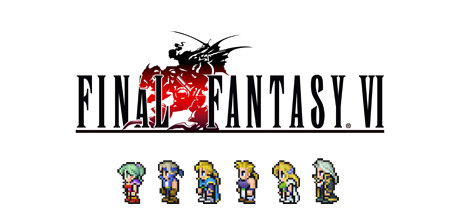
The original FINAL FANTASY VI comes to life with completely new graphics and audio! A remodeled 2D take on the sixth game in the world-renowned FINAL FANTASY series! Enjoy the timeless story told through charming retro graphics.
Modeled estimate, not a reported figure. How we estimate →
Media

About
Genres
Stats
All-time low is the lowest price we've recorded for this game since we started tracking it.
Engagement
Hours played at review time, across 77 reviews with recorded playtime.
Reviews
Themes across 77 recent reviews and how positive each mention is. A keyword signal, not full sentiment analysis.
positive critical· bar length = how often the theme comes up
Reviews
Depois de platinar Final Fantasy VI, posso dizer que ele se tornou o meu favorito dos FF. Levei um pouco mais de tempo para concluir tudo do que no Final Fantasy V, mas valeu completamente a pena. As melhorias em relação aos títulos anteriores são muito perceptíveis. O jogo é lindo, com uma direção de arte incrível, uma trilha sonora fantástica e um elenco de personagens muito marcante. A história me prendeu do início ao fim e a experiência foi excelente. Meu único ponto negativo foi o final, achei que deixou algumas coisas em aberto e poderia ter entregado um encerramento mais satisfatório para a jornada. Quanto à platina, ela é consideravelmente mais trabalhosa do que a de Final Fantasy V, principalmente por troféus como o do Setzer (777) e alguns outros que exigem bastante dedicação. Ainda assim, nada disso tira o brilho da experiência. No geral, foi uma jornada inesquecível. Um RPG excepcional e, até agora, o meu Final Fantasy favorito!
나온지 20년 이상 된 게임을 할 때마다 '기술이 많이 좋아졌는데 처음 나왔을 때 한 사람들 만큼의 감동을 내가 받을 수 있을까?'라는 걱정을 늘 하는데요. 파판6은 그런 걱정이 무색하게 너무 즐겁게 한 게임입니다. 특히 오페라 이벤트는 왜 리메이크도 아니고 3D도 아닌 '픽셀 리마스터'인지 알 수 있는 장면이었습니다. 원작을 그대로 살리되 그때 플레이 했던 사람들 만큼의 감동을 주고 싶으면 이렇게 할 수도 있구나 싶어서 여러 의미로 감동적인 동시에 '아, 이래서 게임을 하는구나' 하고 느꼈습니다. 이전 작에 비해 마법이 차지하는 비중은 줄어들었을 지 몰라도 마법과 기계가 공존하는 세계와 각 등장인물들의 세세한 스토리를 즐기고 싶으시다면 추천하고 싶습니다. 명작은 정말 몇십년이 지나도 명작이네요...
Final Fantasy VI is a masterpiece. It's the last of its kind before the PS1 era but it's still so good and props to the Pixel Remaster team for creating this version of the game. It looks beautiful, plays extremely smoothly and has incredible rearrangements of the original soundtrack by Uematsu (the absolute GOAT) This game has a great story and a even more fantastic villain. Believe the hype you've heard around Kefka because this guy is actually insane. The world feels so special and the lore is very interesting. Can't say much here without spoilers but FF6 has a super good story and the way that they were able to convey it through the old pixel style is both cute and astonishing. Gameplay wise, it has the Active Time Battle System which was first implemented in this game but FF7-9 also has the same system and it's just a good system in my opinion. It's simple but plays well and does still have some strategic aspects you might wanna think about. What's really nice is how every single character has their own unique gimmick and for the most part, all of them are very useful and the animations for some of the attacks are great. Of course everyone knows that FF is very character-centered and almost everyone in the game is written very nicely. It doesn't have a specific protagonist (you could argue there are 2 protagonists) but the cast of characters they have just makes it work. Each party member has something special going for them, have their own backstory, their motivations and so on. However this is where I'll give one criticism of the game. Despite having fantastically written characters, the party doesn't really feel like much of a team. Don't get me wrong there are definitely some decent team dynamics throughout the story but compared to 7 and 9, it feels kind of lacking. The characters are great on their own but when you look at the story from above it kind of feels like the whole team is disconnected and there are even optional party members that just kinda... exist. If this game's party was written like how 7 or 9's party was wriitten, it would easily be the best Final Fantasy story in my opinion, the potential is there. Part of me yearns for a remake of the game, just imagining all the crazy scenes and voice lines is making me sad that the game is so old (but still amazing). 9.8/10
Aside all other positive aspects, such as pretty great music remake, smooth and more "flowing" spell animation, etc.... There just too many "bonus" contents that were removed in this version compared to previous versions, such as : - Dragons' Den, including all extra items that was obtainable (e.g legendary signature weapons such as Apocalypse and Save the Queen) - Some Esper Battles along with its following Magicite (Gilgamesh, Leviathan, and Cactuar) - Soul Shrine that unlocks after beating Dragons' Den. - Items stolen from the Statue of Gods during final battle before fighting Kefka, such as stealing Ragnarok sword from Lady will not be saved after beating Kefka. Which also means Lightbringer sword can't be obtained. FF VI has gone throught a lot of versions where bonus game and contents were added along the way, and this Remaster actually refers to Point Zero where this game ever started. Now players have less thing to do in the game.
I did not enjoy my playthrough due to extreme RNG. Would not recommend.
Holy ♥♥♥♥, that scene where Celes [spoiler]throws herself off a cliff after the main villain has destroyed the world and become a god, and she's lost everyone and everything[/spoiler] stuck with me even after the ending. What a game... what a deeply moving game... 30 years later, I'm a Gen Z adult playing this for the first time, and it still hits just as hard as the 90's.
Few games have left a lasting mark on the role-playing genre quite like Final Fantasy VI. Originally released in 1994, it remains not only one of the greatest RPGs ever made but, for many fans and critics alike, the finest entry in the Final Fantasy franchise. While later installments introduced groundbreaking graphics, voice acting, and cinematic storytelling, Final Fantasy VI achieved something timeless: it created a deeply human story through an unforgettable ensemble cast, exceptional world-building, and themes that continue to resonate decades later. What truly sets Final Fantasy VI apart is its cast. Rather than revolving around a single chosen hero, the game tells the story of fourteen playable characters, each carrying their own burdens, motivations, and emotional scars. Every member of the party feels like a protagonist in their own right, contributing to a narrative that explores identity, love, loss, redemption, hope, and the will to keep living in the face of overwhelming despair. Terra Branford begins as a mysterious young woman stripped of her freedom, forced to serve as a weapon because of her extraordinary magical abilities. Her journey is not about defeating evil alone but about discovering what it truly means to be human. Throughout the game, Terra struggles to understand love, compassion, and belonging, making her personal growth one of the most heartfelt stories in the series. Locke Cole serves as more than the typical treasure hunter. Beneath his confident exterior lies a man haunted by guilt over failing someone he deeply loved. His determination to protect others stems from painful regret, giving emotional weight to every decision he makes. Locke's story reminds players that heroism often grows from past failures rather than perfection. Celes Chere undergoes one of the franchise's most remarkable transformations. Once an imperial general, she questions everything she believed after witnessing the Empire's cruelty. Her struggle with trust, forgiveness, and self-worth reaches its emotional peak during one of the game's most unforgettable sequences—a moment that perfectly captures the themes of hopelessness and renewal that define Final Fantasy VI. Edgar Roni Figaro balances charm and humor with the heavy responsibility of ruling a kingdom caught between peace and war. His relationship with his twin brother, Sabin Rene Figaro, forms one of the game's strongest familial narratives. Sabin rejected the throne in pursuit of personal freedom, while Edgar sacrificed his own desires for the sake of his people. Their contrasting choices show that both duty and freedom demand sacrifice. Cyan Garamonde represents unimaginable grief. After losing everything he held dear, he continues fighting despite overwhelming sorrow. His journey explores acceptance and healing rather than revenge, making his story one of the game's most emotionally powerful arcs. Shadow is perhaps the game's most mysterious character. His past is revealed gradually through dreams and subtle storytelling, rewarding attentive players with a tragic tale of regret, isolation, and broken promises. Rather than explaining everything outright, the game trusts players to piece together his history, making his character all the more compelling. Setzer Gabbiani initially appears to be a carefree gambler, but beneath his adventurous spirit lies the memory of a lost love and shattered dreams. His airship becomes more than a vehicle—it symbolizes the freedom to keep moving forward despite heartbreak. Relm Arrowny and Strago Magus introduce themes of family and legacy. Despite their lighter personalities, they remind players that wisdom and innocence can coexist, adding warmth to a story often filled with tragedy. Gau's background is among the most heartbreaking in the game. Abandoned as a child and forced to survive alone on the Veldt, he never loses his kindness or curiosity. His reunion with his father is painful precisely because it refuses to offer an easy or idealized resolution, reflecting the game's mature approach to family relationships. Mog, Umaro, and Gogo may receive less narrative attention than the rest of the cast, yet they enrich the world's diversity and encourage exploration. They reinforce that Final Fantasy VI is a world inhabited by unique individuals rather than simply a stage for the main plot. At the center of this incredible cast stands Kefka Palazzo, arguably the greatest villain in Final Fantasy history. Unlike antagonists driven by conquest or revenge, Kefka embraces pure nihilism. His descent into madness culminates in an achievement few RPG villains can claim: he actually succeeds. The world is destroyed. Civilization collapses. Hope disappears. This moment fundamentally changes the structure of the game. Instead of embarking on a simple quest to prevent disaster, players must rebuild a broken world and reunite scattered companions who have each found different ways to cope with unimaginable loss. Some choose isolation. Others cling to responsibility. Some nearly surrender to despair altogether. The World of Ruin transforms Final Fantasy VI from a traditional fantasy adventure into a profound meditation on resilience. What makes the narrative extraordinary is that defeating Kefka is not merely about saving the world. It is about proving him wrong. Kefka believes life is meaningless because everything eventually ends. Every character's journey becomes a response to that philosophy, demonstrating that meaning comes not from permanence but from the relationships we build, the people we protect, and the hope we choose to carry despite suffering. The game's soundtrack, composed by Nobuo Uematsu, elevates every emotional moment. Whether it is Terra's Theme, Celes' haunting opera performance, Dancing Mad, or the many character-specific motifs, the music gives each scene emotional depth rarely achieved in the 16-bit era. Even decades later, these compositions remain among the finest in video game history. Visually, Final Fantasy VI pushed the Super Nintendo to its limits. Its expressive sprite animations, memorable environments, and cinematic presentation proved that technical limitations could be overcome with artistic vision. Iconic scenes—the opera house, the Phantom Train, the Floating Continent, and the apocalyptic World of Ruin—remain unforgettable because they rely on masterful direction rather than graphical realism. Many Final Fantasy games excel in specific areas. Some have stronger combat systems, others feature more advanced graphics or larger worlds. However, Final Fantasy VI achieves an exceptional balance between storytelling, gameplay, music, atmosphere, and character development. Every major party member experiences meaningful growth, every victory carries emotional significance, and every setback reinforces the game's central themes of hope, perseverance, and the enduring value of human connection. Whether someone ultimately prefers another Final Fantasy is a matter of personal taste. Games like Final Fantasy VII, Final Fantasy IX, and Final Fantasy X have each earned their devoted followings for good reasons. Yet there is a compelling argument that Final Fantasy VI represents the creative peak of the franchise. Its ensemble cast remains unmatched, its villain remains legendary, its emotional storytelling has aged remarkably well, and its exploration of loss and hope continues to inspire players across generations. More than thirty years after its release, Final Fantasy VI is not simply remembered as a classic—it is remembered as a masterpiece. It demonstrates that unforgettable stories are not defined by technological advancements but by unforgettable characters, meaningful themes, and the emotional impact they leave behind. For many fans, Final Fantasy VI is not only the greatest Final Fantasy ever made but one of the greatest video games of all time.
2부에서부터 공략 없으면 거의 불가하다 싶이 아무런 가이드도 없고 확실히 옛날 게임이라 그런지 불친절함 공략 보고 깨야됨..
залупа ♥♥♥♥♥♥
This is my favorite game from the FF series
Related
Related
Trends
Modeled estimate over time, reconstructed from Steam's monthly review histogram.
Engagement
DAU/MAU are modeled from peak concurrent players (≈×8 and ×28) — Steam publishes no active-user counts, so treat these as rough estimates, not reported figures.
Audience
Audience
Games most often reviewed by the same players — an audience-affinity signal from our review sample, not full ownership data.
Languages: English, French, Italian, German, Spanish - Spain, Japanese, Korean, Portuguese - Brazil, Russian, Simplified Chinese, Thai, Traditional Chinese
Estimated from the language of this game's reviews — a proxy for where players are, not official Steam demographics.
Related
| Poker Night at the Inventory | $1.6M | 8.3K | 95% | $9.99 |
| DEFCON | $1.6M | 4.3K | 87% | $11.99 |
| Zompiercer | $1.6M | 4.5K | 89% | $9.99 |
| A Quiet Place: The Road Ahead | $1.6M | 2.5K | 75% | $29.99 |
| Ultimate Fishing® Simulator 2 | $1.6M | 2.2K | 68% | $19.99 |
| Vagante | $1.6M | 5K | 89% | $14.99 |
Related
| FINAL FANTASY IV | $877.2K | 3K | 91% | $17.99 |
| FINAL FANTASY III | $826.8K | 2.8K | 93% | $17.99 |
| FINAL FANTASY | $1.7M | 8.5K | 95% | $11.99 |
| FINAL FANTASY V | $723.1K | 2.4K | 90% | $17.99 |
| FINAL FANTASY II | $677.3K | 3.4K | 82% | $11.99 |
| Sea of Stars: Sunset Edition | $9.5M | 15K | 89% | $17.49 |