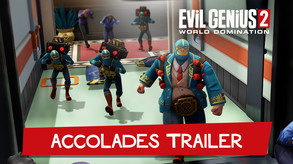
A satirical spy-fi lair builder where YOU are the criminal mastermind! Construct your base, train your minions, defend your operations from the Forces of Justice, and achieve global domination!
Modeled estimate, not a reported figure. How we estimate →
Prices
Each in the currency that store quoted — not converted: the gap between two rows is the publisher's pricing, not an exchange rate.
Availability
We put this game to every storefront we collect. A market that answered not sold has told us something about the game; a market we never asked has not, and the two are never drawn the same.
Discounts
Every price cut of more than 20% we have observed, in each market that quoted one, with this game's chart position on either side of it. These are episodes, not a model: a sale is one event, and one event cannot tell you what the next one will do.
Reviews, worldwide (the counter carries no country): 0.57/day in the week to Sep 2 → 0.86/day in the week after.
For scale, across Steam · Top Sellers · Brazil over the last 30 days: the 25 chart moves that followed a price cut of more than 20% went a median of 10 places towards #1, and the 2,413 moves with no price cut behind them went 2 away. One store, one chart, one country — it is the only place we have enough observations to say even that.
Prices outside the United States have been collected since 6 August 2026 and chart positions since 19 July 2026, so a cut older than that has no market to compare and a market that joined later has no history yet. Nothing here is converted between currencies.
About
Add-ons
Each DLC is estimated with the same model as a game, then summed — a modeled figure, not reported DLC sales.
Sums Steam only; PlayStation, Xbox publish no volume signal, so the true total is higher by an unknown amount.
| Store | Price | Audience | Score | Chart | Est. revenue |
|---|---|---|---|---|---|
SteamYou are here | $39.99 | 13.2Kreviews | 69% | — | $17.9M |
| $7.99−80% | 1.3Kratings | 85% | — | not modelled | |
Updates
Build ids and update times come straight from Steam's PICS — the same source SteamDB reads. Patch history grows as we record new builds.
Engagement
Reviews
Themes across 833 recent reviews and how positive each mention is. A keyword signal, not full sentiment analysis.
Reviews
in Evil Genius 1, whenever a minion brings in gold, it would add to a stack, and as the player earns more and more gold, the stack would become taller visibly and once the stack has reached its full height and a new stack would appear. In EG2, there is only one stack, and it is the same no matter how much money the player has. This epitomises the problem with this game, very flashy but obviously not enough love and attention to details have gone into making this game. I think this game is fine for people who never played EG1 before, but for me it is a dump down of the original game,
I wish I could recommend Evil Genius 2 in good faith, but there are simply too many issues for the experience to ever feel genuinely enjoyable. The writing is stilted and awkward, as if HR had set up camp in the writer’s room to ensure every line passed a corporate smell test. The result is humor that rarely lands and dialogue that feels strangely sanitized for a game about supervillainy. Base-building, one of the series’ core appeals, is hampered by bizarre item footprints and layout restrictions that make most rooms feel same-y by necessity rather than design. Instead of fostering creativity, the system nudges you toward a handful of functional, uninspired templates. And then there’s the time gating, which is frankly excessive to the point of being a deal breaker. Periods of simply waiting stretch on so long that the game begins to feel more a mobile title engineered around being idle rather than a strategy sim built around planning. It feels like the design was originally aiming at mobile monetization hooks that were later removed, leaving only the tedium behind. Ultimately, the series still has so much potential, with an identity and tone that no other game quite captures. But Evil Genius 2 squanders the charm and creativity that could have made it a worthy successor.
Media

Related
Related
Price dynamics, follower growth, revenue and sales trajectories with interactive tooltips
This and every other Pro feature is free until October 20, 2026. A free account is all it takes.
14 of 15 markets; the rest we haven't asked for this title, not markets where it is unavailable.
14 on sale1 answered “not sold”0 we did not ask
The 1 “not sold” market is read from the Steam price pass of Aug 17: that day the store answered for this game elsewhere and gave no price there. The 14 priced markets are the same rows as the table above — each the latest price we hold, dated here when it is older than that pass. The 0 marked “not asked” were not put to this store at all — either it has no storefront there or we do not collect it yet, and neither is a statement about the game. A refusal is a refusal on one day; a store can list a title again tomorrow.
Genres
Stats
All-time low is the lowest price we've recorded for this game since we started tracking it.
Languages: English*, French, Italian, German, Spanish - Spain, Portuguese - Brazil, Russian, Simplified Chinese, Traditional Chinese*languages with full audio support
| $39.99 |
| 1.2Kratings |
| 74% |
| — |
| not modelled |
Matched by title — a reused name can pair the wrong games. * is a critic aggregate. Prices and positions are each store's United States storefront; Epic charts worldwide. Audience and Score too, except Steam's, which is worldwide.
Hours played at review time, across 840 reviews with recorded playtime.
positive critical· bar length = how often the theme comes up
I still have a boxed copy of the original Evil Genius. Even allowing for the haze of nostalgia, I confidently recall it being reasonably entertaining and stylish, though certainly not flawless. This though, is just *dull*. It has the feel of an idle or freemium game, constantly waiting for timers to complete and having to do small variations on the same thing over and over and over again. There's little thought or strategy involved, it's just a matter of persistence through the painfully drawn out campaign. Unlike those idle or freemium games, though, there is a layer of micromanagement required which compels attention despite how tedious it all is. A small detail left overlooked can quickly cause things to fall apart, and the game is terrible at communicating things. For instance, there is an auto-rebuild option for items, but you have to click it manually for every...single...item. Easy to forget when your base is filled with many hundreds of items. I missed it for a particular item which disposes of body bags, which was quietly destroyed in one of the interminably repetitive fires which plague bases. Soon enough, half my minions deserted because they went into a morale spiral due to a single body bag in an obscure part of the lair. It meant little in the scheme of things - just a lot more tedious waiting for timers - but I was so bored that I didn't notice. It may have only cost $1 in a bundle, but it wasn't worth the time.
A lot in the game screams mobile game design. Timers, shallow loops, and UI choices that genuinely feel like the game was originally meant to be a free to play mobile title. It all disappointingly plays like a dumbed down version of the first game: less depth on both the world map and in the lair, simplified trap mechanics, simplified minion management and an overall strangely hollow gameplay loop. It’s not unplayable it has the humor and "eye candy" regarding the models and animations. But the game is just painfully underambitious and undercooked when they already had a really good recipe to build from and expand upon, which i think a "sequel" should do.
This game would be peak if they just added another year or two of proper support and playtesting and feedback updates. Unfortunately it's like a love letter lost in the trenches. Never to reach where its meant to be.
It is not a horrible game. I kept playing hoping it would get better but it just became more and more grindy. The setting, humor, art, graphics, and sound are all great. The base building is fun. Defending it is fun for a bit but it gets repetitive. The side quest system is repetitive. The main quest is repetitive. The world map is not fun at all and guess what? that right: extremely repetitive. The core gameplay is good but the video game built around it is not.
Evil Genius 2 confidently delivers the core fantasy of the series: you are not just building a lair, you are staging a full-on cartoon villain show, where every corridor, every trap, and every control panel supports the same tone. And it shines the most in its visuals. The artists and animators absolutely nailed it: the style is sharp, readable, and packed with detail, and the animation is full of life, with little gestures and comedic pauses that sell the humor. It is especially fun to watch the objects in your base and how minions interact with them. Even the most routine tasks turn into tiny comedy scene. The story is another big win. It is not trying to be serious, but it stays entertaining and fits the classic spy movie vibe perfectly. Each Evil Genius also gets their own narrative flavor. The mission structure may not be radically different mechanically, but the presentation and story framing changes enough to make each campaign feel distinct. More importantly, the geniuses have unique quirks that go beyond their basic descriptions, and those details genuinely change the feel of a playthrough. Emma is a great example: she cannot use a gun, so she fights in her own way, and it reinforces her identity as a mastermind who controls the situation rather than brute forcing it. Maximilian, on the other hand, is pure theatrical greed. His executions can turn characters into gold statues that you can literally sell, which is both hilarious and perfectly on theme. Replayability also gets a real boost from the island selection. Different islands are not just cosmetic. Their layouts affect choke points, travel distances, and how cleanly you can control infiltration. In that sense, islands can be treated like an extra layer of difficulty tuning. The configuration of the lair influences how agents reach critical areas, which makes planning more interesting before you even place your first room. Unfortunately, the game loses momentum in the late stages, and this is where it deserves criticism. The early pacing feels great: you expand, unlock rooms, experiment with traps, and constantly feel progress. But later on, progress turns into a long chain of waiting. You wait for minions to train into the right profession, then wait for them to run across the base, then wait for resources to be carried, then wait for schemes to finish, then wait for intel, fuel, and gold to build up. The problem is not difficulty. It is downtime. Too often you are not making smarter decisions, you are simply watching timers. This is where the first Evil Genius still has an edge in overall rhythm. Evil Genius 1 was rougher and less polished, but it felt more emergent and chaotic in a way that kept you engaged. The lair was a living machine that could break in unpredictable ways, and you spent more time reacting and adapting. Evil Genius 2 is the stronger game in presentation, animation, and overall comfort, but it also feels more scripted and more grindy near the finale. It remains stylish, funny, and charming all the way through, yet in the endgame it can start to feel less like running an evil master plan and more like waiting for the next progress bar to finally reach the required number.

Evil Genius is half a great game welded to a screensaver. The first stretch is a delight — building the lair, setting traps, actually feeling like a criminal mastermind. Then the wheels come off. The entire second half collapses into clicking regions on the world stage and waiting for minions to finish training, an endless loop of queue, wait, repeat that asks nothing of you and gives nothing back. There's no escalation, no new mechanic, no reason to think. Just menus and cooldowns dressed up in villain costume. And it's lazy in a way you can see. The endgame is the early game with the wording changed — the same handful of systems recycled under new names, over and over, until the credits mercifully arrive. Whether it was a deadline or a budget, something clearly went wrong partway through development, and instead of designing a second half they laid down filler and hoped nobody would notice. People notice. What starts as one of the most charming premises in strategy gaming ends as a spreadsheet with a countdown timer.
I've tried to review this ignoring my love for EG1, and treat it as a game in it's own right. I think the biggest problem for me with this game, is it's an idle game that you can't idle. So much of it is just... waiting. Agents come in waves every so often, you deal with them then you wait. You need to do research to progress. So you wait for that to finish. You can only do one mission on the world stage in each area at a time. So you wait. I spent most of the game on fast forward mode, with my vaults full and my base secure. You're only allowed to do one side objective at a time, so that just becomes a matter of queuing them up and doing them one at a time. You could probably finish the game in a few hours if you were able to do more side objectives at once. I do want to try and say some good things too - I really like the way they've give the EG a bit more personality and interaction, and kept some of the silliness of the original. But this would have done so much better as a mobile game that would run while I did something else, and could come back to once everything is complete.
A great game that missed out on an opportunity to satirize real life. For example, why can't you do what real evil geniuses do globally: - Dumb down the curriculum of public education in order to ensure that the plebeians will be obedient and efficient workers rather than individuals that question anything around them - Create various political entities that represent a spectrum of ideals that have been carefully manufactured, tribalize said ethoses, then pit the parties against each other while remaining in control of them all - Encourage the general public to support lose-lose situations and plans, whether it be: warfare, needless extra taxation, censorship, limiting rights and responsibilities, or consuming poison - Control thoughts and behaviour through all forms of media entities globally - Have people globally hate anyone and everyone around them except for the individuals that are truly responsible for their problems - Create issues, then profit off of them by offering solutions of my choosing and personal benefit (war, disease, resource depletion, etc.)
Selling now
See how fast this game is selling right now — estimated copies and revenue per day from recent review growth.
Active players
Estimated daily and monthly active players (DAU/MAU) modeled from peak concurrency.
Players by region
Where this game's players are, estimated from review languages.
Players also reviewed
The games this title's players most often review too — audience affinity.
Related
| Game | Estimated lifetime revenue | Reviews | Review score | Price |
|---|---|---|---|---|
| $1.1M | 3.6K | 93% | $9.99 | |
| $9.6M | 14.4K | 79% | $19.99 | |
| $1.7M | 3K | 87% | $19.99 | |
| $1.3M | 2.2K | 70% | $19.99 | |
| $7.1M | 12.8K | 92% | $14.99 | |
| $3.8M | 5.3K | 82% | $19.99 |
Related
| Game | Estimated lifetime revenue | Reviews | Review score | Price |
|---|---|---|---|---|
| $18M | 94.3K | 74% | $9.99 | |
| $18M | 18K | 94% | $29.99 | |
| $18M | 24.5K | 81% | $29.99 | |
| $18.1M | 20.3K | 93% | $29.99 | |
| $17.7M | 20.5K | 90% | $34.99 | |
| $17.7M | 20.9K | 49% | $19.99 |