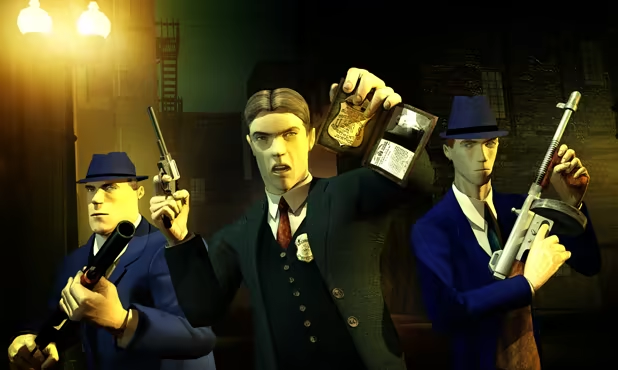
Chicago 1930, developed by Spellbound and published by Microids, is a real-time tactical game that immerses players in the volatile atmosphere of Prohibition-era America. Set in a version of Chicago drenched in crime, corruption, and ambition, it offers a dual narrative structure where players can experience the conflict from two opposing sides: the law and the mob. It’s a premise rich with potential, promising to let players decide whether to clean up the city’s underworld or dominate it through fear and violence. At its best, the game captures the aesthetics and tone of the 1930s gangster scene—the trench coats, Tommy guns, smoky bars, and jazz-soaked tension of a city teetering between law and lawlessness. However, while the setting is evocative and the concept intriguing, the execution struggles to live up to the promise, resulting in an uneven but occasionally fascinating experience.
The structure of Chicago 1930 revolves around a blend of tactical combat, squad management, and light role-playing elements. Each campaign—whether you choose to side with the police or the mob—allows you to build a team of five operatives with distinct abilities and skill sets. Characters specialize in attributes such as marksmanship, melee combat, stealth, charisma, and first aid, and these stats can be upgraded as missions progress. The game’s “Slow Motion Mode” allows players to briefly pause the action to issue orders, adding a semi-strategic layer to the real-time mechanics. This design was clearly inspired by earlier titles like Desperados and Commandos, but unlike those genre standouts, Chicago 1930 struggles to deliver the same sense of precision and control. The framework for a complex tactical experience is present, yet the artificial intelligence and cumbersome interface often prevent it from achieving its full potential.
One of the game’s biggest strengths lies in its commitment to atmosphere. Spellbound captures the essence of the 1930s underworld with surprising authenticity for its time. The isometric environments are filled with period-appropriate detail—speakeasies buzzing with illicit trade, rain-soaked alleyways hiding ambushes, and offices dripping with the corruption of backroom deals. The soundtrack and ambient sound design complement this aesthetic perfectly, featuring jazz-inspired motifs and subtle environmental cues that reinforce the noir tone. The visual direction, while dated by modern standards, carries a distinct charm; the sepia palette and stylized architecture bring the city to life. There’s a palpable effort to make every scene feel rooted in its era, even if the limited animation and camera angles sometimes undercut the immersion. Despite these technical constraints, the game’s artistic vision remains one of its most memorable features.
Unfortunately, the gameplay doesn’t always match the strength of the presentation. The controls feel clunky and unintuitive, particularly when commanding multiple units in tense combat situations. Pathfinding issues are frequent—characters can get stuck behind furniture or fail to respond to commands in time, often leading to chaotic encounters that feel more accidental than tactical. The enemy AI suffers from similar inconsistencies, alternating between oblivious and hyper-reactive, making stealth approaches frustratingly unreliable. The balance between gunfights and strategy feels uneven, with many missions devolving into simple shootouts instead of offering diverse tactical opportunities. This design imbalance undermines the potential for creativity, pushing players toward brute-force solutions rather than rewarding thoughtful planning. The difficulty curve can also be erratic, with some levels offering satisfying challenges and others feeling unfairly punishing due to clumsy mechanics rather than deliberate design.
The dual campaign structure adds replay value, though the narratives themselves are fairly straightforward. The mob storyline follows the rise of a crime boss as he expands his influence through violence and manipulation, while the police campaign casts you as an agent trying to dismantle the criminal empire from within. The writing does its job but never rises above genre clichés; characters are archetypal rather than nuanced, and dialogue often serves more as exposition than character development. Still, the idea of seeing events unfold from both perspectives gives the game an appealing symmetry, and it succeeds in conveying the moral grayness that defined the era. Each side’s missions share a similar structure—complete objectives like eliminating rivals, rescuing informants, or raiding enemy hideouts—but the context and tone differ just enough to make replaying worthwhile for fans of the setting.
From a technical standpoint, Chicago 1930 shows its age. Originally released in the early 2000s, the game’s visuals and interface were modest even by that era’s standards. The isometric camera works well enough for the tactical design but limits immersion, and the lack of modern scaling or resolution support can make it look awkward on current systems. The sound design remains effective, though repetitive voice lines and gunfire effects can become grating over time. The overall stability of the game is decent, but occasional bugs—such as crashes during transitions or broken mission triggers—can still appear, especially in the digital re-releases. These technical shortcomings are not catastrophic, but they reinforce the sense that this is a product of its time, a piece of early-2000s experimentation that hasn’t aged as gracefully as its inspirations.
Despite its flaws, there’s something undeniably appealing about Chicago 1930 for players who appreciate the gangster genre. Its setting and atmosphere do most of the heavy lifting, giving it a distinct identity within a sea of strategy titles. When the mechanics do align—when your team executes a coordinated takedown or a tense shootout erupts in a smoky bar—the game can feel genuinely cinematic. Those moments remind you of the potential that lies beneath the rough edges. Unfortunately, they’re too inconsistent to sustain the experience for long. The lack of mechanical depth and polish limits what could have been a classic in the tactical strategy genre, relegating it instead to the status of a cult curiosity.
In the end, Chicago 1930 stands as an ambitious but flawed attempt to blend tactical combat and noir storytelling. Its atmospheric depiction of Prohibition-era Chicago and dual-perspective campaign give it a unique charm, but its clunky controls, erratic AI, and dated interface keep it from achieving the refinement of genre standouts. For fans of vintage strategy games or those fascinated by the gangster mythos, it offers an enjoyable, if uneven, glimpse into a world of moral decay and urban violence. For others, its limitations may overshadow its charm. It’s a game that feels like a time capsule—one that captures the spirit of its era both in theme and design, rough edges and all.
Rating: 6/10