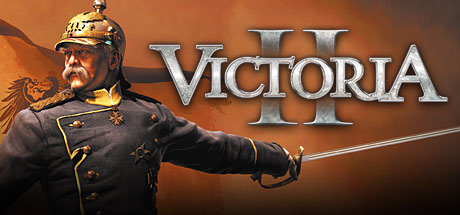
Carefully guide your nation from the era of absolute monarchies in the early 19th century, through expansion and colonization, to finally become a truly great power by the dawn of the 20th century. Victoria II is a grand strategy game played during the colonial era of the 19th century, where the player takes control of a country, guiding...
Modeled estimate, not a reported figure. How we estimate →
Media

About
Genres
Stats
All-time low is the lowest price we've recorded for this game since we started tracking it.
Languages: English, French, German
Updates
Build ids and update times come straight from Steam's PICS — the same source SteamDB reads. Patch history grows as we record new builds.
Engagement
Hours played at review time, across 600 reviews with recorded playtime.
Reviews
Themes across 599 recent reviews and how positive each mention is. A keyword signal, not full sentiment analysis.
positive critical· bar length = how often the theme comes up
Reviews
Victoria II: An Intellectual Sandbox Disguised as a Grand Strategy Game Victoria II is not a game you play so much as one you study. Where most grand strategy titles reward territorial expansion or military dominance, Victoria II asks something far more demanding: that you understand systems—economic, social, political, and ideological—and how they collide over time. Its brilliance lies in how little it explains and how much it expects. At its core, Victoria II is an argument about history. The game models the 19th and early 20th centuries not as a sequence of wars, but as a living web of populations (POPs), markets, technologies, and ideas. Every citizen has a job, culture, religion, literacy rate, political ideology, and material needs. These aren’t abstractions for flavor; they drive everything. If your artisans go bankrupt because global prices shift, unrest follows. If literacy rises, new ideologies emerge. If factories lack inputs, industrialization collapses regardless of how many you’ve built. The game constantly reminds you that power is structural, not merely military. What makes Victoria II especially intellectual is how indirect control defines the experience. You do not simply command outcomes—you influence conditions. You don’t order people to become socialists; you industrialize too quickly, neglect reforms, and let inequality ferment. You don’t choose to be a democracy; you allow consciousness to rise, literacy to spread, and political movements to gain momentum. The game forces you to think like a statesman rather than a general, weighing long-term stability against short-term gains. The economic system alone is famously opaque, yet that opacity is part of its philosophy. The world market behaves independently of the player’s wishes, reflecting the reality of global capitalism. You can subsidize industries, manipulate tariffs, or hoard resources, but you can never fully escape systemic pressures. This creates a rare sense of humility in strategy gaming: even a Great Power is constrained by forces larger than itself. Victoria II also excels intellectually in how it treats progress as morally ambiguous. Industrialization brings wealth—and misery. Imperialism brings resources—and radicalization. Social reforms stabilize nations—but weaken elite control. Every “solution” introduces new contradictions. There is no optimal path, only trade-offs, and the game never lets you forget them. It is not accessible. It is not smooth. It is often frustrating. But that friction is precisely what elevates Victoria II. Mastery comes not from reflexes or optimization alone, but from comprehension—of demographics, incentives, feedback loops, and historical logic. When things go wrong, it feels less like the game cheated you and more like history asserting itself. Victoria II is intellectual because it respects the player enough to be difficult, and because it treats history not as spectacle, but as a system of pressures and consequences. It doesn’t flatter you with power fantasies; it challenges you with responsibility. Few games demand so much thought—and fewer still reward it so profoundly.
Great game, and the best simulator of society/economy of the late 19th century that you can play. Buy this, not the travesty that came after.
Recommended if you're contemplating suicide and you need a little extra something to kick the chair out from underneath you.
My name gilbert I am so joyful and I love this game :) because this game has made me have joy in my life. Thank you, Victoria II.
> Went liberal france > Got too much infamy > Had the war of the 8th and 9th coalition > Got shat on Very realistic
**A Review of *Victoria II*** *By Arthur Schopenhauer* One beholds the screen and is struck first by its poverty. The map is functional, no more; the interface is a grey expanse of ledgers and tabs, devoid of charm, devoid of warmth, devoid of any aesthetic intention whatsoever. It is the world rendered as corporate quarterly report. A child's atlas, glimpsed through frosted glass. One pays a princely sum for this—and then pays again, and again, for the DLC that renders the simulation merely incomplete rather than utterly barren. The price persists, undignified, like a scar one must continually finance. And yet. Beneath this dour facade, something extraordinary stirs. The economy breathes. Not metaphorically—actually, mechanically, inexorably. Pop needs ale; the barley farm employs labourers; the labourers require furniture; the furniture factory consumes timber; the timber price rises; the farmer prospers; the farmer purchases ale. One observes this chain, this humble, global communion of supply and demand, and one understands, for the first time, the true pulse of the nineteenth century. It is not battles. It is not treaties. It is grain. It is coal. It is the quiet, ceaseless metabolism of human want. Then the crisis arrives. A great power demands concession. Another balks. The alliance web tightens. Suddenly, impossibly, the world is at war—not for glory, not for ideology, but for the price of textiles. The economy, so recently a marvel of equilibrium, becomes a frantic, hilarious catastrophe. Unemployment soars. Armies starve. The British Empire, lacking sufficient tropical wood, collapses into fiscal irrelevance. It is absurd. It is unhistorical. It is, against all reason, immensely enjoyable. *Victoria II* is not beautiful. It is not fairly priced. It extends no courtesy to the newcomer. But it understands, as few games do, that history is not made by heroes. It is made by clerks. And the clerks, for once, are fascinating company.
Welcome to Victoria II. We have: - Yellow Prussia - Jacobin & Socialist Revolt - 6th Opium War - camps in Yugoslavia - sPAIN & Fattoman - minor's struggle - Comet Sighted! - Event 4434, 4435, 60120, 80003
juego muy solido, el mejor de Paradox, a pesar del paso del tiempo y el envejecimiento de sus gráficos se mantienen como un juego bastante completo en tema de contenido y mecanicas para su época y que para estándares de Paradox tiene muy pocos DLC y bastantes baratos
Did not enjoy a single second of playing. I've never felt this much nostalgia for a game I genuinely despise. I feel like a stupid dude and I can't run an economy. Every game hundreds of waves of rebels reform my government every three seconds, I lose 5-15 wars, and my allies switch up on me. But the soundtrack is just too immaculate for me to rate the game negatively. It just makes me feel like a dignified gentleman. 10/10, would sacrifice my firstborn for this game
This game will leave you wondering who the ♥♥♥♥ the anarcho-liberals are after they’ve sieged your capital for the twelfth time in a single playthrough.
Related
Related
Trends
Modeled estimate over time, reconstructed from Steam's monthly review histogram.
Engagement
DAU/MAU are modeled from peak concurrent players (≈×8 and ×28) — Steam publishes no active-user counts, so treat these as rough estimates, not reported figures.
Audience
Audience
Games most often reviewed by the same players — an audience-affinity signal from our review sample, not full ownership data.
Estimated from the language of this game's reviews — a proxy for where players are, not official Steam demographics.
Related
| ENDLESS Legend™ | $14.8M | 19K | 83% | $29.99 |
| The Outer Worlds 2 | $14.8M | 8.7K | 74% | $69.99 |
| Watch Dogs®: Legion | $14.8M | 12.3K | 56% | $59.99 |
| The Evil Within | $14.8M | 33.2K | 85% | $19.99 |
| The Wolf Among Us | $14.8M | 39.9K | 98% | $14.99 |
| No, I'm not a Human | $14.9M | 29.7K | 93% | $14.99 |