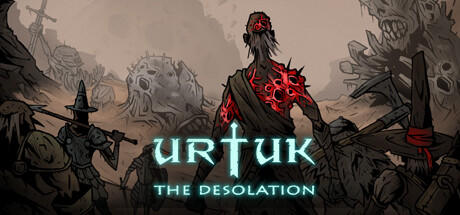
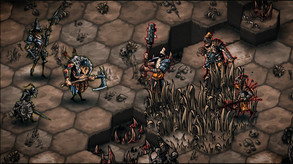
Urtuk is an open world, tactical turn-based RPG in a low-fantasy setting. Guide your band of adventurers through the ruins of an ancient world. Recruit new followers, loot the corpses of your fallen foes, and do your best to survive in this harsh and unforgiving realm.
Modeled estimate, not a reported figure. How we estimate →
About
Genres
Stats
All-time low is the lowest price we've recorded for this game since we started tracking it.
Languages: English, Russian, Polish, French, Simplified Chinese, Traditional Chinese
Engagement
Hours played at review time, across 45 reviews with recorded playtime.
Reviews
Themes across 45 recent reviews and how positive each mention is. A keyword signal, not full sentiment analysis.
positive critical· bar length = how often the theme comes up
Reviews
It's interesting, but strikes me as an awkward, more confusing Battle Brothers. Facepalmed hard when my armoursmith couldn't equip anything but a staff, making it impossible to actually use his Weapon Enhancer ability for anything worthwhile. The description directly specifies "any" weapon or armour. This may have potential for me, and plenty of folks seem to enjoy it, but the backlog beckons.
Game lacks an UNDO button. Apparently enemies level with you, which is annoying - means game isn't designed to be balanced. Making enemies level with you is a bit of a cheap trick.
Urtuk: The Desolation, developed and published by David Kaleta, is a turn-based tactical RPG that carves out a strong identity through its uncompromising focus on combat depth and its bleak, oppressive world design. Rather than presenting a traditional heroic journey, the game places players in control of a small group of outcasts struggling to survive in a decaying land shaped by experimentation and mutation. The narrative framework is intentionally minimal, serving more as a backdrop than a driving force, but it effectively establishes a tone of desperation and isolation that carries through every battle and decision. The heart of the experience lies in its tactical combat system, which operates on hex-based battlefields where positioning is everything. Terrain plays a crucial role, with elevation differences, environmental hazards, and spatial control often determining the outcome of encounters. The ability to shove enemies into pits, traps, or otherwise disadvantageous positions adds a layer of strategy that goes beyond simple attack exchanges. Each turn demands careful planning, as missteps can quickly lead to irreversible losses. The initiative-based turn order further reinforces this, requiring players to think several moves ahead and adapt to shifting battlefield conditions. One of the game’s most distinctive systems is its approach to character progression. Instead of traditional leveling or skill trees, characters evolve through mutations gained from fallen enemies. These mutators grant powerful abilities but come at a cost, typically reducing maximum health or introducing other trade-offs. This creates a constant tension between growth and survivability, forcing players to make meaningful choices about how far they are willing to push their characters for greater power. The system encourages experimentation and allows for a wide range of build possibilities, ensuring that each playthrough can feel different depending on the mutations and recruits acquired. Outside of combat, the game adopts a streamlined structure that emphasizes forward momentum. Players navigate a branching overworld map, moving from one encounter to the next while occasionally stopping at events, recruitment opportunities, or resource nodes. While this provides a sense of progression, it is relatively light compared to the depth of the combat system. The overworld serves primarily as a framework to deliver battles rather than a fully fleshed-out strategic layer, which may leave some players wishing for more complexity or narrative development between encounters. Visually, Urtuk: The Desolation stands out with its hand-drawn art style, which leans heavily into themes of decay and mutation. Characters are often grotesque and unsettling, reflecting the harshness of the world they inhabit, while environments convey a sense of abandonment and ruin. The aesthetic is not traditionally beautiful, but it is highly distinctive and effective in reinforcing the game’s tone. Combined with a subdued and atmospheric soundtrack, it creates an experience that feels consistently bleak and immersive. The game’s greatest strength—its deep and demanding combat—can also become its primary source of fatigue. Because the overall structure revolves heavily around repeated battles, the experience can begin to feel cyclical over extended play sessions. While the variety of enemies, mutations, and tactical scenarios helps maintain engagement, the lack of significant changes in pacing or structure means that the gameplay loop remains largely consistent from start to finish. Players who thrive on strategic challenges will likely appreciate this focus, but others may find it repetitive over time. Difficulty is another aspect that may divide players. The game does not always clearly communicate its systems, and certain encounters can feel punishing, especially when compounded by the permanent consequences of poor decisions. However, for those willing to learn its mechanics and adapt, the difficulty adds to the sense of accomplishment. Victories feel earned, often the result of careful planning and a deep understanding of the game’s systems. Ultimately, Urtuk: The Desolation is a game that excels by committing fully to its strengths. It offers a rich and rewarding tactical experience supported by a unique progression system and a striking visual identity. While its limited focus and repetitive structure may prevent it from appealing to a wider audience, it delivers a compelling experience for players who value strategy and are willing to engage with its demanding nature. It is not a game that tries to be everything, but within its chosen scope, it succeeds with confidence and clarity. Rating: 8/10
Unfortunately doesn't work at all (white screen with the cursor, music playing and that's it).
Ну что хочу сказать? Игра довольно хороша! Билды персонажам можно сделать разнообразные за счёт мутагенов и приобретённых в боях навыках. Любителям билдостроения рекомендую. Любителям просто РПГ - рекомендую. Любителям пошаговых и тактических РПГ - однозначно рекомендую! Советую к прохождению для прохождения её ещё раз, т.к. открываются новые "классы" героев. Реиграбельность высокая. Если игра зашла, то пройти её за новых открытых героев точно захочется! Новый опыт получить, новый билдочек замострячить... Ну вы сами всё знаете!
Not balanced at all, some missions are easy, some are impossible. Thanks for the boss at 4000+ PV, doing triple attacks and getting life when being hit...
1
Игры и фильмы про путешествия к центру земли всегда манили игроков Конечно все мы знаем что просто так туда не попасть Здесь несомненно нужен ноль переход Великий подвиг наших славных предков А ты Землянин сыграй в игру потренируйся а мы посмотрим на твои успехи
I think it's worth the price. Although it does get monotonous at the end.
It's decent, especially if bought on sale, but just for the gameplay and perk combos, story could be cut out and it might be better afterwards. All the characters and most of the trinkets are fun and different enough, the encounters are challanging and there are multiple types of them. Sadly the rng sucks and I'd rather get nothing than see some of the bad trinkets, but that's just how it is. PS ♥♥♥♥ the boss that was on the second map with the crossbowmen on the "towers" and had 20 bs skills but on your team gets just two weaker versions and barely can 1v1 while in his fight he almost killed everyone in 1v4 or 1v5 (not that it changes that much) with pretty much everyone on my team being able to solo the normal encounters
Related
Related
Trends
Modeled estimate over time, reconstructed from Steam's monthly review histogram.
Audience
Estimated from the language of this game's reviews — a proxy for where players are, not official Steam demographics.
Related
| 7 Days to Die | $425.3M | 403.5K | 87% | $44.99 |
| Mount & Blade II: Bannerlord | $309.8M | 293.9K | 88% | $49.99 |
| Divinity: Original Sin 2 - Definitive Edition | $169.5M | 204.5K | 96% | $44.99 |
| Don't Starve Together | $164.6M | 539.5K | 95% | $14.99 |
| Crusader Kings III | $148.7M | 141.7K | 90% | $49.99 |
Related
| Umineko When They Cry - Answer Arcs | $725.3K | 1.5K | 96% | $29.99 |
| STAR WARS™ Galactic Battlegrounds Saga | $725.2K | 4.7K | 91% | $5.99 |
| Burglin' Gnomes | $726.2K | 4.1K | 85% | $7.99 |
| Prey: Typhon Hunter | $726.2K | 860 | 33% | $39.99 |
| Ozymandias: Bronze Age Empire Sim | $724.5K | 1.7K | 88% | $14.99 |
| Constructor | $726.7K | 765 | 77% | $29.99 |