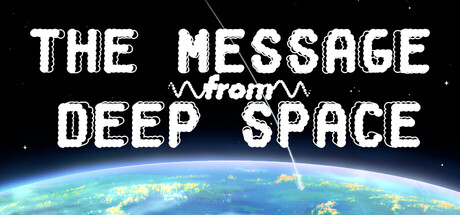
Mission: Translate an interstellar message, using the universal languages of math & science.
Modeled estimate, not a reported figure. How we estimate →
Charts
Each storefront's own chart, in its own country — the closest public signal to sales where none is published. A country missing from a list is one we don't collect there, not one where the game doesn't chart.
No United States chart position — it charts only in the markets below.
About
The Message from Deep Space is an odyssey of puzzles. Take the role of the mission's Translator, working alongside a scrappy band of scientists, and venture headfirst into the world of deciphering an alien language --- completely from the ground up.
Set in 1973, Earth is the recipient of a meteorite that broadcasts radio waves. In the role of the mission's Translator, the player is responsible for designing responses to the meteorite's transmissions, which, if correct, will elicit new messages from the meteorite. Only through this radio wave dialogue will patterns, words, syntax, and meaning all take form, leaving but one question:
What is it the aliens want to say?
Translate an alien language
Learn about an alien civilization
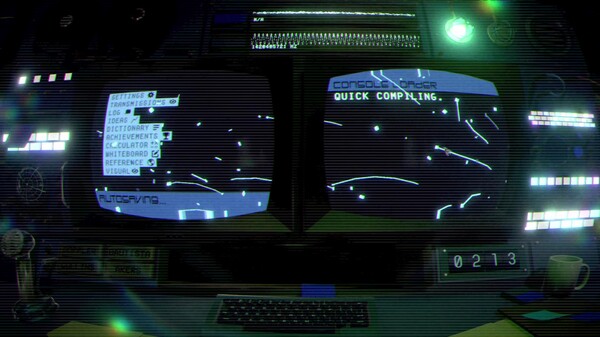
Interface with a retro computer
Manage a user-driven dictionary
Design radio transmissions by frequency
Collaborate with scientists that respond to your actions
+1000 in-game dialogues
+30 minutes OST
+30 hours of gameplay
Inspired by The Golden Record aboard the Voyager I space probe, The Message from Deep Space takes a realistic approach to deciphering an interstellar message. Beginning with the limited universal constants available to technologically advanced civilizations, the message spans a range of real-world fields of math & science. Decoding the message is tough, but with the support of the game's meticulous linguist, the single-minded computer programmer, and the affable astronomer, it is a challenge fit for anyone with Curiosity and Perseverance.
Genres
Stats
All-time low is the lowest price we've recorded for this game since we started tracking it.
Engagement
Reviews
Themes across 1057 recent reviews and how positive each mention is. A keyword signal, not full sentiment analysis.
Reviews
I don't normally post game reviews. Tend to be a lurker in the background enjoying the games I've purchased, but I think it's important for me to write a review for this game. If you like math, scientific, and linguistic puzzles, get the game. Heck, play the demo first to see if it's for you. But please do give it a chance. I can't say I've played many games with this much heart and passion in them that you can really feel while playing. Maybe it's because I'm only recently coming off my Project Hail Mary obsession (who am I kidding, I'll probably obsess over it forever), maybe it's because I adore games like Chants of Senaar where you're building a language from the ground up, maybe it's just because I'm a huge nerd, but I absolutely adore this game. I don't know if it's because it makes me feel smart when I get something right or understand a concept right away, or the fact that it challenges me when I don't, but there's something really special about this game that I think deserves everyone's attention. I genuinely wish there was a job like this in the world that I could do because I'm positive I would be fulfilled by it. Thank you, developers, for creating such an incredible experience. I can't wait to see what the next 30+ hours have in store for me!
Media

Related
Related
Price dynamics, follower growth, revenue and sales trajectories with interactive tooltips
This and every other Pro feature is free until October 20, 2026. A free account is all it takes.
Languages: English
Hours played at review time, across 1.1K reviews with recorded playtime.
positive critical· bar length = how often the theme comes up
The game starts out great, but devolved into a series of puzzles that all feel the same, and not in a good way. There's inconsistencies and weird quirks in the language, it's not always clear what form replies should take (both of these issues could be solved by having messages follow an actual formal language; most of the early game feels like that's going to be the direction anyway and it's fun!), and holy ♥♥♥♥ there's so much needless elementary arithmetic. I don't think I'm going to finish the game at this point. I just don't care enough to do yet another grade-school math problem involving 10 digit numbers that have to be manually copied over. It's just tedious
Listen. My feelings toward this game are best described as "love-hate". But the "hate" aspects are heavily weighted toward the end of the game, and given I just finally finished the thing, I'm feeling quite irate. Plus, there are a bunch of other reviews that are clearly borderline but went with a thumbs-up, so I feel justified in balancing them out at least a bit. I think that as a game, it's sometimes really great, usually quite good, but unproductively frustrating in just a few too many places. As a piece of science fiction (and more broadly fiction) it's a bit of a mixed bag. Game-wise: The NPC collaborators are really well done. The way that they support your solving/understanding process without interrupting it is really well designed. They act as a diegetic and highly plausible "anchor" that subtly makes sure you don't stray too far from the "intended" interpretation. Even when the intended interpretation is an unwarranted illogical leap, but that's more my next point. They also do a great job of lampshading and/or spelling out certain things about the world in a way that makes them clear without assuming the player didn't understand this insight already. It's really conducive to role-playing as a super smart scientist working on an interesting problem with colleagues. 95% of the time, this is a really good puzzle game. The idea of building up a common language from zero is executed really well. 95% of the time. But later in the game, as the concepts get more abstract (and therefore more susceptible to not being interpreted EXACTLY as intended) the game gets much LESS thorough about making sure it actually communicated what a concept means before layering on other questions that assume you understand it exactly as intended. Sometimes it just straight up throws a circular definition at you and then goes "OK, great, now that I explained that, YOU have to figure out how it's connected to previous stuff". There are also a couple of places where the game goes to great lengths to set up very specific rules, and then later all of a sudden throws them out of the window and expects answers that directly contradict the previously established rules. These puzzle issues are my main source of frustration. And they would probably be less frustrating if it didn't start out so well and my expectations weren't so high at the beginning. Toward the very end (#917), I just decided "screw it" and opened up a walkthrough. I probably wouldn't have gotten through the wild logic leaps without it. This rather undermined whatever effect the ending was meant to have on me. Nitpick: Why on earth are there scan lines and monitor artifacts **on my face**? like, I'm looking at the game world, which **includes** computer monitors most of the time, but the scan lines and color splits are over the whole screen. More serious nitpick: these things give me eye strain and the combination of settings to turn them off is rather obtuse. I missed at least one for like half the game. Also, I can't turn off the twitching waveform at the top, OR the arbitrary color changing later on. Fiction-wise: I really liked everything that had to do with the aliens themselves: what the are, how the live, etc. That was all super cool and provided the best revelation and/or cliffhanger moments. Other reviews have described this game as "hard sci-fi". I would say it's hard-ish, but gets progressively softer as it goes along. It's still much more "hard sci-fi" than any other sci-fi game I can think of in the moment. But again, it set me up for disappointment by being a lot better and more feasible toward the beginning of the game and setting high expectations. Here is how I can describe my main "plausibility" problem without spoiling the game directly: I've always been bothered by the fact that they put a line drawing of two humans on the Pioneer Plaque and expected aliens to just "get" that this particular subset of indentations in one of the surfaces of a prism were a 2D representation o (a platonic ideal of) f 3D beings made by projecting them onto a 2D surface and then doing basically a quite complex and fairly arbitrary edge detection algorithm. Let alone be able to "reverse" this edge-detection and projection to envision anything remotely close to an actual human shape. It makes a *lot* of unwarranted assumptions that someone looking at this would already be thinking in ways that are quite similar to ours. At the beginning, this game felt like it was doing a really god job of avoiding this type of "we're exactly the same!" assumption. That lasted maybe a third of the way through, until it went into concepts that are both softer and more complex (and therefore LESS likely to be the same across completely different alien races). This is correlated to, but different from, my main gameplay problem. Seeing these complex concepts that, for some reason, translate ideally from alien minds to ours made me roll my eyes. But most of the time, it didn't prevent me from being able to figure out the intended meanings. It's only when the game relied on "you get it, it's this exact complex concept we have" so much that it totally neglected any explanation that the gameplay frustration came in. Especially when I was still playing the game like I was dealing with an alien mind here, and the borders around the concept were not necessarily where a (culturally american) human would draw them, so the "logical" leap was not obvious to me. Separately: I really liked the characters and their banter overall. But I feel like the "character growth arcs" are hokey, forced, often illogical/inconsistent, and sometimes quite frankly downright insulting in terms of what kind of personality change is portrayed as "necessary growth". I would think that if you name your characters A, B, C, and D, then you've given yourself license to *not* have to force unnecessary drama into the story. I really don't think the wonder of the actual discoveries would have suffered if the characters were already stable non-angsty adults (with the same exact personalities that they have in the game!)
It's a masterpiece. Stop reading reviews, just play it. There aren't words to explain how good it is.
finn'in söylediği gibi; mathematical! senelerdir matematik görmememe rağmen, matematiğe olan hayranlığım nedeniyle hayatıma bir şekilde dahil etmek, üzerine gitmek istiyordum. bu oyun sayesinde en güzel şekilde dahil oldu. unuttuğum şeyleri araştırıp, bir an için dünyanın en aptal insanı gibi hissederken, diğer yandan doğru cevapladığım her input için hayranlıkla karışık tatmin olma hissini yaşıyorum. 8'li sisteme alıştıktan sonra bizim sistem daha zor geldi tuhaf bir şekilde. oyunu kodlayanın beynine sağlık. muhtemelen oyunu çook saatte bitireceğim ama hiç sıkmadan 10 saati 1 saat gibi hissettirdiyse, eminim o çok saat kısmı da akıp gider. bir de... Outer Wilds sonrası merakımı bu kadar yükselten bir oyun olur mu merak ediyordum ki The Message From Deep Space imdadıma yetişti. hem bu kadar farklı olup hem de nasıl o noktadan beni yakalayabildi bilmiyorum ama eminim Outer Wilds seven birçok kişi bu oyunu da oldukça sevecek.
流程非常长,断断续续打完的,偏中评。 复古的美术和氛围很有感觉,故事是关于与外星文明造物的首次接触,展开特别慢。 语言解谜可玩性不高,有的部分挺枯燥,不乏对电波的成分。
Big typo in 237, answer is [spoiler]molecule 6[/spoiler] don't waste time chasing a false lead like I did!
I was quite happy with the first third of the game involving math and science, then surprisingly I was greatly disappointed by the second half of the game after it introduced grammar. TLDR - math and science puzzles are well-defined and good, word association puzzles are inconsistent and frustrating. Overall I think the game concept is great. You decipher words by starting with the universal languages of math and science, building up a dictionary before crossing over to ideas more specific to the aliens. Math puzzles were "learn a word by figuring out a pattern, demonstrate your understanding by extending the pattern". Cool. Math is precise, only a single answer ever makes sense, and it was quite satisfying to [spoiler]have this lead up to graphing and 3d images.[/spoiler] Science puzzles were "learn a word by recognizing the scientific concept being implied, demonstrate your understanding by applying formulas to new examples". Great. The provided reference pages listed the potential scientific concepts one might come across, and math and images related to science are reasonably recognizable so I never felt lost. It was satisfying to obtain words for advanced concepts [spoiler]like the speed of light, and to derive concepts like an alien-meter based on light-speed-lengths. [/spoiler] Then grammar was introduced, and language puzzles were "learn a word through word association with old words". I don't think this is intrinsically problematic, but my frustrations with how these puzzles were implemented began about halfway through the game and ruined my experience with the rest of the game. Specifically, first, the puzzles don't strictly adhere to the grammar they themselves define. Words defined as nouns will get used as verbs and vice versa. Word order is flexible, for example [spoiler]"swim big capable" (T806) and "small capable swim" (T808)[/spoiler]. Sentence syntax is regularly ignored to omit terms and use fragments. I understand that real life languages can be like that, but the inconsistency caused ambiguity, it felt careless, and it spurred the unpleasant practice of brute forcing answer variations. Even if real languages have those quirks that doesn't mean they should be used when introducing a language. Second, the word associations really rely on intuition, which I find causes too many "either you get it or you don't" puzzles. And with so many puzzles in this game, you're likely to encounter multiple frustrating ones, leaving you again to brute force the recent words you acquired or permutation of words you encountered. Worse, I often felt certain puzzles were intentionally confusing just to stretch the definition of a new word into more puzzles. For example, [spoiler]we're told a new word is related to "seeing bad life", "seeing small", and "being in hot water", and that it's the opposite of something, so what is that something it's the opposite of? (T865-866)[/spoiler]. This withholds the old word that we've already covered a hundred transmissions ago from the definition of the new word in order to have the definition require additional intuitive steps. Unfortunately I felt this was bad communication rather than a good puzzle. Third, a huge amount (possibly a majority?) of the language transmissions reduced to "0 = 0", tautologies, and other trivial logic ("If A then B. If not B then <blank> A". "If A then B. If B then C. If A then <blank>"). I assume this serves to emphasize a point, but the information presented in these statements often felt repetitive, felt like they were belaboring the point instead, and stopped being satisfying for me to complete. Combined, I stopped getting any sense of reward for completing these puzzles. It was disappointing to have to brute force answers. There was a slow drip of interesting alien lore, but for me the immersion was broken repeatedly by the feeling of carelessness in the puzzle design (there's still a duplicate transmission at the time of this writing) and the feeling that the aliens were communicating very poorly, as if they couldn't decide if their messaging should be obvious to hammer in the point or obtuse so the listener has to figure things out. To be clear, there are a lot of good things about this game. The concept is great, I enjoyed the soundtrack, and I enjoyed the simple feel-good story and the characters. But the game is somewhat long given the simple story, and the languages puzzles are too weak to carry it. I think I would've enjoyed the game a lot more if it strictly followed the grammar or simplified the grammar. I also would enjoy a shorter (than a average 40 hour completion) game such that information is less repetitive. Thanks to the developer for making this game.
Turns out, with just some integers and a bit of shared knowledge about the universe, you can learn to speak with anyone. This game starts with some simple math problems, then builds on your understanding to develop a vocabulary of increasingly complex concepts. The math is an essential part of the magic, so don't listen to the haters! It's extremely impressive not only that this evolution from math to language is possible, but that the developer did the work to realize it into something interactive. After a while, you get lost in the words, forgetting that at the bottom of it all, it's all just a list of integers that you've managed to apply meaning to. Incredible.
途中で離脱。 他レビューにあるように理系的なロマンに満ちあふれた良いSF。 だけど、推理パズルゲームとして見ると、「なぜその解答だけが正しくて、この解答は不正解なのか?」「そもそも何を問われているのか?」が中盤からかなり理解しにくくなってエイリアンの言いたいことを察しまくる感じになります。そもそも例題やヒントも極限まで少ない上に理不尽寄りな設問も多く、たとえゲーム内のヒントを読んでも解答にたどり着けないこともありました。納得できない答えもあるし。その辺りのフラストレーション(解けたのに報酬・満足感が得られない)でめげて辞めちゃいました。が、これら異常な難易度である問題点を除けば、ストーリーや構成自体は悪い作品ではないと思ってます。 ストーリーを追いたければ最悪Steamガイドに解答一覧があるのでまあそれでいい人はそれで進めて補完すればいいと思う。私は自力でパズルを解きたい派だったのでキツさが勝った。好きになりたかった作品だったのだけど。 https://www.youtube.com/watch?v=M6XnDnktU4s
Selling now
See how fast this game is selling right now — estimated copies and revenue per day from recent review growth.
Active players
Estimated daily and monthly active players (DAU/MAU) modeled from peak concurrency.
Players by region
Where this game's players are, estimated from review languages.
Players also reviewed
The games this title's players most often review too — audience affinity.
Related
| Game | Estimated lifetime revenue | Reviews | Review score | Price |
|---|---|---|---|---|
| $124.4K | 611 | 77% | $11.99 | |
| $69K | 977 | 88% | $3.99 | |
| $1.3K | 14 | 79% | $5.99 | |
| — | 0 | — | — | |
| $124.4K | 1.2K | 91% | $7.99 | |
| $32.8K | 98 | 83% | $16.99 |
Related
| Game | Estimated lifetime revenue | Reviews | Review score | Price |
|---|---|---|---|---|
| $305.9K | 1.1K | 77% | $9.99 | |
| $305.9K | 756 | 81% | $19.99 | |
| $305.8K | 967 | 80% | $19.99 | |
| $305.8K | 3.1K | 85% | $4.99 | |
| $306.3K | 2.3K | 93% | $7.99 | |
| $306.4K | 1.2K | 87% | $9.99 |