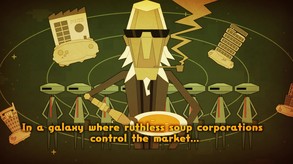
PixelJunk Nom Nom Galaxy is an eccentric combination of sandbox construction, platforming, automation, exploration, tower defense, and action that manages to turn an intentionally ridiculous concept into a surprisingly involved management game. Developed and published by Q-Games Ltd., it places the player in the role of a SoupCo Astroworker tasked with traveling to distant planets and transforming their natural resources into soup for hungry customers throughout the galaxy. Instead of focusing on a single genre, the game constantly moves between gathering resources, constructing facilities, fighting creatures, improving production, and competing against rival corporations.
The basic objective sounds simple: explore a planet, collect ingredients from its flora and fauna, create soup, and send the finished products into space. In practice, this process develops into a much larger production system. Different ingredients can be combined through an extensive recipe system, encouraging players to investigate their surroundings rather than repeatedly harvesting whatever happens to be closest. Exploration therefore has an important economic purpose. Discovering useful plants and creatures can provide opportunities for new recipes, while learning where resources are located helps determine how a factory should be organized.
Base construction gradually becomes one of the most compelling aspects of the experience. A small operation can eventually grow into a sprawling industrial complex, and expansion introduces increasingly complicated logistical problems. Production equipment needs to be positioned sensibly, ingredients must reach the appropriate areas, and finished soup has to move through the factory efficiently. The game rewards players who think beyond immediate needs and construct facilities that can accommodate future growth. There is considerable satisfaction in watching a messy collection of rooms and machines evolve into a coordinated production line.
Automation adds another layer to this progression. SoupCo robots can perform various jobs, including collecting ingredients, assisting with factory operations, and defending the base. Their usefulness increases as the factory becomes too large for one worker to manage comfortably. Gradually transferring repetitive responsibilities to machines creates a rewarding feeling of advancement. The player begins by performing many tasks personally but eventually becomes more of a manager, troubleshooting weaknesses and expanding the operation while automated systems handle routine labor.
Nom Nom Galaxy does not allow industrial expansion to proceed without resistance. Alien plants and animals can be dangerous, environmental conditions complicate exploration, and rival soup corporations create direct competition. Enemies can attack the player's operation, meaning that a highly productive factory is not necessarily a successful one if it cannot survive an assault. Defensive preparation consequently becomes just as important as production. This is where the tower-defense influence works particularly well, because players are protecting something they have personally constructed rather than defending an arbitrary objective.
Competition against rival soup corporations gives the economic mechanics additional meaning. Profit battles are ultimately about securing control of the galactic soup market, so increasing production is connected to a larger objective. The concept is deliberately comedic, yet the underlying challenge encourages careful management. Players need to balance expansion, ingredient gathering, automation, defenses, and actual soup production instead of concentrating entirely on one activity. When several problems occur simultaneously, the experience can become wonderfully chaotic.
The living planets also help make expansion feel meaningful. Environments evolve as the player's base develops, creating a stronger relationship between industrial growth and the surrounding ecosystem. Rather than simply placing machinery onto an unchanging map, players can observe how their presence becomes increasingly significant. Combined with the colorful 2D visual design, unusual alien creatures, exaggerated machinery, and playful science-fiction setting, this gives Nom Nom Galaxy a personality that distinguishes it from more conventional factory games.
For players who enjoy construction but dislike competitive pressure, S.O.O.P. Simulator provides a more relaxed alternative. It removes the concern of corporate competition and allows greater attention to building, harvesting, and exploration. This is an excellent complement to the primary structure because the construction mechanics are enjoyable enough to support experimentation without requiring constant market battles. It also makes the game more approachable for players who primarily want a creative sandbox.
Customization extends further through the SoupCo Planet Database, which allows players to design playable planets and share creations with others. Custom maps significantly increase the potential longevity of a sandbox game because players are not permanently restricted to predetermined environments. The ability to create, explore, and exchange planets complements the factory-building mechanics particularly well and gives creatively inclined players another substantial system to experiment with.
Cooperative play is another major advantage. The game supports local split-screen cooperation and online sessions for as many as four players. Its structure is naturally suited to teamwork because numerous responsibilities can be divided among participants. One person might gather ingredients while another expands the factory, handles production, or protects the base. Cooperative play can turn stressful multitasking into organized chaos, and the unpredictable interactions between players, creatures, machinery, and production systems can produce some of the game's most entertaining situations.
The biggest drawback is that the enormous mixture of ideas can occasionally make the experience feel unfocused. Players expecting an exceptionally deep automation simulator may find individual production mechanics less elaborate than those of games devoted entirely to factory engineering. Likewise, anyone approaching it primarily as an action platformer may be surprised by the amount of construction and management involved. Navigation, harvesting, repairs, combat, production, and defense can also pile up rapidly when playing alone. The game is strongest when its variety is viewed as the attraction rather than when any individual component is judged in isolation.
Overall, PixelJunk Nom Nom Galaxy is an inventive and charming experiment that successfully connects several seemingly incompatible genres around an absurd interplanetary soup business. Q-Games Ltd. created a game where exploration feeds manufacturing, manufacturing encourages automation, expansion creates defensive challenges, and economic competition provides motivation for improving everything. Its systems can become chaotic and occasionally cumbersome, but the freedom to construct enormous factories, discover recipes, automate labor, defend against attacks, create planets, and cooperate with friends gives the experience considerable character and replay value. For players who appreciate unconventional sandbox games and enjoy balancing creativity with strategic pressure, it remains one of the more unusual entries in the PixelJunk series.
Rating: 8/10