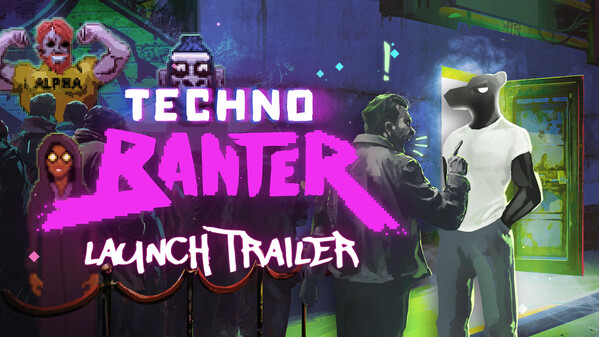
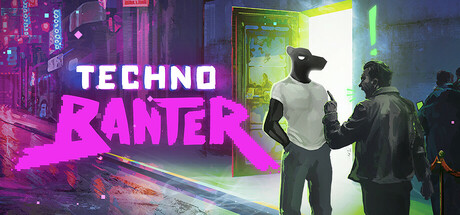
You're the bouncer of the Green Door club, where every decision matters. Reject the unworthy of partying with clever retorts, explore a neon-lit city, and immerse yourself in the Berlin-like city's underground techno scene. The beat is pumping—are you in?
Modeled estimate, not a reported figure. How we estimate →
About
Welcome to the gritty neon-lit streets of Rainbow Drive, where the night never ends, and the music never stops. In Techno Banter, you step into the shoes of Nil, a once-rising star turned bouncer at the infamous Green Door club. Your job? Keep the party alive by assessing the guests at the door. Are they ready to rave, or are they just not cutting it? If they’re not up to par, it’s time to turn them away with a razor-sharp insult, clever comeback, or a devastating quip.
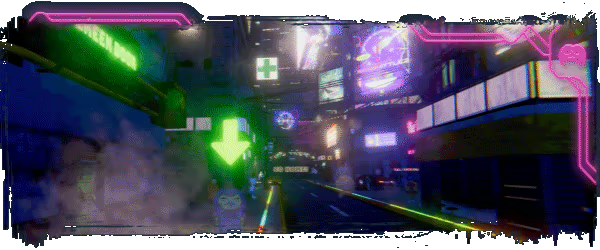
Every night brings a new challenge. You’ll face a parade of quirky, eccentric characters, each with their own backstory, style, and attitude. As the gatekeeper of the Green Door, you’ll need to quickly size up each guest. Does their outfit scream ‘party material,’ or are they a walking fashion disaster? Are they here to dance the night away, or are they just trouble waiting to happen? When it’s time to say no, you’ll have to do it with flair—because in Techno Banter, words can hit harder than a bass drop.
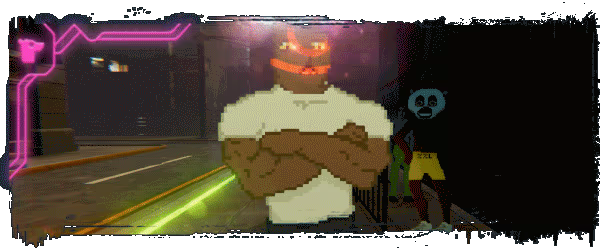
Explore the pulsating, vibrant world of Rainbow Drive, a district that thrives under the glow of neon and the thump of heavy basslines. The city is alive with strange and fascinating inhabitants, and it’s up to you to navigate its twists and turns. From dark alleys to dazzling dance floors, every corner of the city tells a story, and every night brings a new experience. As you work the queue at the Green Door and improve the quality of the party, you’ll also have the chance to upgrade the club, turning it into the ultimate techno haven.
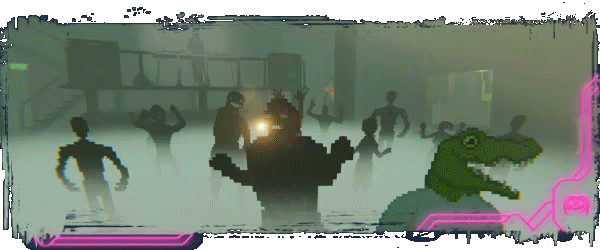
A true techno experience wouldn't be complete without a killer soundtrack. Techno Banter features tracks from real-life Berlin-based DJs, capturing the raw energy of the underground scene. Each party is underscored by deep house and techno beats that transport you straight to the heart of Berlin’s rave culture. Whether you’re bouncing guests or exploring the city, the music will keep your adrenaline pumping and your head nodding.
Are you ready to elevate the party to the next level - or will you bring ruin to the rave scene?
The night is yours in Techno Banter.
Stats
All-time low is the lowest price we've recorded for this game since we started tracking it.
Languages: English, German
Engagement
Hours played at review time, across 40 reviews with recorded playtime.
Reviews
Themes across 40 recent reviews and how positive each mention is. A keyword signal, not full sentiment analysis.
positive critical· bar length = how often the theme comes up
Reviews
Would give this a side-thumb if available, but went with the thumbs down to counterbalance the existing positive skew in the reviews. I would still recommend Techno Banter to someone more patient than me with respect to jank/lack of polish. The narrative has heart, the writing is solid (actual wit and nuance in a video game), the soundtrack is nice if relatively vanilla, and the overall experience has a real sense of place. The actual game, however, has design issues and is lacking in polish. I would much rather have consumed this story as an animated television show instead of as a game. - The mini-games, while not difficult, interrupt the flow of the dialogue battles and become tedious. The attack-avoiding mini-game in particular has hitboxes different from what's drawn on the screen at ultrawide aspect ratios (tested at 5k2k resolution, 21:9, and was able to resolve the issue by temporarily moving to 4k resolution, 16:9). This issue was also reported on the game's discussion forum but never resolved: https://steamcommunity.com/app/2348400/discussions/0/597393727567176439/ - There is usually if not always only one "correct path" to resolving the dialogue battles, so they only present an illusion of choice. This is not a huge deal for most of the dialogue battles, but for the two late-game dialogue battles where lies must be detected and the conversation has to flow one specific way to get the optimal outcomes, it becomes rote trial and error. - The lack of a save point just before the final boss fight combined with the mechanical issues I described forced me to repeat the sequence leading up to it several times, turning the boss fight into tedium and completely ruining the narrative climax of the game. I got the impression that this critical sequence was not properly playtested, which isn't acceptable even for an indie game. - Lack of gamma slider + very dark environments make it difficult to find some locations, like Seaside. The only signposting in the game for that location comes in the form of a literal sign placed above the player character's eye level, and other locations have no signposting. I totally understand the intention to not hold the player's hand and encourage actual discovery, but that has to be supported by readable visual cues in the level design. - Nit, but the character portrait and status information in the bottom-left were often incorrect immediately after reloading an old save. - Nit plot hole/missed detail: near the end of the game, you receive a border pass. This pass can only be used as intended to cross the border via car with another character; when walking to the checkpoint with the pass in the inventory, there is no option to present the pass to the border guards to cross alone on foot. I can understand not wanting to flesh it out as an additional alternative ending option, but I was expecting at least a unique dialogue option acknowledging that the developers thought this possibility through.
Especially these days, it's common for a game to overstay its welcome. This is one of the cases of the opposite, where a game is good and checks out far too early. The gameplay loop is fun, if a little simple. Deciding who gets to come in or not and evaluating guests is a good time and works fairly well, the writing is clever, the art style isn't complex but it works for what it is. I did enjoy it. The problem is that there's just not a lot there. It has side quests, but the only real reason to do any of them is to get the desired ending. You get money from some of them, but it's pretty much useless. You don't do anything with it except use it for an ending or to do one or two side quests, but as long as you don't screw up your job, you'll have plenty left over. The club has an upgrade system which is cool, but from what I can tell it does basically nothing except increase the club's rating, which in turn does nothing at all as far as I know. I'm not sure what happens if you fail to get the required rating each night, maybe it's game over, but it's so easy to tell who should and shouldn't be allowed in that unless you fail on purpose, there's no chance of you not getting the rating you need. There are outfits (and no outfit) which is fun, but none of them do anything, you rarely see them outside of the menu and the brief glimpse of Nill you get when the queue starts, and they don't carry over to new games so by the time you get them all, the game is over. They don't have to be game changing, but maybe having more special dialogue depending on your outfit, or your footsteps sounding different based on what you're wearing, or having some small bonus like being able to move faster in the minigames or taking less damage would be nice. There's also no point to being naked except getting the hermit to come to the club and a few small changes to dialogue that don't change anything and that Nill doesn't respond to, not even clever comebacks. When the guy by the laundromat says "I won't ask why you're not wearing clothes" Nill could say something like "this coming from the man who never wears a shirt", or when the laundromat lady is like "oh you must be in desperate need of clothes!" Nill could sarcastically respond with "actually no. I'm trying to start a movement to put you, personally, out of business". The only major change is your boss refusing to let you work until you get dressed. It feels like if that's an option the game explicitly gives you, then it should do something or make a meaningful change, same with the outfits because you almost never see Nill anyway, so what's the point in having the option to dress up or dress down? The leveling and upgrade system has the same problem: there's basically no point to it and it really doesn't do anything for you. Upgrading your skills lets you do a few things here and there, but it's not really needed at all aside from making things just slightly easier, and there are so few that you'll max out your skills by about night 3 or 4 anyway, making any further levels and xp you get literally useless. As far as bugs go, I don't think I encountered any at all even though it's a common complaint in the reviews. Either I was lucky or they've managed to patch most of them out. Obviously, it's possible there are things I've missed but I think I've seen almost all of it. The good parts are really good. The music and characters are all done very well. The gameplay itself is fun, it's just incredibly simple. The story is fine, but as I said it ends entirely too quickly. Just when you're starting to get into it and get used to everything, the game is over. Maybe a sequel to this could work where this game's systems are expanded on and Nill is running or bouncing for a new club. Overall, worth a play especially on sale, and it's clear effort was put into the game. I just feel like certain things could have benefited from a bit more effort.
Cool game
[h1]English[/h1] In [i]Techno Banter[/i] we work as a bouncer at the techno club [i]Green Door[/i]. The idea is simple: A party is only as good as its crowd. We size up the guests approaching from the line, have a quick chat and scan for red flags. These include aggression or arrogance, creepiness or poor hygiene, being underage or extremely drunk - or wearing blue jeans. Those who fit in at the party get in. Those who don’t stay out. At the end of the shift the eccentric club owner Gunthy presents us with the evaluation of our decisions. The party's score affects not only our pay but also whether we can upgrade the club. Then we return home down the empty street at sunrise. A rejection at the door rarely goes peacefully. Then a verbal battle ensues: Under time pressure we respond to smug remarks and snarky insults with fitting comebacks to lower our opponent's energy bar. Mistakes cost us our own stamina, while successful retorts earn experience points. These let us level up helpful skills like manipulation, reason or intimidation. Added to the quick-witted word duels are rare mini-games like dodging the fists of particularly unreasonable guests. Every evening we start out in our modest high-rise apartment, take the elevator and make our way to our club on Rainbow Drive. The street and its establishments are free to explore and full of lovable and quirky characters seeking little favors or providing entire side quests. For example, we help Jimmy, the disco cleaner who listens to business podcasts, pitch his half-baked startup ideas, heckle a stand-up comedian at the [i]Faust[/i] bar next door, help our colleague Cyrus hit the desired "300" at the gym and write a song with the bartender Min, which she later performs. Other encounters are stranger: There is the sad snack bar owner searching for the final ingredient for his transcendental soul soup, the sinister bouncer at the [i]Naked Eye[/i] who orders us to fetch a burger, the doomsday cultists on the curb or the mysterious bearded man in a car blasting bass who tasks us with granting entry to guests with certain characteristics. On another occasion we encounter a self-proclaimed time traveler in a leather jacket at the door who begs us not to let him into the club under any circumstances - though he actually means his younger self, who is waiting further back in line. In conclusion [i]Techno Banter[/i] is a little gem that offers unexpected variety and depth as well as a cool soundtrack - unfortunately it's far too short. The game isn't just carried by urban nightlife vibes and melancholic humor, it also conveys a guiding philosophy in a surprisingly compelling way: Even as an individual one can considerably impact the lives of others. Not only by deciding who gets into the club as a bouncer, but on a larger scale, because ultimately the city and its residents are at stake. Whether we've taken care of the people beforehand or failed to do so substantially influences their fate. In the end short epilogues reveal where life carried them. [h1]Deutsch[/h1] In [i]Techno Banter[/i] arbeiten wir als Türsteher des Technoclubs [i]Green Door[/i]. Die Idee ist simpel: Eine Party ist nur so gut wie ihre Gäste. Wir mustern die aus der Schlange herantretenden Besucher, plaudern kurz und scannen sie auf Red Flags. Dazu gehören Aggressivität oder Arroganz, Creepiness oder mangelnde Hygiene, ein zu junges Alter oder zu viel Alkohol im Blut - oder das Tragen von Blue Jeans. Wer zur Party passt, kommt rein. Wer nicht, bleibt draußen. Am Ende der Schicht präsentiert uns die exzentrische Clubbetreiberin Gunthy die Bewertung unserer Entscheidungen. Der Score der Party beeinflusst nicht nur unseren Lohn, sondern auch, ob wir den Club upgraden können. Auf der leeren Straße im Morgenlicht machen wir uns dann auf den Heimweg. Eine Ablehnung an der Tür verläuft selten friedlich. Dann kommt es zum rhetorischen Kampf: Unter Zeitdruck reagieren wir auf überhebliche Sprüche und schnippische Beleidigungen mit passenden Comebacks, um den Energiebalken unseres Gegenübers zu senken. Fehler kosten uns die eigene Vitalität, gelungene Konter bringen hingegen Erfahrungspunkte. Mit diesen leveln wir hilfreiche Fähigkeiten wie Manipulation, Verstand oder Einschüchterung hoch. Zu den schlagfertigen Wortgefechten kommen seltene Minigames wie das Ausweichen vor den Fäusten besonders uneinsichtiger Gäste. Jeden Abend starten wir in unserer kleinen Hochhauswohnung, nehmen den Lift und machen uns auf den Weg zu unserem Club am Rainbow Drive. Die Straße und ihre Geschäfte sind frei erkundbar und voller liebenswerter und eigenwilliger Charaktere mit dem Wunsch nach Gefälligkeiten oder ganzen Sidequests. So helfen wir etwa der Business-Podcast hörenden Disko-Putzkraft Jimmy, seine unausgegorenen Geschäftsideen an den Mann zu bringen, provozieren in der [i]Faust[/i]-Bar nebenan den Stand-Up-Comedian, helfen unserem Kollegen Cyrus beim Stemmen der ersehnten "300" im Gym und schreiben mit der Barfrau Min einen Song am Seaside-Ufer, den sie später performt. Andere Begegnungen sind schräger: Da ist der traurige Imbissbetreiber, der die letzte Zutat für seine transzendentale Seelensuppe sucht, der finstere Türsteher des [i]Naked Eye[/i], der uns zum Burgerholen verdonnert, die Endzeit-Kultisten am Straßenrand oder der mysteriöse Bärtige im bassdröhnenden Auto, der uns den Auftrag gibt, an einem Abend Gästen mit bestimmten Merkmalen Zutritt zu gewähren. Ein andermal begegnen wir an der Tür einem lederbejackten, selbsternannten Zeitreisenden, der uns bittet, ihn auf keinen Fall in den Club zu lassen - gemeint ist allerdings sein jüngeres Ich, das weiter hinten ansteht. Zusammenfassend ist [i]Techno Banter[/i] ein kleines Juwel, das unerwartete Vielfalt und Tiefe sowie einen coolen Soundtrack mitbringt - leider ist es viel zu kurz. Das Spiel wird nicht nur von den Vibes des urbanen Nachtlebens und von melancholischem Humor getragen, sondern vermittelt überraschend überzeugend eine Lebensphilosophie: Selbst als Individuum kann jeder das Leben anderer wesentlich beeinflussen. Nicht allein, indem man als Türsteher entscheidet, wer in den Club darf, sondern im größeren Rahmen, denn die Stadt und ihre Bewohner stehen am Ende selbst auf dem Spiel. Ob wir den Leuten zuvor geholfen haben oder daran gescheitert sind, prägt ihr Schicksal maßgeblich. Am Ende zeigen kurze Epiloge, was aus ihnen geworden ist.
Good story, like the gameplay and style
Honestly, I only bought it because of the art style and furries. But it's a fun game and the characters are funny!
Self contained masterpiece. That's my first thought after finishing the game. It's original, creative and hilarious with its characters and writing. I have laughed out loud (yes, literally) multiple times during my playthrough, which haven't happened for a while (although it may be due to the genres I usually play). I think I might replay it some time later, just to see all of it (missed a couple points on my first playthrough). If you are looking for a fun for a couple of nights and don't mind chatting with a bunch of wierdos on one particular street - this is your pick. Points of criticism for devs after first playthrough (SPOILERS): 1) [spoiler]Min should have had another quest line or more dialogue, so we could build more connection before the ending.[/spoiler] 2) [spoiler]I got yanked during the second white party and had to watch the unskippable cutscene again. This is tedious, there should be another save after the entrance of the Tongue.[/spoiler] 3) [spoiler]Man with great abs was absent in the last scene (which is a shame, his abs are great).[/spoiler] 4) Somehow my "Soothing words" skill has autoleveled and I haven't been able to get corresponding achievement. 5) During government approved [spoiler]fishing[/spoiler] camera goes wild constaintly while I [spoiler]cast the hook[/spoiler]. Don't know if it's a bug or a feature, but it feels wierd. 6) I'm playing on 31 inch monitor, but when I first started the game it couldn't determine correct resolution. To determine it I needed to restart the game a two times. And it warranted a restart because apparently skill signes don't go away, but stick to the top of the current screen above subtitles. Well, while in wrong resolution it stuck right in the middle of said subtitles, rendering any attempt to read them useless :D. So yeah, choose correct resolution right away or try restarting till game determines desirable option.
Only finished the first day bouncing on my own at the club and had a good time observing the prospective patrons and seeing the result after some chaotic and funny dialogue option choices when someone you reject won’t leave. Game oozes wirh unique style and personality and for that I have to recommend it highly.
I had fun in the demo so decided to buy the full game, this game has witty banters, story, and boppin beats. It got multiple endings and shenanigans (spoiler, don't let the robot in until you see the miracle, you'll thank me later). There's definitely more stuff to explore here, like i found a key from fishing and i couldn't save the fruit shop keep. Just wished there's more of the club building, rpg leveling, endless days for more banters and stories. But as all great things, there must be an end, and what an imperfect and beautiful end it gave me.
Techno Banter is a stylish, attitude-driven indie experience that thrives on tone, dialogue, and atmosphere rather than traditional action or complex systems. Developed by Dexai Arts in collaboration with Crunching Koalas and published by Crunching Koalas, the game drops players into a neon-drenched, cyberpunk-leaning nightlife scene where words are the primary weapon. It’s a game less about what you do with your hands and more about what you say, how you say it, and who you decide deserves access to the night. You play as Nil, a bouncer stationed at the entrance of the Green Door, a techno club located in the gritty district of Rainbow Drive. Each night, a line of strange, abrasive, eccentric, and sometimes unsettling characters forms outside, all eager to get in. Your job is to evaluate them—based on appearance, dialogue, attitude, and contextual clues—and decide whether they belong inside or should be turned away. This setup immediately recalls games built around gatekeeping and judgment, but Techno Banter distinguishes itself by replacing bureaucratic logic with sharp-tongued verbal combat. Rejecting someone isn’t a silent checkbox; it’s an exchange of insults, sarcasm, intimidation, or cutting humor that defines the game’s personality. The banter system is the heart of the experience. Dialogue choices are aggressive, funny, cynical, and often deliberately uncomfortable, reflecting a world that thrives on edge and excess. Your responses influence not just whether a patron backs down or escalates, but also how Nil’s reputation develops. Over time, you gain experience that can be spent on social skills like persuasion or intimidation, opening up new dialogue paths and giving you more control over how encounters play out. These RPG-like elements are light but effective, reinforcing the idea that Nil is becoming sharper, meaner, or more influential as the nights go on. Beyond the club entrance, Techno Banter expands into a compact but densely characterized city space. Rainbow Drive is filled with side stories, oddball characters, and optional interactions that flesh out the setting beyond the door. Exploring these areas introduces additional narrative threads, ranging from absurd to unsettling, and provides context for the social ecosystem surrounding the club scene. These moments help break up the routine of door duty and give the world a sense of continuity, even if the overall structure remains fairly linear. Presentation is one of the game’s strongest assets. The visual style leans heavily into neon lights, gritty urban textures, and surreal character designs that blur the line between human, animalistic, and outright bizarre. This aesthetic reinforces the sense that the city operates by its own twisted rules. The soundtrack is equally important, featuring pounding techno and electronic tracks that feel authentic to the setting rather than generic background music. The constant pulse of the beat shapes the mood, making even dialogue-heavy moments feel tense and energized. Writing carries much of the game’s weight, and it largely succeeds thanks to its confidence and commitment to voice. The humor is dark, abrasive, and unapologetically cynical, often poking fun at subcultures, authority, and social hypocrisy. While this sharpness gives Techno Banter its identity, it also means the game won’t resonate with everyone. Some dialogue intentionally pushes boundaries, and players sensitive to abrasive humor or confrontational themes may find it exhausting rather than entertaining. The game knows this and never attempts to soften its edge, instead fully embracing its niche appeal. Mechanically, Techno Banter is relatively simple, and that simplicity can sometimes feel limiting. The core loop of evaluating patrons and engaging in banter is compelling, but it can grow repetitive over longer sessions, especially once players understand the patterns behind certain encounters. Side activities and city exploration help mitigate this, but the experience remains more about narrative flavor than mechanical depth. Occasional minigames and scripted sequences add variety, though they feel more experimental than essential. In the end, Techno Banter is a game defined by confidence in its own identity. It doesn’t try to be universally appealing or mechanically dense; instead, it focuses on delivering a memorable mood, sharp writing, and a distinct social fantasy where language is power. For players who enjoy narrative-driven games, dark humor, and worlds that feel culturally specific rather than broadly sanitized, it offers a unique and memorable slice of interactive storytelling. While its limited scope and repetition may prevent it from becoming a long-term obsession, its atmosphere, soundtrack, and unapologetic attitude ensure it leaves a strong impression long after the club doors close. Rating: 8/10
Related
Related
Trends
Concurrent players on Steam, sampled daily since tracking started.
Audience
Estimated from the language of this game's reviews — a proxy for where players are, not official Steam demographics.
Related
| Yakiniku simulator | $57.9K | 441 | 94% | $4.99 |
| Tokyo Valkyries | $57.9K | 77 | 84% | $20.69 |
| Tiny Tales: Heart of the Forest | $57.9K | 244 | 79% | $14.99 |
| Chaotic Airport Construction Manager | $57.9K | 258 | 89% | $7.99 |
| Summer at Smile Café | $57.9K | 205 | 84% | $10.99 |
| Delve Deeper | $57.9K | 419 | 61% | $4.99 |