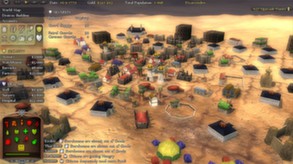
Strategy, trade and empire building on the old Silk Road. Spice Road is a town building, social and economic simulation game full of original challenges.
Modeled estimate, not a reported figure. How we estimate →
Media

About
Genres
Stats
All-time low is the lowest price we've recorded for this game since we started tracking it.
Languages: English
Engagement
Reviews
Themes across 60 recent reviews and how positive each mention is. A keyword signal, not full sentiment analysis.
Reviews
Thanks to some top-notch customer service on the part of Aartform, I now have this on Steam! My play hours may not show it, but I've been playing this game for just under a year and have logged probably over 100 hours with it all-told. It was a great game to pass the time while I was commuting from my last job and it is surprisingly deep despite being a little rough around the edges visually. I'm absolutely overjoyed to be able to play it on Steam and start earning achievements! First things first: This game mainly caters to the kind of player that is interested in logistics and supply chain economics and is only really a city-builder or Civ style game in the loosest sense. You are building a network of trade nodes and attempting to meet various scenario goals or self-created goals (in the sandbox mode) as opposed to fighting battles or growing population. The main challenge is building an efficient and profitable network of trade cities given the resources on the map. One word of caution: The later scenarios are *hard*. You have to really know how the supply/demand model works and understand route efficiency. Route length and travel times are very important when trying to make the big bucks supplying a huge town. It can be very frustrating: I was stuck on one scenario for a long time because I didn't understand some concepts about the economic model. This game does *not* hold your hand and is for people looking for a mental challenge. All told, this is well worth the price (I paid the full price and got more than my money's worth) if you are the kind of person that 1) loves classical economics and trade/logistics theory 2) are not afraid to step up to a challenge and 3) aren't too hung up on the dated graphics. BIG thumbs up!
Related
Related
Trends
Modeled estimate over time, reconstructed from Steam's monthly review histogram.
Hours played at review time, across 61 reviews with recorded playtime.
positive critical· bar length = how often the theme comes up
This is exactly the kind of game I was hoping for when I read the title and description on Greenlight. An economic engine, a city builder, a pseudo-historical setting, and an exploration game. A game that is real time but can slowed down (or sped up.) Very nice graphics, easy to learn interface, mellow sounds. I very much like this game.
The graphics are cheap and cheesy but the systsem requirements so low this game will probably run well on a George Foreman grill. Spice Road reminds me of Railroad Tycoon -- optimizing finances and spending a good bit of time interpreting spread sheet data -- logistics. But where I got tired of Railroad Tycoon rather quickly, this game keeps my interest by having a bit of Civilization (the Sid Myers series) thrown in. The ability to train guard units and send them out alone or embedded in caravans really rounds out the game nicely. In the future, I hope there are more types of military units than simply "Guards," or some small expansion of combat. There are many types of buildings to put in your cities and choices to be made about when to level them up which also helps this game be more compelling than simply optimizing spread sheets. The depth of game is quite good. Don't be fooled by early missions; there are like 20 missions for a good reaon -- it takes that long to learn the basic game. There is a lot of subtlety here which is key to keeping any game interesting after multiple play-throughs. After 2 missions you might think it is simple, but after 8 you realize it is anything but simple. After 12, the possibility of Buyer's Remorse begins to permanently fade. I was hoping to learn a bit of history when I bought this game, and in that arena, I have been disappointed. I have not come away with a deeper understanding of who the major players of the area were nor what their cultures were like, but the game is still an enjoyable change of pace for thinking fans of strategy games. Adding a few sentences of historical context to each of the mission descriptions would go a long way for history buffs. Still it is fun to engage in the virtual construction of opium dens, slave markets and monastaries with consequences for the choices you make. You can choose war or peace with NPC factions and pay protection money or fight NPC bandits. Limited finances will make you constantly choose carefully what to build next. Choices, choices! Some complaints I have: When I start a new town and send out 4 scouts, I often leave 2 on auto-pilot and give 2 instructions on where to go. Later on, I can't easily tell which ones I'm controlling. I get the impression that if you ever take a scout out of auto-explore, it just patrols back and forth to the point you set, wasting time, not exploring after the first round trip. (Not sure if I fully understand its AI yet.) Worse, the caravans and guards remove the fog of war, but don't fill in the resources, so I can't tell if a patch of ground has been explored for resources by scouts or not. Put it all together, and I feel quite out of control when it comes to exploring for resources. I need more information and more control. It is frustrating when resources are suddenly revealed long after you thought you had scouted out an area... long after you chose where to place your city in that area. I'd like to see a path when I mouseover a scout -- his planned route of where to go next. Or maybe an icon showing whether he is on auto-pilot. I'd like the ability to return a patrolling scout back to auto-exploration. I'd like to see two different types of fog: one that lets me know if an area has been explored by scouts or not. Maybe a caravan can remove the fog of war, but the area still has a grey tinge until explored by a scout? I'd like the scouts to look a little less like the caravans. A medium blue oval is sometimes hard to distinguish from a medium-small blue oval. How about adding some bumps to the caravan icon or something? The list of commodities in the profit/loss view is not alphabetized, making you read the entire list every time you want to find "weapons" or "food" or "ore." On the other hand, at least there is a long enough list to make the game interesting. Occasionally you will take out loans, but when you repay them, you must repay your largest loan first which can make it hard to get out of a hole once you get a little stuck. All in all, Spice Road definitely has its charms. It is stable, smooth, coherent, and consistently entertaining. Despite discussing some specific short-comings, I expect to get a couple hundred hours out of this title. I got it on Steam sale for $11.99, and that price seems about right to me. I would hesitate at $20. I am hard to impress, but give it 6.8/10 in its current (Nov 2014) form -- a worthy entry in any Steam library of strategy games. New patches still coming out -- should improve over time.
Spice Road is an unique and interesing strategy game from Aartform Games that has a great deal of depth to it. You start out on a grid based map and choose where you want to start a city/town. And then you build up the town with a huge focus on economy rather than supply management. This unique mechanic works really well thus distancing itself from other strategy games like Banished and Civ 5. (When I say economy, I'm talking about $ and trade routes) Aside from economy you'll be building your city/town from different categorries of buildings. (i.e. Housing, Administration, Resources, Trade, Recreation, Spiritual, Security, and Health) Each helping out the town in it's own way. For example: to keep people healthy you can build a well and to keep people spiritually active you can build a shrine, etc. Also, there are hardly any loading screens and the game can run on almost anything. That being said, the game does suffer from poor graphics and poor audio quality. Also there is no combat and it's pretty easy. But overall, I can recommend this game to any strategy fan or gamer who wants to get into strategy games. *Review copy was provided by Aartform Games; Thank you!*
I can highly recommend this game to anyone who enjoys logistics & economical strategy games. It reminds me a bit of some of my old favorites, such as Railroad Tycoon 3 or Capitalism 2. To the people who say this is an easy game, they didn't give it enough time. If you put it on hard, some of the scenarios in the first act even can be difficult. I'm sure it will increase the challenge in later acts as well. It isn't just "put down some buildings and watch numbers change". That would be like saying the Civilization series is just building units and sending them to fight. You have to think about: - where to place camps - when to upgrade - which buildings to build RIGHT NOW, vs which to build later, vs which to never build. - There are a variety of considerations to deal with: limited budgets (this is the main restriction), competing factions taking up good spaces if you aren't fast enogh, bandits taking out your caravans, etc. With a limited budget, you really do have to think about what your next moves should be. Cons: - The campaign maps are static. Meaning if you have trouble and restart the mission, you know exactly where the resources are: you already found them in your last game. If you aren't exploring blind, you can get a big advantage by grabbing the best spots much earlier (since you know where they are now). To the dev: I'd suggest randomizing resource placement on the campaign maps to combat this. - Once you get rolling and have a decent income, it isn't that difficult for the rest of the game. Maybe this changes in the later missions or sandbox mode. That said, there is still room for thought; you could just brute force build a bunch of stuff with your good income, but you'd maximize profits better by considering what to build when. (Perhaps later on when competition is more fierce this will be different.) Review Caveats: I'm only through 6 campaign missions so far, will update if anything changes after playing through more.
Imagine Anno, except not bad, or Children of the Nile, except released on Steam in 2014, and all about economy. You erect towns and make your lovable bumblebees happy (at least on the earlier levels, conjuring happiness involves building a few basic buildings and does not require careful balancing or come with trade-offs). In the meantime, you also try to maximise trade route efficiency and just make some good old fashioned dosh. No greenback no victory. Every mission adds further jolly gameplay concepts, while finishing objectives gives you upgrade points to improve your buildings and unlock new ones. Unfortunately no multiplayer and no sandbox mode.
Some of the other reviews give this game a thumbs down for not being SimCity; I give this game a thumbs up primarily for not being SimCity. It tries to do something different, and while it could use a TON more polish and mechanics that add a bit more depth and variety that keep it fresh for a longer period of time, the game is different enough that it scratches a managerial itch of mine I have trouble finding good ways to scratch. Unlike a lot of trading games that demand you manually perform boring, routine transactions yourself, Spice Road automates nearly all the routine tasks. That said, this is where it starts to run into problems, because it has the Final Fantasy XII problem of automating the simple, routine actions, but then not adding in anything else for you to actually do once you've set up the routine. That said, to counter one of the complaints about the game made by some of the other reviewers, there's nothing particularly wrong with being able to hold TAB and speed the game up until things happen. The game's base speed is a super-slow-motion, so that you can make tons of decisions in a relatively short span of time within the game, then, once all your orders are done, you just hold TAB until you're ready to take more actions (such as waiting for more money to come in to build the next building), and hitting F4 even explicitly exists as a "fast forward until the next building gets built" button, although I rarely bothered using that instead of TAB. The interface in general is rather lacking, however. It's great that things are automated, but at the same time, it's extremely hard to understand what's actually going on behind the scenes. You can be told, for example, that a goods workshop consumes ore and tools, plus hires 10 workers and pays a salary to them, in order to craft goods... but then it doesn't say HOW MUCH ore is used to make how many goods. Control over your city basically runs on seeing a HUD that has green lights when things are good, and which turns yellow, orange, or red when you need more of something, but beyond that, the game makes it very difficult to reverse-engineer anything about what's going on below the surface. This often matters while playing, because you can have a city that produces tons of food or goods, but still have a yellow food or goods indicator because your city is trading away all the goods because some off-map trading node will pay more for your goods, and your merchants will trade away their own lunch and starve if it makes them an extra dollar of profit (then blame you for starving). In most cases, it almost doesn't matter at all, however. Outside of the "Isolation" mission, the only thing you really need to do is look at what's making profits, and look at the price indicator on the world map. The only thing that actually seems to matter is the price of different commodities, so if something is expensive, you just try to build more of that thing. I find the supply chain dissappointingly short. Basically the only thing that you use to actually manufacture secondary goods is ore. You need food, ore, one kind of "recreation" good (alcohol -which is for some bizarre reason not grown in the same place as food and vice versa in spite of anything you can brew almost definitionally being edible-, opium, and tea), and one luxury good (and one of the luxury goods can be manufactured through ore, so that's not even necessary). This basically means that you need ore and food, and the rest is just fluff that you exploit solely to drive up profits. Ore is used to make tools (needed to run almost everything), goods (needed in freakishly large quantities by your population), weapons (needed by soldiers for combat), and artisan (artificial luxury goods). These make you all the money you will ever need, and beyond that, you just need access to food and a recreation resource. (And you can easily trade for the latter, although you need enough food that there will be problems if you solely rely upon importing food.) Likewise, there's a halfhearted attempt at having "inns" that allow for "tourism", but you basically just set down more churches and saloons and they generate money even if you have no other resources to exploit, which makes the other resources even more meaningless. Beyond this, there are cities, where you invite nobles to your city to buy more things you can sell them for a profit, but which make increasing demands upon your city's infrastructure to the point that once you set down the palace and actually turn a town into a city, then unless you have leveled-up buildings, then you cannot build more infrastructure to meet needs fast enough. (Build a palace, and it demands more security, so you build more barracks or a fortress, but then it needs more repair, so you build repair yards, then it needs more population, so you build apartments, but then you need more healthcare and recreation, so you build a hospital and casino, but then you need more population, so you build apartments, but then you need more religion, warehouse space, and water, so you build a cathedral, 3 more warehouses, and more wells, but then it needs more security and population...) You can level up your buildings to make them more efficient, but the problem is that the high-tier buildings you get in cities require geometrically more experience to level up, and since you need to keep building more and more of everything, you never get the chance to level those things up. Because of this, there's basically never any reason to have a city except to satisfy arbitrary mission objectives for one. If you CAN build a city, then you're obviously making money hand-over-fist already, and therefore don't NEED a city to make any more money. (Cities are generally just giant pits you throw money into, anyway...) This brings us to the common failing of so many management games, which is that difficulty exists only in the earliest stages of a mission, and once you start making ANY profit at all, there's almost no reason outside of some catastrophically stupid self-inflicted blunder you would ever stop making money. There is almost no way to feel a challenge in this game outside of finding out that the first town you blindly put on an unexplored map was placed near no resources, and you are forced to reset. (Expect to make one blind guess-and-scout short session focused purely on exploring the map, then reset once you know where everything is for every mission.) Combat does hypothetically exist, but it's a bit of a joke. Build four barracks, set them to attack a town, and speed up time until you defeat everything. Even if outnumbered, you can wear them down with attrition and replacing dead guards is cheap. One other commodity is slaves. Slaves are abysmally badly represented, and are basically just a "population recource" you find and exploit like ore mines or farms. Slaves grow infinitely, and once in your slave huts, are just population that eat 45% as much and never cause any problems or change society in any visible way. Graphics are also... bad. Like N64 graphics bad. I presume the developer bought them in some sort of medieval asset pack, because some of the graphics don't quite match the function of the building. Apartments are clearly castle keeps, while slavers and silk weavers live in treehouses for some reason. The world map is just made of colored semicircles and arrows gliding around. I play management games that are practically just spreadsheet management games, however, so I don't particularly mind graphics, and the game has minimum specs low enough to run on a graphing calculator. Just... don't expect to use it to wow your friends. It's ultimately worth buying at least on sale for its novelty, but it desperately needs deeper mechanics to make it interesting for more than just grinding out the achievements. It's a city manager where there's far too little to actually manage.
Based on the description, I felt it had the potential to be a fun city builder in the same vein as Pharaoh. Unfortunately it's a bland game where the TAB key becomes your best friend to fast forward through mundane objectives. Simply put, this game is a disappointment.
"~5/10" According to My Own Ratings. It's an interesting game. Rather ugly even for a merchant/management one. But the main problem is that you can't really play the sandbox mode without going through the whole (boring) campaign mode. The sandbox mode is unlocked from the start, but everything is locked there. So far, I couldn't find out if it has anything new at all. I tried the sandbox mode, found it a bit annoying that I couldn't figure out how to unlock the new buildings, read the in-game help, it didn't help at all. So, I assumed it would take some illogical sequence of steps and went to campaign mode to check how it's done... it's exactly how I expected it to be in the first place. And when I hopped back into sandbox mode, the option had magically appeared. I thought I didn't pay enough attention the first time, so I tried some more and that's just how it is. The options are missing from sandbox mode or locked until you do the campaings to unlock them. It's a deal breaker for me, since this kind of game usually requires an extremelly well thought campaign missions to make them worth playing. If you have never tried any games that even remotely resembles this one, you may enjoy it a lot. If you have, you might want to play them instead. I'm still trying gather the patience to go through the (so far extremely boring tutorial-like) campaing missions to see if this game has anything new at all. I haven't seen a reason to be hopeful though.
This game is a pure indie gem. It scratches the trading itch Railroad Tycoon III had left and the Port Royale series failed to take over with very nicely designed game mechanics. Add to it a bit of citybuilding and strategy and... voila ! It is very replayable.
Audience
Estimated from the language of this game's reviews — a proxy for where players are, not official Steam demographics.
Audience
Games most often reviewed by the same players — an audience-affinity signal from our review sample, not full ownership data.
Related
| MustScream | $52.3K | 314 | 46% | $6.99 |
| BARRIER X | $52.3K | 2.4K | 85% | $0.89 |
| Carmageddon TDR 2000 | $52.3K | 490 | 73% | $4.99 |
| Alone in the Dark 3 | $52.3K | 138 | 75% | $14.99 |
| Hero Generations: ReGen | $52.3K | 92 | 60% | $14.99 |
| Fight Crab 2 | $52.3K | 161 | 94% | $14.99 |
Related
| 7 Days to Die | $425.3M | 403.5K | 87% | $44.99 |
| Mount & Blade II: Bannerlord | $309.8M | 293.9K | 88% | $49.99 |
| Squad | $166.3M | 240.4K | 81% | $39.99 |
| Don't Starve Together | $164.6M | 539.5K | 95% |
| $14.99 |
| Satisfactory | $164.4M | 275.8K | 97% | $27.99 |
| Kerbal Space Program | $154.7M | 144.7K | 96% | $39.99 |