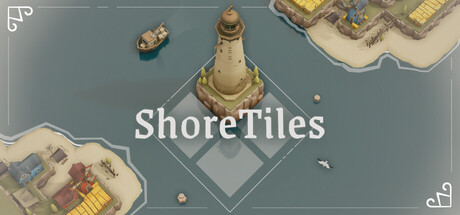
Build your island around a fragile lighthouse in this Gloomy tile-placement strategy game. Balance growth, economy, and defense - because when night falls, THEY will rise from the depths.
Modeled estimate, not a reported figure. How we estimate →
About
The light must never go out.
In the middle of a cold, endless sea stands a solitary lighthouse. Around it, your island begins to take shape, tile by tile, piece by piece. The sun breaks through the clouds and hope is in the air, but something eerie lurks beneath the surface.
ShoreTiles is a strategic building and defense game where strategy, wits and luck all contribute to your island’s ultimate fate. What begins as calm construction by day turns into a desperate fight for survival by night.
Build what must protect you:
Draw island tiles from an unforgiving deck and place them into your world. There is no undo, only what comes next. Connect matching terrain types, form patterns, and impose order on chaos. Efficient planning rewards you. Hesitation costs you space.But no matter how perfect your island looks… it is never truly safe.
Prepare while you still can:
Coins are more than progress, they are your only form of control:
Raise new Lighthouses to push back the fog
Build Settlements, Farms and Walls to bring your island to life and earn gold
Establish Military Camps to defend your island from they who lurk below
Because when darkness falls, they rise:
Creatures emerge from the depths. Twisted forms, neither human nor beast. Silent. Relentless. Drawn to the lights and the lives of those on the shore. Your defense depends entirely on your preparation. Connected military tiles determine how many units stand against them.
And sometimes… it won’t be enough.
As your island expands, the diversity of its structures and units grows with it.
Discover remnants of those who came before you, such as gold chests, relics and more, as well as discovering new building types & combat units through the Progress Map - However, as you progress, the fog may reveal advantages for your battles, but it can also bring new enemies.
Features:
Atmospheric tile placement centered around vulnerable lighthouses
Constant pressure from an unseen threat beneath the waves
Strategic combo mechanics with meaningful trade-offs
Nightly attacks from eerie deep-sea creatures
A fragile balance between expansion, economy, and defense
High replayability through randomized tile sequences
What ShoreTiles is:
A calm yet deeply unsettling gameplay experience
Strategic planning under growing pressure
A dark coastal atmosphere inspired by the 1960s
A constant tension between control and collapse
What ShoreTiles is not:
Not a cozy builder without consequences
Not a safe experience
No escape from the night
As long as the light burns, you still have a chance. The only question is: For how long?
Genres
Stats
All-time low is the lowest price we've recorded for this game since we started tracking it.
Languages: English, Italian, French, German, Spanish - Spain, Japanese, Polish, Russian, Ukrainian, Korean, Portuguese - Brazil, Portuguese - Portugal +6 more
Engagement
Reviews
Themes across 96 recent reviews and how positive each mention is. A keyword signal, not full sentiment analysis.
Reviews
还不错,白天建筑,晚上防御入侵,强度不高,不过目前也才玩到十多天
Combat controls are unwieldy and units placed directly in the path of incoming enemies often fail to engage. Sent feedback in-game but the combat controls are not anywhere as good as peer games (Thronefall), RTS (Starcraft 2 et al.), or even any Moba.
希望可以设置跳过计算金币的过程动画,中后期会消耗很多时间等待
Media

Related
Related
Price dynamics, follower growth, revenue and sales trajectories with interactive tooltips
This and every other Pro feature is free until October 20, 2026. A free account is all it takes.
Hours played at review time, across 96 reviews with recorded playtime.
positive critical· bar length = how often the theme comes up
如果你想获得类似绝境北地的战术策略体验,那你来错地方了 如果你想获得类似冰汽时代的建造运营体验,那你来错地方了 如果你看完上述两条还打算买,那我可以告诉你:你来错地方了 这35.7块钱真的真的有更好的去处,比如我上述提到的两款游戏 战斗手感稀烂,逻辑链条混乱,UI设计不知道在干嘛这些问题都是表层的 更深层的问题是,作者自己都不清楚,自己想要一个怎样的完整流程,这个流程内的元素是怎样交互的,玩家怎样从中获得正向与负向的反馈,以及如何从这些反馈中调整游玩策略以获得更好的反馈 同样是一个兵,同样是一片树林,同样是一座房屋,最终呈现效果差意味着编程所付出的努力远低于那些表现效果更好的游戏 吃惯了细糠,真就咽不下这口粗粮了 但如果你认为各类小程序游戏很好玩,那这个可能很适合你,毕竟开始之后不需要充钱还没有广告
ShoreTiles takes the familiar pleasure of tile placement and turns it into something considerably more threatening than its attractive miniature islands initially suggest. Developed by Voxel Studios and published by Noovola, it is a single-player strategy game that combines puzzle-like construction, economic management, defensive planning, roguelite progression, and real-time survival. Its defining idea is simple but effective: build an island around a vulnerable lighthouse during the relative safety of daylight, then discover whether your decisions were good enough when creatures emerge from the sea after nightfall. The construction system provides the foundation for nearly everything that follows. Island tiles are drawn from a randomized deck, forcing you to work with what you receive rather than designing an ideal settlement without restrictions. Matching terrain, connecting appropriate areas, and creating useful patterns reward careful placement. More importantly, there is no convenient undo function. Once a tile has been committed, that decision becomes part of the island. This gives even ordinary placements meaningful consequences and encourages players to consider future expansion instead of chasing only immediate rewards. Coins represent an important part of the strategic economy because they allow greater control over the developing island. Settlements, farms, walls, military camps, and additional lighthouses all contribute differently to survival and growth. Expanding the network of lighthouses pushes back the fog, opening additional territory and possibilities, while economic structures help generate the wealth necessary to continue developing. Military camps prepare defenses against the creatures waiting beneath the water. The challenge comes from balancing all of these priorities when available space, resources, and upcoming tiles may not cooperate with your plans. Nighttime provides the counterweight to the relatively peaceful building phase. Strange creatures rise from the depths and advance toward the lights and inhabitants of the island. The number and effectiveness of defending units depend heavily on how military tiles have been arranged and connected. Consequently, the island is not merely something you construct for points or aesthetic satisfaction. Its geography becomes part of your defensive strategy. A layout that appears highly efficient economically can prove dangerously exposed once enemies begin approaching from the coastline. This day-and-night structure gives the game an engaging cycle of preparation and consequence. Daytime encourages experimentation, optimization, and expansion, while nighttime effectively judges the quality of those decisions. There is a constant temptation to grow because additional territory can produce more wealth, structures, discoveries, and tactical opportunities. Yet expansion also increases the amount of land that must be considered during an attack. The game therefore makes growth feel rewarding without allowing it to become an automatic path toward victory. Exploration provides another layer of unpredictability. Pushing through the fog can reveal gold chests, relics, new building types, additional combat units, and other benefits. The Progress Map gradually expands the strategic possibilities available to the player. However, advancement is deliberately double-edged because discovering more of the world can also introduce new enemies. This creates an effective roguelite tension where becoming more capable does not necessarily mean becoming safer. Randomized tile sequences are particularly important for replayability. Because players cannot depend on receiving identical pieces in an identical order, successful strategies require adaptation. Some runs naturally produce satisfying combinations, while others demand compromises and creative recovery from poor draws or earlier mistakes. The inability to reverse placement decisions strengthens this system because imperfect choices remain visible throughout the run. Winning therefore feels less like executing a memorized blueprint and more like successfully managing an unpredictable situation. The atmosphere gives the mechanical framework much of its personality. A solitary lighthouse surrounded by a cold, seemingly endless sea creates an immediate feeling of isolation. The visual presentation can appear peaceful during construction, but the knowledge that hostile creatures will eventually emerge prevents the experience from becoming completely comfortable. Its dark coastal setting, influenced by a 1960s aesthetic and Lovecraftian imagery, works particularly well because the horror remains integrated into the strategy rather than existing only as decoration. Players looking specifically for a traditional cozy city builder should understand that the attractive tile-based presentation is somewhat deceptive. There are peaceful moments, but the game is deliberately built around pressure, irreversible choices, resource limitations, and eventual attacks. Likewise, players expecting a complex conventional RTS may find the military mechanics comparatively streamlined. ShoreTiles is strongest when approached as a strategic survival puzzle where construction, economics, randomization, and defense continuously influence one another. Steam Deck compatibility deserves some qualification. The game currently has full controller support and its configuration includes Steam Deck touchscreen functionality, which are encouraging signs for handheld controls. However, the Steam listing does not currently display an official Valve Steam Deck Verified or Playable rating. It is also officially listed for Windows rather than native SteamOS/Linux support. For that reason, it is best described as having promising Steam Deck support characteristics but without an official Steam Deck compatibility badge at present, rather than claiming that it is formally Verified. The overall design succeeds because decisions made during quiet moments acquire significance later. Building a settlement is connected to generating resources, military placement influences nighttime survival, lighthouse expansion reveals more territory, and exploring that territory can uncover both advantages and new dangers. There is always a trade-off between creating the island you want and preparing the island you actually need. ShoreTiles ultimately delivers an appealing mixture of relaxing tile placement and mounting survival pressure. Its randomized construction provides replay value, the permanent placement system gives decisions weight, and the transition from peaceful development to nighttime defense creates a strong identity. Some players may wish for deeper city management or more elaborate RTS mechanics, but the comparatively focused systems suit its puzzle-oriented structure. For anyone interested in strategic tile placement with roguelite uncertainty and a gloomy coastal atmosphere, it offers an inventive variation on the genre. Rating: 8/10
这个游戏整体是不错的,就这个价格而言。这个游戏最大的问题就是优化,一局稍微长点就卡得要死,把这个问题解决了就是一个好游戏。
Прикольная игра: смесь Статик Дреда, Дреджа и Дорфромантика :)
[h1]Some Tiling[/h1] (Build 25143621) You're not so much a lighthouse keeper as you are a desperate urban planner putting down a Costco warehouse's worth of tents on a constantly growing island to conscript the entire population of local military-age males to fight mysterious monsters coming up from the depths. After each night, you earn gold from the surviving buildings and buy sets of tiles from the store, letting you influence the RNG of the city-builder mechanic. It's a pretty straightforward build-defend-rebuild loop, with a very lightly applied narrative. [h2]Pros[/h2] -[b]Terrific Tileplay[/b] I cannot stress to you enough just how fun the city building is, especially with the aesthetic. The game dripfeeds you upgrades/advanced buildings at just the right pace. And as the island advances, unique tiles come out of the fog. It's a tried and true method, giving you a small goal to build towards as you complete the main quest. This variation ensures each playthrough is fresh as you can't just resort to the same building strategy each time. And as you go, the buildings evolve with each other as they are placed together, match-three style. This activates special abilities, increases production, or gives you more militia forces. This citybuilding phase has the beauty of complexity hidden in simplicity. This is why I keep coming back to the game. -[b]Vicious Vibes[/b] The music is spot-on for an eldritch, from-the-depths horror. And the devs have been very artistic with the way melee combat is actually musical. The sound effects are discordant string plucks, becoming horror stings as battles amass on the island while the entire overture plays on. I love that clear attention to detail the developers paid to the rhetorical use of music in the genre of eldritch horror. It is just fantastic. And that attention to detail is extended to the artwork. It's drab, dour, and exactly what you would expect for a haunted coastal town. The rain is always teasing at the edges of your frayed psyche. And when you begin to lose the defense of the light against the horrors, grayscale sets in across the town as fog descends upon you. -[b]Dedicated Devs[/b] As you're about to read, there are some pretty egregious problems with the game. However, the developers have been quite active in the forums. There was a day zero hot patch. They've been on the ball responding to critiques and criticism. The concerns I am about to voice, they have already released a statement assuring the playerbase they are looking into. This bodes well. Shoretiles is clearly more than just a product to these artists, and you can see it in their communications. I like that and personally I'm going to keep an eye on this studio. [h2]Cons[/h2] -[b]Catastrophic Combat[/b] Each 'nightfall', your townsfolk get together their various nautical-themed weapons and form militias. You command them around the map, being able to split them into increasingly small units. Unfortunately, as the game goes on and your island grows, the distances between militias also grows. So, you have more land you need to defend but less to do it with. On the surface, this is a good mechanic for naturally increasing difficulty. However, repairing the buildings you lose each night eats into your ability to upgrade and also can cause a negative feedback loop of losing production buildings, spending what little cash you have on their repairs, and then being unable to defend against an even bigger horde the next night because your already-deficient militias weren't upgraded. Additionally, this is the one downside to the match-three builder mechanics, as you spawn a [i]hideous[/i] amount of tents on the island to grow your defense. Militia size scales with how many tents are chained together. Not only does this take away space from production buildings and reduce earning potential, it just makes everything look ugly. The tents don't follow the visual evolution of other buildings, so by the midgame it just looks like a homeless encampment in the middle of your island. The enemy emerges each night, tries to burn down your light house, and the townsfolk fight back. And the micromanagement is ridiculous. Units have an intercept radius, but it's pretty small. You can try to build small encampments to dot around the island and thus spawn a bunch of small militias, but enemy power scaling makes this less of a defense-in-depth strategy and more of a feed-townsfolk-to-the-merpeople scheme (As I'm playing back through it to check my notes, I just unlocked an archer tower? So that's cool. Towers definitely should be in the game a lot earlier). By the final fight, nearly every wave is composed primarily of the anglerfish, an enemy type capable of quickly overwhelming militias smaller than 10 (the magic number I've personally found), which is a unit size it takes a bit of investment to even reach. With so many small units, you have to constantly move militias around the island to intercept the various landing parties. You can't place a large militia in a corner and hope it intercepts all enemies there while focusing your micro on the other side of the map. Because that unit will just sit there and watch the eldritch horrors burn everything down outside of their tiny AoE. It's not a bad thing that you can't be everywhere at once. In fact, that would be a great challenge. However, as the militias' numbers dwindle, you have to move more and more of them together to defeat a mere few enemy. There is no ability to combine units, so the micro gets even worse as things get out of hand. -[b]Lackluster Loot[/b] What do you get at the end of combat? Three tiles. Each time. You earn three tiles and maybe some cash(?) but the 'fight end' screen is just anticlimactic showing you two meaningless scores and all there is to really notice is "Oh, I earned another three tiles." Anything that you actually [i]overcame[/i] is rewarded passively by, you know, not having the island burned to the ground, or quietly by just having number-go-up for your gold purse. There's nothing [i]exciting[/i] about winning combat. There are no limited-time monsters you have to chase down to earn unique tiles or quests to 'kill X Monsters with Y type Militia'. This is further reflected in the final boss fight, where the ending is just... so abrupt. There was an inkling of a narrative inside the game, but when you finally win... you just get booted back to the main menu as a thank you for your troubles. It's disappointing. Where's the sense of accomplishment with that? The narrative could be expanded upon. Maybe add mysterious relics that monsters drop or locations in the fog you have to investigate. Just something more to really seize upon the great vibes they were able to make for this game. While the atmosphere to this game is exquisite, the combat is so [i]exhaustingly[/i] tedious and boring that I actively stop playing the game because of it. It is [i]so bad[/i] I cannot recommend the game because it gets in the way of enjoying the parts of the game that actually work. [h3]Shoretiles as it stands is a chore, but with as active a developer team as Voxel Studios, I believe that will soon change.[/h3]
Islander X Dorf Romantik X Townscaper je ne sais pas ce qu'il y a à dire de plus.
遊戲是好玩的 操作是便秘的 按暫停要移動部隊超難選 描述是看不懂的 這個重組XX兵種到底是要怎麼重組 WTF 他只要不到兩百元也不太能要求啥 但還是希望做精緻一點吧
Selling now
See how fast this game is selling right now — estimated copies and revenue per day from recent review growth.
Active players
Estimated daily and monthly active players (DAU/MAU) modeled from peak concurrency.
Players by region
Where this game's players are, estimated from review languages.
Players also reviewed
The games this title's players most often review too — audience affinity.
Related
| Game | Estimated lifetime revenue | Reviews | Review score | Price |
|---|---|---|---|---|
| $299.6K | 1.2K | 73% | $9.99 | |
| $59.4K | 677 | 92% | $5.99 | |
| $6.1K | 44 | 91% | $4.99 | |
| $3.5K | 38 | 89% | $4.99 | |
| $82.6K | 256 | 92% | $9.74 | |
| $28.4K | 151 | 72% | $7.99 |
Related
| Game | Estimated lifetime revenue | Reviews | Review score | Price |
|---|---|---|---|---|
| $21K | 91 | 92% | $11.99 | |
| $21.1K | 222 | 94% | $4.99 | |
| $21K | 177 | 94% | $4.99 | |
| $21K | 57 | 86% | $14.99 | |
| $21.1K | 72 | 78% | $5.99 | |
| $21K | 68 | 85% | $12.99 |