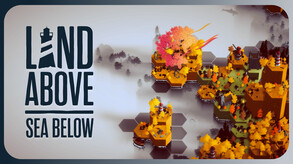
Land Above Sea Below is an atmospheric building strategy and puzzle game where you have to build your island from tiles in order to raise its height as much as possible, to avoid it getting flooded by the constantly rising sea level.
Modeled estimate, not a reported figure. How we estimate →
About

Genres
Stats
All-time low is the lowest price we've recorded for this game since we started tracking it.
Languages: English, Hungarian, French, Italian, German, Spanish - Spain, Portuguese - Portugal, Russian, Simplified Chinese, Traditional Chinese
Engagement
Reviews
Themes across 43 recent reviews and how positive each mention is. A keyword signal, not full sentiment analysis.
Reviews
It's a very pretty attempt to follow the popularity of other, aesthetically similar games - but one that has either no internal logic at all, or that logic is so complicated and grossly misrepresented by the ingame tutorial that I, and a lot of other reviewers, don't have a clue how it works. It's a very strict but randomly generated puzzle game with arbitrary and unpredictable failure states, rules apply one minute and not the next, and the basic gameplay loop feels... like an idea that should have been shot down early in prototyping, creating ugly networks of unfinished rivers and walls. The default gameplay mode has a hard time limit that ends the game before anything interesting can happen, so you play the secondary unlimited mode until you realise that by design, the world can only be ugly chaos, without the tantalising possibility of creating something aesthetically pleasing unless you master the mystery of the game's rules around rising water/rising land. I can't recommend it. At best, it's an overly complex puzzle game with no explanations in its tutorial, no intuitive visual indication of its rules, and a frustrating objective that makes it hard to enjoy or create something aesthetically pleasing. More likely it's just an unfinished concept running on immediate aesthetic appeal and comparison to better-designed games.
Media

Related
Related
Price dynamics, follower growth, revenue and sales trajectories with interactive tooltips
This and every other Pro feature is free until October 20, 2026. A free account is all it takes.
Hours played at review time, across 44 reviews with recorded playtime.
positive critical· bar length = how often the theme comes up
The game is trying to hard without spending much at all on understanding what made Dorfromantik good :/
This game is gorgeous. The artwork is amazing and the background music is soothing. This game is an aesthetic masterpiece. IT IS SO HARD!!! If you are looking for a more challenging puzzle experience than this might be the game for you and I do not regret my purchase. I'll definitely be playing this again. But I cannot honestly recommend a puzzle game that you are going to loose 9 times out of 10.
I've seen an alarming amount of negative reviews written for this title that repeat the same things over and over again, primarily focusing on two key points: the difficulty and a lack of understanding of the game rules. I've been playing the game off and on for about six months as of this writing and would like to help clear up some misconceptions about the game's perceived difficulty which has soured the experience for some. Ultimately, these two aspects go hand in hand: due to the fact that a large amount of players don't understand how to play, they think the game is too hard. The game is challenging for sure, but it's also meant to be challenging and isn't meant to be a game where you top the leaderboard after one go. The tutorial only explains the rudimentary basics and then leaves you to figure out the rest on your own while you play. It's a bit ridiculous to come into a puzzle game that positions itself as "try to prevent your island from sinking into the abyss" as its core gameplay premise and expecting it to be a peaceful breeze on your first try. While Land Above Sea Below may look like Dorfromantik at a glance, they play quite differently from each other despite having a loose overarching premise of fitting hexagonal tiles together to get points and keep going. Both games are about chasing after a high score until you eventually game over when you run out of tiles to place. Do well and you keep getting tiles, do poorly and your game ends. The very nature of these games is that you never really [i]win[/i] the game. Your victory is the high score that you achieved when your run inevitably ends and the drive it creates within you to push even further next time. The key difference between the two titles is that while Dorfromantik is a mostly stress-free experience that only really ramps up when you near the end of your tiles and close in on a game over, Land Above Sea Below has a clear ending point from the very start—the game takes place over the course of 10 turns that it refers to as seasons. During each season you start with seven days to place tiles, with each tile placed being one day. You can extend a season with a near indefinite number of days with good tile placement, thus creating synergies with other tiles. In simple terms, you create better synergies by placing like-coloured tiles next to each other. If you place a tile that touches 5 of its fellow like-coloured tiles then you will create a synergy that awards you with two extra days. Understanding of this principle is key to having long, fruitful seasons. If you simply breeze through each season in the default seven days you'll soon find yourself at a game over screen, scratching your head, wondering what happened. The first season starts out simple, with only one type of tile that we'll refer to from now on a biome. There are four different biomes in the game that progressively make themselves available to you the higher your score and the further you progress in each season. Using this to your advantage in the first season is critical; if you aren't reaching 30-40 days in the first season then you lack a basic understanding of what you're supposed to be doing. I've found great success in simply placing the starting biome tiles in C shapes and creating repeated synergies of 5. This process awards another two days which allows you to continue this method for quite a while. Things only begin to become slightly more complicated when around day 30+ you start getting tiles from the second biome. You also gain extra days from completing mini-objectives. Unfortunately, the game's tutorial doesn't even mention these as far as I can recall—you're simply left to kind of figure them out for yourself. The two main types of mini-objectives that you'll get are certain tiles that have a number written on them, such as [i]60m[/i] when you place it. What this number means is that you have to raise that specific tile 60 metres above sea level to complete the objective, and you accomplish that by creating adjacent synergies of 3 or more that cause that tile to raise until it reaches the mini-objective target. This is rather easy to do early on and crucial to take advantage of, but incredibly easy to miss if you aren't really paying attention. I was completely oblivious to these mini-objectives for my first few runs and once I started completing them intentionally, rather than by accident, I started to make much better progress. The second mini-objective you will get is placing the right combination of tiles around a specific tile. For example, you may get a tile that requires it to be placed by 4 tiles of its own biome, but 2 tiles from another biome. These mini-objectives are a bit trickier to do, and sometimes you'll be forced between choosing when to pursue a tile with one of these mini-objectives or to forsake it outright to create a synergy that you desperately need at that moment. You also gain access to cards that you can play. Whenever you reach certain point thresholds you are awarded with new cards. It took nearly 10 hours into the game before I realized that you can abuse the "undo" card to repeat the same tile placement multiple times to stockpile the rewards you get for placing it. Undoing a turn in this game doesn't undo the points you were awarded, nor does it take away the extra days you received either. It's good practice to stockpile several undo cards until you have a nice moment to abuse them for maximum rewards. This does come with the slight risk of not having an undo card available if you place a tile in error, however. From a distant viewpoint it's easy to mistake Land Above Sea Below as a cheap Dorfromantik knock-off, but they really don't play anything alike besides sharing a few basic concepts and a similar aesthetic. Land Above Sea Below is definitely a little bit harder, and requires a bit more hands-on tinkering to really wrap your head around its systems and to use them to your advantage. If you like the relaxing nature of Dorfromantik—the colourful graphics, themes of nature, and peaceful ambient soundtrack—then you'll get all of that here as well. But, you're also getting a rather delightfully challenging puzzle game that has the added pressure of trying not to let your entire island sink to the bottom of the ocean. I can assure you that once you spend a few hours learning the game mechanics that the rising sea level becomes more of an occasional minor nuisance when you get an undesirable assortment of tiles rather than a legitimate game-ending threat. Beyond that, there is an endless mode that you can play that just keeps going forever, although this mode becomes somewhat problematic the further you get and you'll most likely have to turn the graphics settings down to low just to keep the game running at a stable framerate. I eventually gave up on this mode due to this, as the game is poorly optimized for incredibly long gameplay sessions once you start getting to 50+ seasons. The game also seems to be abandoned by its developers, which is unfortunate. There's a few UI bugs such as mini-objectives not displaying correctly, and an annoying "Dear Player" message on the main screen that can't be dismissed. A few quality of life adjustments and bug fixes would be greatly appreciated but it doesn't seem that we're ever likely to get such an update. Regardless of these issues, Land Above Sea Below is an excellent and quality nature-themed puzzle game that is perfect for a rainy day and a cup of coffee. Just be prepared for a bit of a challenge and don't get too frustrated when your run reaches its natural conclusion. Approach Land Above Sea Below more as a roguelike puzzle game where each run imparts with you a deeper understanding of its systems so that you can make it further next time. Approaching it this way will ensure that you’ll have a much more enjoyable time while you get lost in its atmospheric soundtrack and soak up its excellent nature theme.
This game is infuriating to play. Not the relaxing experience it is advertised as.
[h2]Ощущение, что разработчики придумали хорошую медитативную игру, а потом сломали её дополнительными усложнениями...[/h2] Механику игры можно кратко описать следующим образом: Есть сезон. В сезоне по умолчанию 7 ходов = 7 плиток. Плитки бывают разных типов (сначала доступен один тип, потом постепенно добавляются остальные). За удачное соседство высота плиток увеличивается, а за очень удачное дают дополнительные плитки. При этом, когда ходы исчерпаны, то всё на карте тонет на один слой, а вам снова дают базовые 7 ходов (смена сезона). При этом есть специальные плитки (река, стена, строение), которые не тонут, но и в любое место их не поставить. Основная задача располагать плитки так, чтобы ваше главное дерево не утонуло. Вот и вся механика. Очень похоже на dorfromantik, но, к сожалению, проигрывает ему основательно из-за двух усложнений механики, которые я назову основными недостатками игры. Вот они: [b]1) Плитки поставленные в текущий сезон тонут вместе со всеми (кроме самой последней).[/b] На ранних этапах это даже не мешает. Однако, когда в игру вступают все четыре типа плиток, то вы можете получить такие плитки в сезоне, что половина из них утонет сразу же и испортит вам карту. Более того, когда первый раз добавляется плитка нового типа, то она гарантировано тонет, поэтому приходится её пропускать с помощью специальной карты и ждать реку для этого типа. Это выглядит, как серьезная дыра в механике. [b]2) Четвертый тип плиток.[/b] Он лишний. На самом деле у этого типа даже нет своего древа осени (главное здание, которое надо сохранить). Когда этот тип вступает в игру, то можете забыть про планирование и стратегию. Имея 7 стартовых плиток, вам выпадает всего 2 плитки одного типа, а для получения дополнительной плитки нужна комбинация из 4-6 одинаковых плиток рядом. Нетрудно заметить, что довольно быстро всё, что построено ранее, исчерпает себя в плане комбинаций, а новые вы уже не сделайте. Таким образом, единственная стратегия на этом этапе - относительно бездумно разрастаться до разбросанных на карте мини-островов, забивая болт на свой основной остров. Это безумно портит эстетику игры. Также в игре есть баги. Например, я ставлю плитку к большому острову, а затем собираю комбинацию из четырех плиток, включая предыдущую, и ожидаю, что плитка поставленная первой поднимется на один слой, как и задумано. Но она не поднимается! В результате тонет, а все планы идут по одному месту. Подобные ошибки встречаются не так часто, но они всегда существенно портят нервы. [b]Вывод:[/b] Это могла бы быть очень хорошая медитативная игра, но она криво усложнена механиками, описанными выше. А если и удалось перетерпеть эти усложнения, то неудачно пойманный баг может знатно подпортить впечатления. Не рекомендую. P.S. Если разработчики уберут четвертый тип плиток (руины) или сделают так, чтобы поставленные в текущем сезоне плитки не тонули до следующего сезона, то игра станет значительно лучше (вплоть до положительного обзора). Но вряд ли они это сделают.
It's a Dorfromantik clone with a handful of interesting mechanics, no balance at all and apparently incoherent internal logic. Normal mode is super hard and creative mode is pointless. There is no middle ground. Also everything is super blurry and leaves are outrageously ugly as they look super jagged and blurred at the same time (what an achievement). A work of hate.
Its pretty frustrating to place a tile down and it instantly tells you AFTER its about to sink, with no undo button without a card. after a few hours, I still can't understand how they determine if tiles are about to sink. It could be my last tile of the season, I place it down, and instantly now 3 are about to sink? why? I don't have a clue.
Easy to play but hard to master. The tutorial is sparse but you can learn the rules from playing a few games. There are three modes to play and you can choose your favourite. No difficulty to select. Also there is no "back" key to undo an accidental mouse click. So factor these things in if they matter to you. Personally, I'm finding this game to be very addictive and well worth the small asking price. You can buy this game bundled with Growth (which is another fun and relaxing map puzzle game) and in my opinion it's a good deal. On the point of relaxing - while learning to play this game it probably won't be relaxing. However, once you learn the rules and accept that your trees must and will eventually sink, then the game does indeed become very relaxing and fun to playing while watching TV or listening to podcasts, etc.
It's a beautiful game with an interesting premise. The problem is there's only two ways you can to play it; either hard mode or sandbox. This game does not let you modify difficulty or gameplay, so you'll either love it or its flaws will drive you away. The game is also not very forgiving. For example, if you misclick and place a tile in the wrong spot, you'll either have to live with that mistake or start an entire new game. Next, the game's tutorial doesn't teach you enough to be successful and usually expects you to look up the information in their manual. And finally, the Interface/ menu is often confusing and/or redundant. For example: There are multiple versions of the same menu, so finding things is confusing. Next, the game will ask 'are you sure you a want to leave this level' when you want to open the menu. However, this is completely redundant since it doesn't actually close the level.
Selling now
See how fast this game is selling right now — estimated copies and revenue per day from recent review growth.
Players by region
Where this game's players are, estimated from review languages.
Related
| Game | Estimated lifetime revenue | Reviews | Review score | Price |
|---|---|---|---|---|
| $2.6K | 14 | 100% | $4.99 | |
| $673 | 5 | 100% | $4.99 | |
| — | 0 | — | — | |
| — | 0 | — | — | |
| $14.7M | 29.6K | 96% | $13.99 | |
| $10.5K | 36 | 75% | $13.99 |
Related
| Game | Estimated lifetime revenue | Reviews | Review score | Price |
|---|---|---|---|---|
| $28.3K | 129 | 71% | $5.99 | |
| $28.4K | 92 | 83% | $7.99 | |
| $28.3K | 60 | 67% | $12.99 | |
| $28.4K | 360 | 99% | $4.99 | |
| $28.4K | 102 | 92% | $14.99 | |
| $28.4K | 76 | 70% | $14.99 |