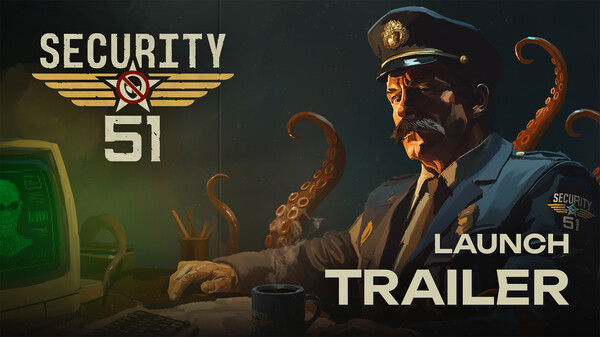
You're a security officer deep within Area 51. Scan the staff, verify clearances, and decide who can enter the elevator and who absolutely mustn't leave. The deeper you go, the less certain you are that anyone standing before you is still human.
Modeled estimate, not a reported figure. How we estimate →
Security 51 is an atmospheric security guard simulator inspired by Papers, Please, and SCP paranoia. You're on duty in the underground bunker of Area 51, where the most dangerous part begins at the elevator: the shaft descends for miles down to unknown levels. Whether it's laboratories, anomalies, inhumane experiments, or something alien—you're not supposed to know. Your task is simple: let in those who have access and stop those who don't... even if everything looks "right" on the surface.
Everyone who passes through your checkpoint carries papers and passes. Your job is to check names, positions, clearance levels, and time, ensuring the number of people entering and leaving matches, and pay attention to any oddities. As time passes you'll catch yourself thinking that something's wrong more and more, and the only thing to rely on will be the protocols. But even they can be wrong.
With experience, you'll gain increasingly more accurate methods of identity verification, such as blood testing. Did that janitor simply open the wrong door, or are they a spy for an enemy government? Or are they not even human? When in doubt, quarantine the suspect. Sometimes you'll make mistakes and lock up an ordinary employee, and sometimes you'll find a titanium cell ripped open from the inside. Some decisions will have immediate consequences, others only after several shifts.
The consequences of every mistake go far beyond issues in the workplace. Let the wrong person out, and the infection will ravage the city. Isolate suspicious employees, investigate anomalies, and launch new operations to contain the threat before it's too late.
Remember, it's not just about who you let in, but who or what you let out into the world.
Genres
Stats
All-time low is the lowest price we've recorded for this game since we started tracking it.
Add-ons
Each DLC is estimated with the same model as a game, then summed — a modeled figure, not reported DLC sales.
Sums Steam only; GOG, Epic publish no volume signal, so the true total is higher by an unknown amount.
Engagement
Reviews
Themes across 360 recent reviews and how positive each mention is. A keyword signal, not full sentiment analysis.
Reviews
You're looking for [i]Papers, Please[/i]. This is not [i]Papers, Please[/i]. The reason you come into this game expecting [i]Papers, Please[/i] is because all marketing implies a game like it; a spiritual sibling if not a spiritual successor. Sometimes, this works for lookalike games, like [i]Not Tonight[/i]. It did not for [i]Security 51[/i]. There are mechanical similarities to [i]Papers, Please[/i]: you scan bodies, you sort documents, and you stamp 'yes' or 'no'. You spend money at the end of each day to pay for food and stress relief. You can work towards multiple endings, I suppose. The pixel art and animations are superb, as is the music. Whoever was responsible for the aesthetics of this game should be proud of the job they did. But the game is fundamentally flawed in a way that won't be saved with spit and polish. The mechanics of this game do not serve the "story", and the "story" does not serve the mechanics. There is no natural sense of progression from one day into the next, no escalation of threat or difficulty, no unique dialogue with [i]any[/i] of the people you allow or deny entry to, no cause-and-effect behind the tasks you're being asked to do and the "choices" you make or have made, as limited as they are. Upgrades do not matter - in fact, it's better to not buy them and save your money [i]for reasons[/i] - and they do not carry forward (or backwards) as meta progression. It's not like you need them to alleviate an increasing difficulty. At most, even in the final levels, you will be checking two or three features at a time. It is as if the game is scared of making the process of checking too complex in a game about checking for things. Every ending you can achieve in the game is identical. The pathways seem to diverge only slightly in what items on the list you need to look out for. There is a "story" between the acts, which boils down to which threat you are facing and which solution (aka which icon) you're going to fix it with. You also get a different ending slide, and a badly-written conversation with the [i]terminally[/i]-cringe Machina Fatorum. When grinding out some of these ending achievements, I discovered an even more fatal flaw, which ripped down the curtain and said the show's over: [b]The most efficient way to 'win' is to save a bit of money on easy days and then let everyone through. There is no reason not to.[/b] A game in a genre for detail-obsessed perfectionists doesn't reward perfectionism — or punish carelessness. So, what's the point? [i]Papers, Please[/i] came out in 2013, over a decade ago. It is well-loved, well-remembered, and its name is well-represented in these reviews for good reason. I suspect no-one will remember [i]Security 51[/i] in a few weeks.
Media

Related
Related
Price dynamics, follower growth, revenue and sales trajectories with interactive tooltips
This and every other Pro feature is free until October 20, 2026. A free account is all it takes.
Languages: English, Simplified Chinese, Russian, French, German, Spanish - Spain, Traditional Chinese, Polish, Portuguese - Brazil, Japanese
| $9.99 |
| — |
| — |
| #42 |
| not modelled |
Matched by title — a reused name can pair the wrong games. * is a critic aggregate. Prices and positions are each store's United States storefront; Epic charts worldwide. Audience and Score too, except Steam's, which is worldwide.
Hours played at review time, across 360 reviews with recorded playtime.
positive critical· bar length = how often the theme comes up
역시나 비홀더 만들때 시전 했던 개버릇을 남 못주고, 이번에도 한글 지원이라고 사기쳐서 발매한 뒤에 말 바꾸는 행동을 반복한 Alawar입니다. 심지어 이번 한글지원 표기 문제를 스팀 측의 잘못으로 떠넘기기 시전을 하는걸 봐선 이 새끼들은 개선의 여지가 없습니다. 비홀더 출시 당시에도 지금과 동일한 짓거리를 시전했고, 이후 엄청난 시간이 지나서 나온 한글화는 역시나 개발새발 수준이었습니다. 절대 이 개발사를 믿지마세요. 만원도 안하는 가격이고, 한글지원 표기에 속아서 구매했는데 다른 분들은 속는일이 없길 바랍니다.
Disappointing Experience — Demo Was Better Than the Full Game I honestly enjoyed the demo far more than the actual full release. Here is why this game falls short: Unclear Mechanics: The logic behind the quarantine room and city policies is never properly explained. It feels completely arbitrary rather than strategic. Punishing Reset Loop: I reached Day 15, hit a sudden ending because of those unclear mechanics, and was forced to restart all the way back from Day 1. No Tutorial Skip: Being forced to replay the entire unskippable tutorial on every single run is pure artificial padding and respects none of the player's time. Frustrating Progression: Turns into a tedious chore of replaying the same early-game dialog and steps over and over. Disappointed with the current state. It needs Quality-of-Life updates (like tutorial skipping, clearer policy feedback, or mid-run checkpoints) before I can recommend it.
The Papers Please style mechanics work well, and the environment is great, but it has nearly zero story, and nearly zero characters. And some sort of story or characters to love is important in a game like this, because without something to get invested in, it's more a chore simulator or cookie clicker None of the people you inspect are reoccurring characters, none of them have notable personality, and there are no puzzles or interactions to affect their lives beyond if you let them in or detain them, both cases in which you never see them again (unless you count seeing their recycled face on an entrant with a different name). It's a darn shame, because in an environment of aliens, robots, fae, and cryptids, the potential is endless. But it made a decent gameplay loop and went no further.
Это шутка какая-то? У игры приятный визуал, есть несколько забавных механик - обнаружение аномалий по фото, скан кожи, осмотр внутренних органов, рентген костей, тест роршаха, забор крови, анализ на группу крови, выявление аномальных кровянных телец под микроскопом, проверка документов под ультрафиолетом иии.... все это абсолютно не нужно. Ты можешь просто игнорировать АБСОЛЮТНО ВСЕ механики досмотра и просто пропускать всех подряд - и все-равно будешь в плюсе. Абсолютно не важно кого ты пропускаешь - все эти люди не рассказывают тебе какие-то истории, не пытаются тебя убедить или обмануть, в конце-концов принятое тобой решение на кпп никогда и ровным счетом никак не повлияет ни на тебя, ни на твое место работы, ни на ситуацию в мире. Единственное, что имеет значение - так это то, каких людей ты отправляешь в изолятор на эксперименты. Например, собирая людей с "грибной инфекцией" ты выйдешь на "грибную концовку". И так 9 раз. 18, если быть точным, ведь каждую концовку можно еще и альтернативно получить, провалив ее, но добиться этого можно только если не нажимать каждый день "начать операцию в городе" - что не требует вообще никаких усилий, менеджмента или ресурсов. По-итогу, игра превращается в рутину, где ты просто скипаешь дни, бездумно пропуская всех подряд, ведь тебе надо посмотреть 18 концовок. Удивительно как разрабы умудрились выкинуть из заложенной Papers Please успешной формулы - эмпатию и какую-либо интеракцию с людьми на кпп. Сyка, НИ РАЗУ не было такого, чтобы лицо человека, предъявившего документы не совпадало с личностью, их предъявившего! Ты можешь просканировать человека, найти у него аномалию в органах - и запросить справку об этой аномалии. И угадайте что? НИ РАЗУ более эта справка тебе не понадобится, кроме самого первого дня, когда эту "МеХаНиКу" презентуют! У нас в игре 20 правил досмотра, но за день единовременно будет задействовано не более трёх. И, соответственно, не важно что ты обнаружишь - джингробеззи на фото за спиной, бомбу вместо печени или мутировавший вирус в крови - если об этом сегодня не сказано в инструкции (а об этом не будет сказано), то - игнорируй, пропускай - ультимативный ответ на ВЕСЬ игровой процесс. Тебе даже деньги зарабатывать нет смысла! Потому что: а) ты всегда в плюсе, что бы ты не делал б) покупки в магазине бесполезны в) за день нельзя отсмотреть больше людей, ведь их всегда фиксированное количество. Нет смысла становиться эффективным работником и быстро и грамотно досматривать людей, чтобы за фиксированный рабочий день успеть пропустить больше человек. Потому что рабочий день ограничен не временем, а фиксированным количеством людей! У тебя 10 человек на вход и 5 на выход (не больше, ни меньше) - и ты за первую четверть рабочего дня уже управился! 10 упущенных потенциалов из 10, игромеханический провал, абсолютно не рекомендую.
Security 51 really suffers from being too easy all the time. All of the investigation mechanics individually are creative and fun, however in the "hardest" missions you are only required to examine 4 mechanics at most and none of them interact with each other. I was consistently clearing days in half the allotted time with no mistakes. More importantly, the characters and story need significantly more depth. The game already has a sanity bar for your character that decreases upon making mistakes or certain decisions, however you as the one playing the game don't really feel torn between anything since there's no repercussions for killing or detaining people. The game allows you to admit people that should not be let in, but there's never a reason to go against the rules you're given because the choices don't matter in the long run. The story has different options and paths depending on how you solve the outbreaks / invasions at each stage, but there isn't really an impact on the lore. What I think needs a complete overhaul is the detain / city mission system. You can detain anomalous individuals to run experiments on, however the experiment just runs itself and the next morning you get a memo saying stuff happened. In the experiment selection menu itself, the descriptions of the experiments say stuff like "if subject asks to open window, shoot on sight", which suggests there would be a minigame of sorts to make the experiment succeed or that you would have a tough choice to make between killing the detained person or letting them go. It's a similar situation with the city missions: the description will say something along the lines of "send team out to exterminate infected individuals and recover body parts for research", but despite the clearly morally questionable nature of the mission, completing it literally does not matter at all. Nobody sees you differently afterward, nothing changes in the newspaper you get every morning, and it's not even mentioned ever again, so it ends up not having any weight to it. As it stands, the game has a really good base design that needs a lot of improvement. The gameplay would really benefit from having a post-game difficulty increase mode or maybe even an endless mode that adds in more and more stuff you have to check for each person. On the story side, the choices need to actually matter. There was not a single moment when I was playing where I considered going against the mission ruleset. Furthermore, I think the price needs to come down. For $10 I have gotten 800 hours of entertainment out of Terraria; in this game I only have 4.5 hours even after playing through it twice. Obviously, the amount of hours you can spend in a game is not the best indicator of how good the game is, but with Security 51 there's no reason to be attached to it other than for its entertainment value. If changes are made I'll remove my review.
I really wanted to like Security 51. The whole Area 51 / SCP / Papers, Please concept sounded exactly like something I would enjoy. The problem is that I kept playing because I was waiting for the game to become more interesting. It never really did. The basic loop is incredibly simple: check people, check documents, use whatever inspection method the game asks for, make a decision, repeat. New mechanics get introduced, but they never made me feel like the game was actually getting deeper. It just felt like I was doing slightly different versions of the same simple task. The game keeps suggesting that something bigger is happening around you — infections, anomalies, decisions, containment, your character's condition, etc. — but very little of it made the actual gameplay feel meaningfully different. I kept expecting the situation to escalate, for my decisions to really matter, for some interesting story to develop, or for the job itself to become more complicated. Instead, it stayed slow, repetitive and surprisingly uneventful. That's probably my biggest issue: I don't really understand what the point of all these additional systems is if they barely affect what I'm actually doing. There are a lot of ideas here, but they don't come together into something that feels important or engaging. Unfortunately, I played past the refund window because I was basically trying to plow through it, thinking, "Surely something interesting is about to happen." It didn't. Great premise. Nice atmosphere. But for me, there just isn't enough depth, consequence or progression behind it to make the actual game interesting.
[b]Not recommended right now. Good bones, but it needs a depth and difficulty pass first.[/b] To be clear about what this is: not a 'stay away', but a 'wait'. Security 51 has a genuinely good set of bones. The checkpoint loop is satisfying, the escalation from 'check the badge number' to 'count how many organs this man has' is funny, and the pixel art suits the bunker well. I enjoyed my first playthrough. Then I looked at what the game wanted me to do next, discovered it was the same playthrough again, and put it down. In its launch state I cannot tell anyone to buy it. Wishlist it and watch the patch notes. [b]Five lines of dialogue is not a character[/b] The biggest problem is the dialogue pool. Visitors draw from what feels like about five lines in total, and within a single shift you will watch the same stock sentence come out of four different people. That is fatal here, because the store page sells you on catching wrong answers, slurred speech and behaviour that deviates from protocol. Verbal tells only work if there is a normal to deviate from. With a pool this small, 'he said something strange' stops being a suspicion and becomes the sixth item on a checklist. Besides, what they say, doesn't matter their right to access regardless. It also guts the emotional half. The NPCs are so devoid of life at this stage that condemning an innocent one carries no weight. Papers, Please got enormous mileage out of the man you turned away yesterday walking back up to your window today. Here nobody comes back as anybody, and the advertised hook of consequences surfacing several shifts later needs a face you can remember. You cannot regret a stranger you were never introduced to. Also, the newspaper on the desk serves only as a way to humor you at the start of each day. [b]Alawar has done this better before[/b] This is the studio behind Beholder, which ran entirely on tenants with names, jobs, families and problems that collided with the rules you were ordered to enforce. They know how to make a bureaucratic system hurt, so the flatness here reads as a scope decision rather than an inability. It is also the most fixable thing on this list, which is a large part of why this is a 'not yet' rather than a 'no'. [b]The branch system is New Game+ in name only[/b] The branching structure is a good idea and I liked having a reason to go back. But replaying a day hands you the same people, with the same names, the same characteristics, in the same order. The novelty of 'I know what is coming' burns off in about ten minutes, and what is left is a memory test rather than an inspection. What makes this odd is that the randomisation clearly exists. Guide writers note that visitor rosters differ from run to run, which is why walkthroughs warn your day may not match theirs. So the seed varies between save files but is frozen inside one, which is exactly backwards for a mode built on replaying days. The various endings are real, the replay value is not right now. And, hanging 68 achievements on identical repeat runs turns completion into admin. [b]The difficulty stops climbing[/b] The manual gets longer without getting harder. You get a fixed number of people to process, comfortably more shift time than you need, and a bonus for clocking off early. At some point I noticed I was done with time to spare so I slowed down, checked everything twice and stopped making mistakes, and the bonus I gave up was worth less than a single fine. The optimal strategy is to play at a pace where the game cannot threaten you, and the game pays you to find it. New tools do not fix this, because they are additive rather than transformative. Fingerprints, blood tests, the thermometer, two flavours of X-ray: each one adds a step to the routine rather than an ambiguity to the judgement. A longer checklist takes more clicks. It does not take more nerve. Difficulty in this genre comes from not knowing which tool to reach for, or not having time to reach for all of them. Security 51 tells you both. Pre-release concerns addressed this exact risk: anomalies going routine once you have seen enough of them, and planted document errors conspicuous enough to catch at a glance. The full release does not dodge this. By the tenth strange X-ray you are not unsettled, you are pattern matching. [b]Quarantining everything is the dominant strategy[/b] This is the structural problem underneath the difficulty complaint. Wrongly detaining an innocent employee costs a small fine and a line of text. Wrongly clearing an infected one is supposed to be catastrophic. With penalties that lopsided, the rational move whenever you are even slightly unsure is to quarantine, kill or just 'let them in', and I did, repeatedly, and never felt bad about it. This genre runs on the dread of a decision you cannot take back. Here there is a rather simple 'get out of jail free card' and nothing makes you regret using it. [b]The upgrades solve a problem the game never creates[/b] They are either priced out of reach or too marginal to feel, but the deeper issue is what they are for. Upgrades buy you speed and certainty, and you are never short of either. Meanwhile satiety and sanity are handled by buying consumables, which makes them a tax on your wage rather than a pressure on your decisions. You do not manage those meters, you pay them off, and constantly having enough money removes them entirely. What is left is an economy with nothing worth buying and nothing worth fearing. I finished my run with unspent money and unbought upgrades and did not feel like I had missed anything. In the version of the game where the shift is too short and the fines actually bite, an upgrade would be the difference between processing everybody and going hungry. That version generates its own tension for free. [b]Most of the anomaly catalogue stayed locked[/b] There is a sizeable anomaly catalogue in here, and mine sat well over eighty percent question marks. As far as I can tell entries only fill in if the manual asks for it on any given day in your playthrough. Whatever the exact rule, the effect is a one-per-day trickle that quietly happens in the background. I spent most of my run staring at a wall of question marks and never really had a need to check certain anomalies to make sure I had an exact one. [b]The story is a strong premise, lightly served[/b] There is a real story here and I wanted more of it. The infection creeping through the city, the antidote research, the mental strain meter: they all gesture at a much bigger game, but in practice they are extra meters to top up rather than pressure that changes how you work the window. The satire stays at the level of a funny newspaper headline. [b]What would flip this to a recommendation[/b] Widen the dialogue pool and let a handful of visitors recur under their own names. Reseed the roster on branch replays. Shorten the shift or lengthen the queue so speed and care genuinely compete. Make a wrongful quarantine cost something that outlives the payslip. Open the catalogue up so it rewards curiosity instead of rationing it. That is a patch and a difficulty and content pass, not a redesign, and this game is one good update away from being the easy recommendation in its niche. [b]Verdict[/b] Not recommended in its launch state. It is cheap, and if you want one evening with a Papers Please-like you will get exactly that. But it is sold on replay value and multiple endings, and the replay is the part that does not work, so you are being asked to pay for content that is functionally the same content twice. I will come back and change this review the day Alawar ships an update that adds depth to the people at the window and difficulty to the shift itself. I want to like this game considerably more than I currently do. Right now: a 5-out-of-10.
Просто хочу поддержать разработчиков. Слишком много негативных отзывов и все потому, что люди либо ждут от игры механики Papers, please, либо не могут разобраться в правилах проверки, которые не такие уж и сложные, если знать что делать. Я пробовал играть почти во все схожие игры, в том числе и Papers, please. И если уж и выбирать, то меня больше зацепила эта игра. И это вовсе не значит, что другие игры были плохими. Каждому свое. Что мне понравилось больше всего: основной упор на проверках разработчики отдали не бесконечной сверке номеров, фамилий и прочих букв и цифр, что по мне слишком утомительно, а на использовании разнообразных механик для проверки людей на аномалии - забор крови, сканеры внутренних органов и кожных покровов, тепловизор, фотоаппарат, тест Роршаха. Такой геймплей намного интереснее, чем просто сверка документов между собой. Например, очень понравилась идея с лифтом - люди не просто проходят в комплекс, но и выходят из него после работы. И ведь тут тоже надо держать ухо в остро. Вроде бы не сложные процедуры проверки, но я несколько раз допускал ошибки именно из-за своей невнимательности. Сцены с ликвидацией или обезвреживанием зараженных - бесценны. Вроде бы и здесь все с юмором сделано, но волей неволей начинаешь переживать - а вдруг ошибка и ликвидируют невиновного. Спустя несколько секунд: "Хорошо, на Вас можно положиться". Выдох. Все сделал правильно. Развитие сюжета завязано на полевых операциях в городе. То, как мы решаем текущие проблемы горожан в ходе исследований, приводит к хорошим или негативным последствиям в итоге. Отдельно стоит отметить замечательную рисовку, юмор и атмосферу - все на высшем уровне. Так что эта игра определенно заслуживает внимания тех, кому нравятся проекты подобные Papers, please. Ей точно есть, чем Вас удивить.
In my opinion, the negative reviews have been too harsh on this game. A lot of people criticize it simply for not being Papers, Please. The truth is, the game never promised a fully coherent story - it's a collection of anomalies and mechanics built around inspecting people. On top of that, there's a looming threat in the city, and examining isolated individuals gives you a way to find a solution to that threat (and create a new one). I wouldn't call the game perfect, but the gameplay loop is quite addictive and works great as a time killer. The visuals are pleasant, and the animations are funny. The main thing worth noting is that the developers respond to player feedback, and significant updates have already been released that added difficulty levels, an endless mode, "story" characters, the ability to carry over upgrades between runs, and other improvements. That's definitely very commendable. If you like the game's theme and need a time killer, then go ahead and get it.
Selling now
See how fast this game is selling right now — estimated copies and revenue per day from recent review growth.
Active players
Estimated daily and monthly active players (DAU/MAU) modeled from peak concurrency.
Players by region
Where this game's players are, estimated from review languages.
Players also reviewed
The games this title's players most often review too — audience affinity.
Related
| Game | Estimated lifetime revenue | Reviews | Review score | Price |
|---|---|---|---|---|
| — | 0 | — | — | |
| $13.7M | 80.5K | 97% | $9.99 | |
| $2.3M | 3.3K | 95% | $17.99 | |
| $607.5K | 1.9K | 76% | $9.99 | |
| $145.7K | 520 | 69% | $19.99 | |
| $9.1K | 28 | 82% | $9.99 |
Related
| Game | Estimated lifetime revenue | Reviews | Review score | Price |
|---|---|---|---|---|
| $172.9K | 737 | 77% | $11.99 | |
| $172.7K | 270 | 77% | $14.99 | |
| $172.7K | 304 | 95% | $29.99 | |
| $172.6K | 737 | 95% | $7.99 | |
| $172.6K | 278 | 62% | $14.99 | |
| $172.6K | 1.2K | 87% | $6.99 |