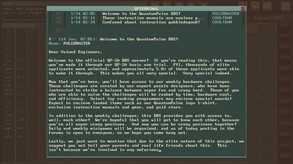
Solve programming puzzles on a fictional computer with radio-based communication and unique limitations. Competitively optimize to compete on leaderboards against friends and the global community.
Modeled estimate, not a reported figure. How we estimate →
Media

About


Genres
Stats
All-time low is the lowest price we've recorded for this game since we started tracking it.
Languages: English
Engagement
Hours played at review time, across 31 reviews with recorded playtime.
Reviews
QuantumPulse 2A is a shining example of how a simple set of rules can lead to complex and rewarding challenges. While it will feel immediately familiar to fans of the genre, the game's novel mechanics will have you thinking in unique ways from the first level. The instructions are simple, allowing you to jump right into the puzzles without a steep learning curve. The manual is clear and informative, and has an entertaining retro style. The designer has paid incredible attention to detail in the user experience. As you “run” your solution, the graphics and sound show the state of the machine in real time, making it easy to see if your solution is behaving as you expected. Error messages are detailed and clear, making it easy to understand what has gone wrong when a solution is incorrect. The game even helps you correct simple typos as you go, with immediate feedback for syntax errors. The ability to step the machine backwards helps to make finding bugs easy. The levels provide a smooth progression, introducing new challenges gradually without any puzzles feeling like “filler.” The simple mechanics hide a surprising amount of depth, offering ample opportunity for different optimization techniques. You can easily spend hours tweaking your solutions to improve different metrics, and the achievements require you to go back and solve some levels in entirely new ways. The graphics have a consistent retro style, the story is amusing, and the sound design is crisp and pleasant. The bonus solitaire game is equally well-crafted - it's a joy to play, with a cleverly-simple animated rules page and excellent UI.
Best of the genre, was looking for a TIS-100-like game for a long flight to New York, laptop was low on battery, so I wanted something power efficient, ran across this game and loved it. Found it fun and challenging, yet better (more complete than the legendary TIS-100). The interface is sooo fun, reminds me of old MS-DOS programs. Once I beat a level, I go back to it to optimize my code, so much fun, highly recommend! Works great on linux too!
Note to future Quantum Engineers, check out the wait/puls instructions early on. They make things much cleaner than my noop synchronization spaghetti. If only every language had a debugger that could go back in time. It's a good brain-teasing/programming game and very well presented.
A puzzle game where you solve problems with small, cooperating microchips, similar to TIS-100 or Shenzhen I/O. However, rather than communicating over wires, the chips broadcast values to each other over radio channels. The instruction set is, if anything, even simpler than other programming games. The chips don't even have an "add" instruction -- instead, when multiple chips broadcast simultaneously on the same channel, other chips can read the sum. But even though the chips are simple, they combine in surprisingly complex ways, allowing many different approaches to each level. Trying to match the fastest, smallest, or cheapest solutions found by other players is particularly challenging -- some of the scores seem almost impossible, others tantalizingly just out of reach... until you hit upon a new arrangement that lets you shave off that one last instruction. (And, of course, the game also includes a deceptively simple solitaire card game, similar to Freecell, unlocked after beating the first few levels.)
The system's design is far too tedious. What might be passed off as intentional limitations often feels simply annoying. It begins with nonsensical rules, like being unable to read from or jump by a node's own channel, and culminates in the absurdity of the 'radio transmission' mechanic. This forces you to waste most of your time just figuring out the correct timing through endless NOP instructions.
I felt in love to graphics and aesthetics of this game. And this game felt easy and awarding. But it was only during the demo and first few puzzles. The farther you go the more annoying the exercises will be. You will feel exhausted solving them and not happy at all. Situation gets worse when you reach stupid limitations of the game UX. E.g.: - you can't format your program and insert line break so that it becomes easier to read because all the lines should fit on the screen - you can't write sensible comments inside the code because of the short line - you have stickers but you can't use them too because they're limited too - if you fail to organize your chips you will really struggle to reorganize them
A nice zachlike, i had apprehension with the radio mechanic but it becomes good when you try it. Only gripe is you need to match or exceed a specific metric with your solution to get gold stars and i feel like i've missed a few important tricks that would've made it actually possible for me to get them on some puzzles, often those with a cycles requirement.
Great fun! It gets you thinking in ways similar to as in Shenzhen I/O and TIS-100: Who knows what when? How can I get rid of one more instruction? How do I get from "no way is that score possible" to "now I can use this one weird trick on future puzzles"? The major conceits are that inter-chip communication is done by radio values that sum when on the same channel, and that a chip can't use its own state to branch. This leads to values ricocheting around in a baroque manner on the one hand, but to some clever mechanics on the other. When it clicks it's really sweet and unique. One innovation (new to me at least): a "beat the team" mode in the leaderboard showing good scores from four people. Instead of chasing a very difficult #1 score one can first go after an excellent but not unreasonable #1 team score.
After the great demo version, finally some fun little assembler puzzles to have fun with. :)
It made me think. I liked it. Might think more Honestly, really good game. I have never played any Zachtronics game and had no problem with understanding the principles of QuantumPulse. I haven't completed all levels yet, but the variety of solutions already makes it interesting. Will update the review if I manage to beat the game.
Related
Related
Trends
Modeled estimate over time, reconstructed from Steam's monthly review histogram.
Audience
Estimated from the language of this game's reviews — a proxy for where players are, not official Steam demographics.
Related
| Prison Girl | $10.6K | 84 | 25% | $4.99 |
| keyg: the last prison | $10.6K | 140 | 84% | $4.99 |
| Red Embrace | $10.6K | 140 | 93% | $4.99 |
| Lunnye Devitsy | $10.6K | 112 | 69% | $4.99 |
| Tribloos 2 | $10.6K | 80 | 89% | $4.99 |
| Manastorm: Champions of G'nar | $10.6K | 70 | 66% | $4.99 |