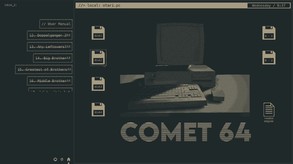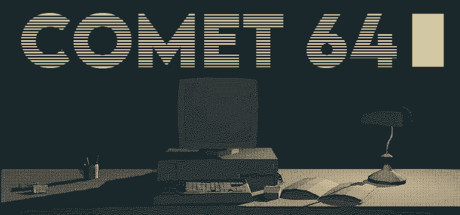
Comet 64 is a programming puzzle game. The year is 1984. All you got is a Comet 64 home computer and the operator's manual it came with.
Modeled estimate, not a reported figure. How we estimate →
Media
About


Genres
Stats
All-time low is the lowest price we've recorded for this game since we started tracking it.
Languages: English
Engagement
Hours played at review time, across 40 reviews with recorded playtime.
Reviews
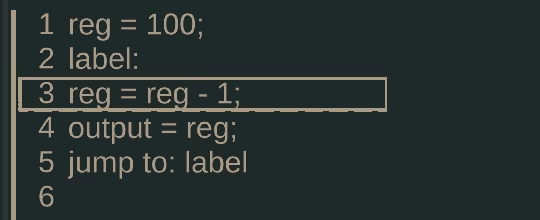
Comet 64 simply does not meet the quality of comparable yet cheaper games like TIS-100 or MHRD. I highly recommend you play those instead; they're much more polished, enjoyable, and educational than Comet 64. Comet 64 is based on a nonsensical computer architecture. It tries to emulate assembly code, but it has so many quirks and inconsistencies that make programming in it frustrating. The story is lackluster, the problems don't follow any themes, and the problem statements are often poorly-written or ambiguous. Simply put, this game is not worth your time. [hr][/hr] If you really want to know, here's a long list of gripes I have with Comet 64: [list] [*] The computer architecture is not designed well - Why does the Bool register store the text "true" or "false"?! Why can't I use it as a numeric 0 or 1?? - Why is there a register dedicated to strings and chars? They feel so out of place in an assembly-level language. - And if there's a string register, why aren't there basic operations like appending chars to it? - The char register can only store the lower-case letters a - z. Why can't it store digits like the string can?? - Why can't computations directly go to the Output? Why do I need to use a valuable register to store the result intermediately? [*] The IDE experience is lacking - Syntax errors in a line are not shown until that line is executed! - Why do all instructions need semicolons at the end? They have no purpose in an assembly-like language. - The input and output tapes are only shown after pressing the Tab key. Why? They don't obstruct anything. - The input and output tapes also cannot be scrolled through; you must write a dummy program to read all the input to see everything. - The Undo shortcut sometimes undoes multiple edits at different locations! And sometimes it undoes a single edit (like a paste) in multiple steps!! I never trusted it. - There's no Redo either! [*] The challenges are not fun - Problem 36 teaches you binary, and expects you to convert a number 0 - 15 from decimal to binary. Except the output must be a string to get those leading zeros, and you can't build it character-by-character, since the Char register doesn't support digits! Can you see why this problem was introduced so late? The "optimization challenge" is to find a solution that is 35 lines or shorter! Decimal to binary is not hard, but this game gives you such poor tools to work with! - For quite a few problems, my initial prototype of a solution is exceeds the "challenge optimizations" by a large margin. It might just be me, but it happens often enough that I feel as though the developers aren't trying that hard. - If these frustrations tempt you to play this game yourself -- don't. Spend your time on a more interesting and challenging programming game like Prime Mover or Manufactoria 2022. They're hardcore for sure, but they're so much better designed and rewarding than Comet 64 is. [/list]
On puzzle 3, my solution gave more accurate results than the "expected" results. So my solution was deemed a failure. I don't know how to introduce whatever inaccuracies this game wants, but I'm not going to waste any time on it. I'm returning this.
This game is a lot better than Overwatch 2.
Im too stupid to play this game
If you're expecting zachtronics, look elsewhere. Too easy, and the pseudo assembly language leaves little opportunity for creative approaches to problems. Would rate neutral if I could.
Achievements broken - I had to delete my save file and restart the game to get all of them. For a game whose gimmicks is that you have 5 registers with different datatypes, it sure hates inventive uses of casting them. This might be a skill issue, but unlike Zachtronics titles, there was no really profound "A-ha" moment where you realized you can use an instruction in clever unobvious ways. The closest this game gets to that is using [spoiler]string constants to cheese levels[/spoiler] and [spoiler]casting from reg to int to perform rounding[/spoiler] - both of which I've seen before in other games. There's an obvious biblical theme throughout the game, but at least to me (a non-christian) I couldn't divine any actual meaning or takeaway behind the references. The artstyle is really nice, and the sound-design is pretty great too. I might not have even downvoted this game if it didn't give me such high hopes in the first half, with the intriguing manual note and the stellar presentation. But the feeling this game left me with was ultimately disappointment.
I really wanted to like this. The visuals are great, I really like the way it looks, and there's some small (arguably silly, but in the best way) touches I really appreciate like the ability to enable keyboard sounds. However. The assembly language has some... very strange limitations, that do not feel organic at all. And the actual difficulty of tasks you get varies *wildly* from one problem to the next, *especially* when you do have an idea for a solution but cannot execute it due to the limitations of the programming language. And that language is also interpreted to such an extent that you only get *syntax errors* once the given line is executed - which would be fine if the language otherwise *felt* like an interpreted higher level language, but the only thing that makes it feel like that even slightly is the ability to have arbitrarily long strings. To provide more details regarding the actual language: It's assembly-esque (so labels & (potentially conditional) jumps and only single operations per instruction), with two numeric registers (one can hold floating point numbers, the other always truncates to an integer), a boolean register, a string register & a character register, as well as a dynamically typed "switch register". The one thing that caused me the most frustration was that the character register *is not allowed to hold anything but alphabetical characters*. So no digits. However, strings can contain digits, and are in fact required to for at least one puzzle. But there's a lot of those weird limitations in the language like this (you cannot use the character register in math operations directly, you have to convert it to a number first with "reg = char;" or "int = char;", you have no usable memory beyond those aforementioned registers *at all* (in Shenzhen I/O you can have external RAM that you interface with, to provide some contrast), even though is assembly-esque you have infinitely long strings and division takes as long as any other instruction; but you don't get any bit (or decimal digit) operations or modulo) that make some solutions (which would ordinarily be the ones that make the most sense in almost any other similar game, as well) almost impossible, if not completely impossible. Especially the limitations of the datatypes of the very few registers gets old quickly, in my opinion. If those issues don't seem like an issue to someone, the game will probably be fun for them, but for me it sadly just got too frustrating to finish somewhere around disk 4.
The game scratched my itch perfectly! I would definitely recommend it for people who like to work around limitations and/or come up with cheesy (but ingenious) solutions.
As a cloud engineer, I actually find this to be a great tool for folks new to coding to learn programming logic. The puzzles are interesting and fun to figure out, sure, but the logical concepts one learns while playing this game are fundamental to programming.
Vou pedir reembolso. (NÃO É PARA TREINAR LOGICA DE PROGRAMAÇÃO) Isso é o que eu queria saber antes de ter comprado, e algumas avaliações falaram, mas eu não tinha visto. É um jogo de puzzle de programação, é verdade. Mas ele não foi feito para ajudar alguém a entender programação, parece mais que ele se inspirou na logica de programação para criar uma nova logica para o jogo. Os métodos utilizados para resolver os problemas são BEM diferentes da programação do mundo real em um nível que não ajuda a entender a logica de programação. Resumidamente, eles pegaram a programação e dificultaram para tornar desafios simples um pouco mais complicados para você se divertir pensando em como resolver. Recomendo para quem gosta de jogos de puzzles, mas não para programadores.
Related
Related
Trends
Modeled estimate over time, reconstructed from Steam's monthly review histogram.
Momentum
Pace estimated from the game's recent review growth (our daily snapshots) at its own sales-per-review ratio — a momentum signal, not booked sales.
Audience
Estimated from the language of this game's reviews — a proxy for where players are, not official Steam demographics.
Related
| Tales of Monkey Island Complete Pack: Chapter 4 - The Trial and Execution of Guybrush Threepwood | $74K | 187 | 81% | $14.99 |
| Space Mechanic Simulator | $74K | 119 | 64% | $19.99 |
| Blacksmith. Song of two Kings. | $74K | 304 | 81% | $24.99 |
| Colony City 27λ | $74K | 426 | 88% | $8.02 |
| War Brokers | $74K | 520 | 91% | $4.99 |
| Achron | $74K | 113 | 65% | $19.99 |