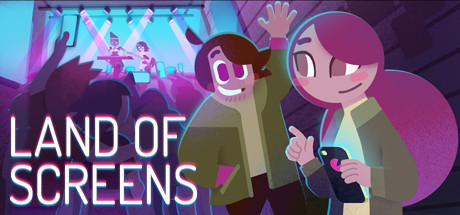
Land of Screens, developed by Serenity Forge and published by Way Down Deep, is a heartfelt point-and-click adventure that explores modern anxieties about social media, connection, and the noise of the digital age. The game centers on Holland, a young woman whose life has just taken a turn for the worse after a painful breakup. Her attempt to process this emotional upheaval is complicated by the omnipresence of social media, where every detail of her personal life becomes public fodder. Determined to escape the constant buzz of online chatter, she embarks on a quiet journey to disconnect from her screens and rediscover what it means to engage with the world directly. Though the game’s message is delivered with sincerity and care, its execution sometimes feels overly simplistic, leaning more on charm and presentation than on gameplay depth.
The narrative unfolds through a series of vignettes that trace Holland’s journey from digital exhaustion toward self-discovery. Each chapter takes place in a new environment—a friend’s apartment, a nature retreat, a family gathering—each one filled with people glued to their devices. Holland interacts with these characters in an effort to help them set aside their screens and reconnect with the moment, often by finding creative ways to spark real-world engagement. These moments are designed to mirror her own struggle: as she coaxes others to unplug, she also learns to confront her dependency on online validation and face the vulnerability of genuine human connection. The story is compact but personal, written in a way that encourages reflection about the role of technology in daily life. It feels familiar without being self-indulgent, capturing the exhaustion many people experience from living through screens.
Gameplay in Land of Screens is straightforward and unintrusive. As a point-and-click adventure, it prioritizes dialogue and exploration over complex mechanics. Players move Holland around static environments, talking to characters, picking up small objects, and triggering short puzzle-like interactions. These puzzles are rarely challenging and usually involve convincing others to step away from their phones or rediscover a forgotten pastime. While this simplicity makes the game approachable, it can also leave it feeling shallow. The interactions are often linear, and solutions are easy to identify, offering little in the way of experimentation or problem-solving. The developers clearly designed the game as a narrative experience rather than a mechanical challenge, and it succeeds on those terms, though players seeking a deeper or more interactive system may find it lacking.
What elevates the experience is the game’s visual and auditory presentation. Serenity Forge’s signature art style—a blend of bright, flat colors and expressive, minimalist animation—creates a world that feels both warm and detached, reflecting the duality of living in a digitally saturated society. Each environment is rendered with clean lines and deliberate composition, filled with background details that hint at personality and mood. The color palette shifts subtly from cool blues and grays in early scenes to warmer tones as Holland reconnects with herself and others. The soundtrack complements this journey with ambient, contemplative melodies that never overwhelm the dialogue or pacing. Small sound effects—like the buzzing of phones, clicking of keyboards, or gentle breeze in outdoor scenes—add texture to the otherwise quiet narrative. It’s a sensory experience that feels soothing and deliberate, even if the gameplay itself remains modest.
The story’s thematic focus on disconnection and rediscovery is clear and often touching, but it is not without its missteps. Some characters feel more like symbolic mouthpieces for the game’s message than fully realized individuals. The script occasionally veers into moralizing, with certain exchanges spelling out the game’s central thesis a little too explicitly. Holland’s journey, while relatable, lacks the emotional complexity that could have elevated the narrative from a parable into something more profound. The game’s brevity also limits its ability to explore these themes in depth; most players will complete it within two to three hours, leaving little time for meaningful character development beyond the protagonist. Despite these issues, the story’s sincerity is hard to dismiss. It captures something universal about the tension between technology and human intimacy, and even when the delivery is heavy-handed, the intent behind it remains genuine.
Land of Screens also succeeds in creating an emotional rhythm that mirrors the process of digital detox. The early chapters feel claustrophobic, full of people staring at their phones and speaking in short, distracted bursts. As the game progresses, the spaces open up—parks, forests, and homes fill the screen, and the chatter fades to ambient sound. This shift in tone feels earned, reflecting Holland’s growing awareness and peace. The pacing is gentle, allowing the player to sit with quiet moments and enjoy the contrast between isolation and connection. While there is no branching narrative or major decision-making, the story’s linearity works in its favor, maintaining a focused emotional arc that builds naturally to its conclusion.
As a whole, Land of Screens is more of an introspective experience than a traditional video game. It doesn’t rely on challenge, progression systems, or mechanical depth to engage the player. Instead, it asks for empathy and attention. It’s the kind of game meant to be played slowly, appreciated for its atmosphere and themes rather than its difficulty. Its short runtime suits this approach—it never overstays its welcome and ends with a note of quiet optimism that feels genuine rather than forced. The combination of sharp art direction, ambient sound design, and a relatable premise gives the game a charm that outweighs its flaws.
Land of Screens is ultimately a reflective story about modern disconnection—about how easy it is to lose oneself in the static of online life and how meaningful it can be to simply look up. It doesn’t break new ground mechanically or narratively, but it delivers its message with honesty and care. For players who enjoy thoughtful, character-driven stories that examine everyday struggles, it offers a brief but resonant experience. Its simplicity may leave some wanting more, yet its sincerity makes it memorable. Like its protagonist, the game invites players to take a moment away from their own screens and remember the human warmth that exists beyond them.
Rating: 8/10