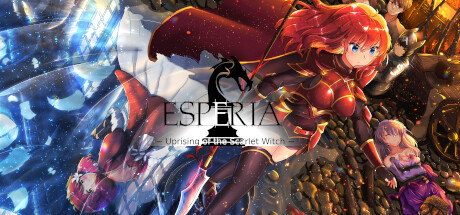
Dive into the world of Esperia, a fantasy tactical RPG with visual novel elements! Lead Diana and her allies into grid-based tactical battles to uncover the secrets of the Kingdom and the world.
Modeled estimate, not a reported figure. How we estimate →
About

Stats
All-time low is the lowest price we've recorded for this game since we started tracking it.
Languages: English
Engagement
Hours played at review time, across 40 reviews with recorded playtime.
Reviews
Themes across 40 recent reviews and how positive each mention is. A keyword signal, not full sentiment analysis.
positive critical· bar length = how often the theme comes up
Reviews
Esperia ~ Uprising of the Scarlet Witch ~ from Prismalice is a tactical RPG that aims high, blending grid-based strategy with visual novel storytelling and a character-focused narrative. It’s a game that clearly draws inspiration from established genre giants, but it also tries to distinguish itself through its emphasis on player choice, heavier narrative framing, and a more demanding approach to combat. The result is an experience that feels both familiar and experimental, delivering strong moments alongside noticeable inconsistencies. The story follows Princess Diana Pendragon, whose life is overturned when she is accused of being a witch and cast out of her homeland. What begins as a tale of exile quickly expands into a broader conflict involving political betrayal, hidden agendas, and supernatural forces. The narrative leans heavily into classic fantasy themes—royal lineage, forbidden power, and redemption—but it also attempts to explore more personal elements, particularly Diana’s evolving identity and her relationships with those who choose to stand by her. While the premise is compelling and the cast is varied, the writing can be uneven, occasionally breaking immersion with awkward dialogue or inconsistent pacing. Even so, the emotional core of the story manages to come through, especially as the stakes grow more defined. Combat is the strongest aspect of the game, built around traditional turn-based, grid-based encounters that emphasize positioning, planning, and unit synergy. Players must carefully consider movement, attack range, terrain advantages, and character abilities, creating battles that reward thoughtful decision-making. The system incorporates familiar mechanics such as class progression and weapon interactions, but adds its own twists through customizable stat growth and expanded skill options. These additions allow for a degree of flexibility in how characters develop, encouraging experimentation rather than locking players into rigid roles. The difficulty level is notably high, with many encounters requiring careful planning and, at times, multiple attempts to overcome. One of the more distinctive elements of Esperia is how it integrates its narrative with gameplay. Rather than separating story and combat entirely, the game presents much of its narrative through visual novel-style segments, complete with dialogue choices that can influence character relationships and unlock additional scenes. This structure adds depth and replay value, but it also affects pacing. Long stretches of dialogue can slow the momentum, particularly when the writing does not consistently maintain engagement. For players who enjoy story-heavy experiences, this approach adds richness, but for those focused on strategy, it may feel uneven. The game offers a substantial amount of content, with a lengthy campaign that includes optional missions and character-specific storylines. This extended runtime allows for deeper exploration of both mechanics and narrative, but it also makes the game’s flaws more apparent over time. Repetition in map design and combat scenarios can set in, and the lack of consistent narrative quality becomes more noticeable during longer play sessions. Still, the overall scope is impressive for an indie project, and there is a clear effort to provide a full, layered experience. Visually, Esperia presents a contrast between its elements. Character artwork and illustrated scenes are detailed and expressive, helping to bring the cast to life and support the story’s emotional beats. In contrast, the in-game battle visuals are more functional, with simpler sprites and environments that prioritize clarity over style. While this does not hinder gameplay, it creates a noticeable gap between the presentation of narrative and combat. The soundtrack, however, stands out positively, with music that enhances both the intensity of battles and the atmosphere of story moments. Another aspect that shapes the experience is how closely it aligns with its influences. Many of its systems and design choices will feel familiar to fans of tactical RPGs, which makes it accessible but also somewhat predictable. It builds on established ideas rather than redefining them, and while it introduces its own variations, it does not fully step out of the shadow of the games that inspired it. Despite its imperfections, Esperia ~ Uprising of the Scarlet Witch ~ succeeds in delivering a compelling tactical experience. Its combat system is engaging and challenging, its narrative ambitions are clear, and its blend of strategy and storytelling offers something slightly different within the genre. While issues with writing and pacing prevent it from reaching its full potential, the core gameplay remains strong enough to carry the experience. In the end, it is a game defined by ambition and effort. It may not refine every aspect of its design, but it provides a deep and rewarding journey for players willing to engage with both its strengths and its rough edges. For fans of tactical RPGs who appreciate a challenge and a story-driven approach, it offers a satisfying, if occasionally uneven, experience. Rating: 8/10
Update: I played a bit more, and this game is more mature that I thought when bought it. So far it's tasteful and doesn't beat you over the head with it, but if a parent is reading this, think more towards Game of Thrones than Lord of the Rings. I wouldn't want to explain to a middle schooler some of whats going on between the lines. This is just indie Fire Emblem. The mechanics are exactly the same. From reading the store page I thought it was an RPG closer to Dragon Quest or Pokemon, but I'm not complaining. There are hints of this being made by one, or very few people. Little things like character portraits not overlapping correctly or being cut off at the edges, and the music transitions never cross-fade. There's also all the UI lack-of-clarity problems that come with the Fire Emblem games, namely never being quite sure if you're about to pass a unit's turn when doing anything besides attacking. The story is very medieval and fantasy. It's somewhat basic and I think I see the plot twist coming while I'm on chapter 2. That's not necessarily bad either. The character interactions also follow the Fire Emblem formula.
A quite interesting game <3 Esperia results of the fusion of two different types of Vgames : Visual Novel (VN) et Tactical RPG. Both separated gameplay aren't particulary new nor even mentionnable. On the one hand, the TRPG part looks like any Fire Emblem game (same classes, weapons, XP...) and doesn't break three legs of a duck (I have no idea how this french expression can be translated in english >.<) On the other hands, the VN part is well written, with a deep background - that probably prepares a second opus of Esperia - but also with a big lack of illustrations and especially back ground images, even in important moments. For example, I can't wait to see the "bad ending" BGI. Hope it will be updated soon ;) Yet, the game is brillant when the VN gameplay and the TRPG gameplay reacts to one another. In my humble opinion, the 3 best moments of the game are the 3 annexes that requires a C-relation between some characters to be played. In those missions, you explore the BG of Esperia, get massive character developpement and unlock some pretty relics and/or bonus classes. I definitly want more of them !! In the end, playing Esperia was quite a nice experience. I look forward to playing the final version of the game and obviously the next opus of the Esperia saga (incoming in 20XX I assume :D)
I absolutely loved this game. if you liked the GBA Fire Emblem games, you will like the gameplay and the game will feel immediately intuitive. Fire Emblem is my favorite series and this is clearly heavily inspired by that. Not just in obvious ways, like a weapon triangle or durability, but in other ways, like extra recruitable characters where the recruitment method is hinted at in the pre-map dialogue, or the map itself. Or supports between characters, which is very reminiscent of GBA Fire Emblem. However this game is not a Fire Emblem game - it is not a AAA game, it is not polished, and it is a little janky. It feels like what would happen if kaga got really into anime and also had to translate the game to English himself. It has bugs (although nothing game breaking or really bothersome - there were some odd bugs that felt like the result of a memory leak and resolved upon reset). Some non playable characters don't have portraits. The music varies in quality from fantastic to completely forgettable. It has a lot of grammar mistakes. Sometimes the dialogue between chapters takes 45 minutes to read if you read every word (they are not kidding when they say it is a visual novel). If you're frustrated by a lack of polish in games I would stay away from this game. Otherwise, if any of the package interests you, I highly recommend it. Try out the demo if you're on the fence. I put in 28 hours on my first play through and will undoubtedly play a second time and likely more, so the value of it for me at full price was more than fair. Lastly, the developer is very active in the discussion pages in the community hub, answering questions and responding to/fixing bug reports, so although I didn't experience anything serious or gamebreaking, I feel they would address it in a timely manner if you did.
Liked: - Solid tactical gameplay - Decent amount of new scenarios and challenges - Variety of units and builds for playstyle customization - Multiple difficulty options for players of different skill levels - Interesting story with lots of well-motivated characters and interesting plot twists Disliked: - Not a ton of interesting mechanics to distinguish itself from its inspirations - Writing and dialog can drag, especially because graphics are limited - The occasional mentions of mature topics are handled inelegantly (although not poorly)
How do we get more healers? Im confused. When promoting Elphin and Nina it shows the staff skill icon. I assumed that meant they would gain the ability to use staffs after promoting. But, they cant. Is that a bug?
This game is alright. The gameplay is very similar to a Fire Emblem (FE) game. For the rest of the review, I will use different FE games to compare this game to. The closest comparison I can give is that it feels like an FE8 ROM hack. This is because FE8 has a lot of ROM hack support, and most modern ROM hacks use more modern features that also appear in this game, like skills and selectable enemy ranges, but still retain some older features. At the start of my playthrough, I did question why this game wasn’t just an FE8 ROM hack. (I assume it has to do with current ROM hack limitations. For example, I know that you can't use the skill system and change the amount of EXP that staves give.) The game also uses an EX chapter system similar to FE6, in which after some chapters, when you meet a specific condition, you can play an optional chapter. The game has around 20 main story chapters and around 10 optional missions/chapters (some are very short). The gameplay is most comparable to FE7 in my opinion. This is because the growth rates of the characters are middling and the map design quality varies just as much. The late game of both games also leaves something to be desired. I want to give a specific shout-out to Chapter 4 in this game for being very much like Chapter 7 in FE6. This map on higher difficulties is brutal and a good indication of whether you want to play on hard mode in this game. The story is fine. It had a lot of potential, but I think it was a bit too ambitious in scale. This is mostly because there are too many antagonistic factions in the game: the cult, the kingdom, and a neighboring country. There are also some “neutral” parties that get some story relevance. Not all of these factions are as important as others, but I do wish more was done with them, as it feels like there are some unresolved plot points (maybe relevant for a possible sequel?). I also wish the game had a continent map, as this would help give an idea of the scale of the kingdom and the world. The characters are fine. Some I like more than others, mostly because of their support conversations. Some are just more interesting, funny, or better written than others. The story and supports do sometimes suffer from being a bit too “anime” for my liking. I maybe come off as a bit negative in this review, but it has enough things that I like about it. I love the support-specific missions. These are missions you can do when some characters have at least a C support with each other, and they give interesting rewards (like a unique class promotion for one of the characters). I also like that characters give each other bonus stats and a skill at B support. The support bonuses are also very strong (like +2 damage and +15 crit), and you can have 5 C, 3 B, and 1 A support, which is more than in older FE games. Another system I like is the “customize” feature. Every level, a character gets 2 points that they can spend to increase their stats in addition to their normal level-up stat increases. The cost to increase a stat depends on the character and the specific stat. This means one character can buy a +1 in STR for 7 points, while another can buy the same increase for 5 points (similar to the Utawarerumono games). The support system and the “customize” feature make it so you can still gain upgrades to your characters even if you get some bad level-ups. The game also has an inbuilt randomizer. It also features different magic support options (like a spell that gives a unit +4 speed for 2 turns) that can be used by anima/dawn mages instead of staff users. Other mages also have their unique support spells to help your units or debuff enemies. I also like that they gave bow units 2–3 range. This makes them very good poke characters and justifies their “can’t attack at 1 range” weakness. I do think that if you are even slightly interested in this game, you should just play the demo. This will give you the best indication of whether this game is for you or not. TL;DR: This game is an alright Fire Emblem-like. It has some interesting mechanics, but a story I found rather lacking. It’s worth checking out the demo to see if you’re interested.
make a sequel i love these games very well done
I would love to recommend this game, however it keeps crashing every level forcing me to restart. The dialogue and characters are well done but in its current state its near unplayable without save scumming
剧情非常有创意的火焰纹章LINK,捏他了亚瑟王传奇却不按常理出牌,几处反转和不完全非黑即白的故事都设计的非常不错,尤其是艾丽西亚的剧情,真的看到我有点破防眼眶发热,亚瑟因为这个黑化真的完全合理,至于后面的我只能说呵男人你真像你爹不愧是亲生的,最后也留了大坑,圣国一看就不是啥正义使者,魔女教团和恶魔也没有完全说明白,海伦甚至支援都没写,个人希望还能有续作吧,另外支持百合,女女支援到A都是货真价实的恋爱结局 说完了优点,下面是一些个人觉得不太好的或者说提意见的,比如高级职业登场的角色数值偏低,还有部分很晚登场的角色几乎没时间刷支援导致很多剧情太难看到,另外就是暗黑系的远程特殊魔法过于凶恶各种超强异常状态,最关键对应的杖却没有可以解除异常的手段。。。。。。
Related
Related
Trends
Concurrent players on Steam, sampled daily since tracking started.
Audience
Estimated from the language of this game's reviews — a proxy for where players are, not official Steam demographics.
Related
| Legends of Savvarah: Time of Pariah | $20.3K | 147 | 97% | $5.99 |
| Sons of Ra | $20.3K | 62 | 79% | $14.99 |
| Self-Delusion | $20.3K | 98 | 94% | $9.99 |
| Infinite Tanks | $20.3K | 201 | 64% | $4.99 |
| The Maker's Eden | $20.3K | 119 | 69% | $8.99 |
| SEX Hospital 💦 | $20.3K | 199 | 72% | $3.49 |
Related
| 7 Days to Die | $425.3M | 403.6K | 87% | $44.99 |
| Mount & Blade II: Bannerlord | $309.8M | 294K | 88% | $49.99 |
| Don't Starve Together | $164.7M | 539.5K | 95% | $14.99 |
| Mount & Blade: Warband | $101.9M | 171.6K | 98% | $19.99 |
| Darkest Dungeon® | $83.5M | 160.7K | 92% | $24.99 |
| Slay the Spire | $80.1M | 216.5K | 97% | $24.99 |