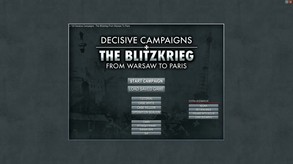
Decisive Campaigns: The Blitzkrieg from Warsaw to Paris is the first in an innovative series of operational World War II wargames that also include a strategic element. The Blitzkrieg from Warsaw to Paris simulates Germany’s military successes in Poland and France in 1939 and 1940 .
Modeled estimate, not a reported figure. How we estimate →
Discounts
Every price cut of more than 20% we have observed, in each market that quoted one, with this game's chart position on either side of it. These are episodes, not a model: a sale is one event, and one event cannot tell you what the next one will do.
For scale, across Steam · Top Sellers · Brazil over the last 30 days: the 26 chart moves that followed a price cut of more than 20% went a median of 7 places towards #1, and the 2,400 moves with no price cut behind them went 2 away. One store, one chart, one country — it is the only place we have enough observations to say even that.
Prices outside the United States have been collected since 6 August 2026 and chart positions since 19 July 2026, so a cut older than that has no market to compare and a market that joined later has no history yet. Nothing here is converted between currencies.
About
Genres
Stats
All-time low is the lowest price we've recorded for this game since we started tracking it.
Languages: English
Engagement
Reviews
Themes across 43 recent reviews and how positive each mention is. A keyword signal, not full sentiment analysis.
Reviews
Decisive Campaigns: The Blitzkrieg from Warsaw to Paris is an operational-level World War II wargame developed by VR Designs and published by Matrix Games that focuses on the explosive opening phase of the conflict, where speed, coordination, and planning defined the outcome of entire nations. Rather than centering on individual battles or tactical skirmishes, the game places the player in charge of large formations and long-term objectives, asking them to think like a high command officer overseeing entire campaigns. Its scope spans from the invasion of Poland through the fall of France, capturing the momentum, risks, and fragility behind the concept of Blitzkrieg warfare. The game’s structure revolves around large hex-based maps that represent vast regions of Europe, with units operating at the regiment, division, and corps level. Every turn requires the player to balance aggressive advances with logistical realities, as supply lines, readiness, and unit cohesion directly affect combat effectiveness. Pushing too hard without securing supply can stall an offensive just as quickly as enemy resistance, while cautious play may allow opponents time to regroup and fortify. This constant tension between speed and sustainability gives the game a strong sense of realism and forces players to think several turns ahead rather than reacting impulsively. Combat itself is detailed without becoming overly granular. Units are modeled with historically grounded strengths and weaknesses, and success depends heavily on combined arms tactics. Infantry, armor, artillery, and support units must work together to break through defenses or hold critical positions. Terrain plays a major role, with rivers, forests, cities, and road networks shaping movement and engagement outcomes. The result is a system where positioning and preparation matter as much as raw numbers, and where a well-planned encirclement can achieve decisive results without excessive losses. One of the defining elements of Decisive Campaigns: The Blitzkrieg from Warsaw to Paris is how it integrates strategic decision-making outside of direct combat. Between turns, players face choices that influence production, logistics, command priorities, and political considerations. These decisions add a layer of narrative and consequence to the campaign, making it feel less like a sequence of disconnected battles and more like a living historical operation. Optional “what-if” paths further enhance replayability, allowing campaigns to diverge from historical outcomes and explore alternative possibilities such as extended offensives or altered strategic goals. The artificial intelligence offers a solid challenge, particularly for players new to operational-level wargames. It is capable of exploiting overextensions, defending key terrain, and applying pressure where weaknesses appear. While experienced players may eventually learn to anticipate its behavior, the AI remains competent enough to keep campaigns engaging and unpredictable. Multiplayer options, including play-by-email, add significant longevity by allowing human opponents to test each other’s strategic foresight and adaptability over extended campaigns. Visually, the game adopts a clean, utilitarian presentation that emphasizes clarity over spectacle. The interface presents a large amount of information—unit status, supply levels, combat predictions, and strategic overlays—without excessive clutter, though the learning curve can still feel steep for newcomers. The art style is functional rather than immersive, but this restraint ensures that the player’s focus remains on planning and execution rather than visual flair. Once familiar with the interface, managing large-scale operations becomes intuitive and satisfying. What ultimately sets the game apart is its ability to convey the operational reality of early World War II warfare. Victories feel earned through careful coordination and planning, while failures often stem from overconfidence or neglected logistics rather than bad luck. The game rewards patience, foresight, and a willingness to adapt plans as circumstances change, making each campaign feel like a complex strategic puzzle rather than a scripted historical reenactment. Decisive Campaigns: The Blitzkrieg from Warsaw to Paris is not a game designed for quick sessions or casual strategy fans, but for players who enjoy deep, thoughtful systems and historically grounded decision-making. It excels at portraying the strengths and vulnerabilities of Blitzkrieg doctrine and offers a compelling sandbox for exploring how early-war campaigns might unfold under different leadership choices. For enthusiasts of operational wargames and World War II history, it stands as a rich, demanding, and highly rewarding strategic experience. Rating: 8/10
Media

Related
Related
Price dynamics, follower growth, revenue and sales trajectories with interactive tooltips
This and every other Pro feature is free until October 20, 2026. A free account is all it takes.
Hours played at review time, across 43 reviews with recorded playtime.
positive critical· bar length = how often the theme comes up
A really good wargame where you can invest hours and hours of your time to finally win. Tactically really deep and when you begin a scenario you will get addicted to this game.
I'm a big fan of the whole Decisive series and this is yet another example of how they use the same overarching system with tweaks to make you, the player, deal with historical issues without completely cramping creativity and freedom. Excellent.
I love this game, even though it's the oldest DC game. I really, really wish Vic would bring PBEM++ and mouse capture to this, it's a travesty that it doesn't have it. Other than that, 100% recommend this
:
No
Не рекомендую. Игра кривая-кривая. Вылетает через каждые 10 минут. Пройти ничего не возможно. Жалею денег.
I've picked this one in a sale or something years ago and finally gave it some time. It's great and I am having a blast. Great wargame, in the mid-tier of complexity. No Gary Grigsby but no panzer corp/Hex of Steel either. It's pretty straightforward but deeper than it looks and requires some thinking. It's dated (16 years and counting), clunky because of that age and sometime frustrating but it also has its charms. I like the visual and the unit cards. In term of balance, it's pretty balanced and Case Yellow is no push-over for the German that have to think and dare, like they did. Same for the allies that are on the verge of being ruptured and overrun and need to think in term of mobile reserve, retreat in due time and force switching. Great operationnal scale with not too few units nor too many. Very historical even if some compromises/choices were made. The computer opponent seems competent enough too. Last but not least : it's focused on the early war (Poland & Western front) which is quite rare on the WW2 scene when these campaigns are pushovers when included in games, because "barborassa and D-Day". So if early war, particulary western front, is your thing, grab this.
a generally well done adaptation of a board game to a PC.
I'm into WW2 especially the period 1939-1940. This game is well designed, unit wise. A lot of research went into the game. I did a google of the territory and the maps are every accurate. I've done war games from individual units (spmbt), Avlon Hill board games (Squad Leader, Panzer Leader, France 1940, etc.) and Blitzkrieg is the best for this time period.
Selling now
See how fast this game is selling right now — estimated copies and revenue per day from recent review growth.
Players by region
Where this game's players are, estimated from review languages.
Related
| Game | Estimated lifetime revenue | Reviews | Review score | Price |
|---|---|---|---|---|
| $1.1M | 3.5K | 85% | $15.99 | |
| $1.8M | 586 | 90% | $79.99 | |
| $126.2K | 135 | 92% | $39.99 | |
| $532.1K | 2.7K | 92% | $7.49 | |
| $2M | 1.4K | 82% | $39.99 | |
| $1.8M | 2.2K | 80% | $29.99 |
Related
| Game | Estimated lifetime revenue | Reviews | Review score | Price |
|---|---|---|---|---|
| $192.4K | 401 | 95% | $14.99 | |
| $192.5K | 233 | 98% | $24.99 | |
| $192.2K | 503 | 60% | $13.99 | |
| $192.6K | 391 | 76% | $19.99 | |
| $192.1K | 331 | 58% | $29.99 | |
| $192.6K | 421 | 71% | $15.99 |