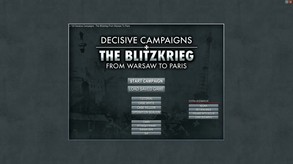
Decisive Campaigns: The Blitzkrieg from Warsaw to Paris is the first in an innovative series of operational World War II wargames that also include a strategic element. The Blitzkrieg from Warsaw to Paris simulates Germany’s military successes in Poland and France in 1939 and 1940 .
Modeled estimate, not a reported figure. How we estimate →
Media
About
Genres
Stats
All-time low is the lowest price we've recorded for this game since we started tracking it.
Languages: English
Engagement
Hours played at review time, across 40 reviews with recorded playtime.
Reviews
Themes across 40 recent reviews and how positive each mention is. A keyword signal, not full sentiment analysis.
positive critical· bar length = how often the theme comes up
Reviews
Blitzkrieg ? - no meaningful air power,bombers do little damage even on large stacks of units in one hex... also there are very few planes available, or sorties, for a two day turn - no effective attack waves, you attack one stack once and the next attack get ridiculous penalties, remember it's a two days turn. Justification: the attacker is bogged down on the battlefield debris of the first attack and the second wave must wait the withdraw of the first one?! Sorry, but how stupid is this in a two days turn? - no overpower, after breaking the enemy lines, tanks, and other units can only take the hex that they just attacked or little else, no bonus actions for the breakthrough... - AI does nothing, literally, rarely counter attacking even when it has major opportunities... - AI just destroys bridges and waits the end of the game, retreating constantly, never surrenders, except when completely surrounded In short, there's no BK at all in this game, one just moves a lot of counters, easily obliterates the ridiculous AI BUT (and that's the problem) one gains a defeat in the end, cause the game's gives you no time to reach objectives that are too far away to be reached in the number of turns given to you, with the lack of the tools that BK used, mainly strong air support and rapid exploration of breakthroughs. So unless you like to rinse and repeat until you find just the right moves to do to get things done on time, avoid this joke of blitzkrieg, it really should be called Sitzkrieg Indecisive Campaign.
Perfect balance between fun and realism. Abstracts the finnicky stuff, keeps the important parts richly detailed, and lets you relive history, employing similiar strategies that the germans and allies historically used. Shows you how much of a gamble Case White and Case Yellow really were as opposed to the cakewalks they were remembered as (and lets you do sealion. Very unrealistic, but a fun bonus).
Very old school game. The Battle System take some getting used to. For Simplicity sake, Its all about getting as close to Stacking Limit as possible, and have as many angles of attack as possible, while maintaining a ratio of combat that's favorable. Still playing, but loving the zen time.
Good operational wargame !
Thank you Vic for making such a badass game.
fun and detailed
:
Decisive Campaigns: The Blitzkrieg from Warsaw to Paris is an operational-level World War II wargame developed by VR Designs and published by Matrix Games that focuses on the explosive opening phase of the conflict, where speed, coordination, and planning defined the outcome of entire nations. Rather than centering on individual battles or tactical skirmishes, the game places the player in charge of large formations and long-term objectives, asking them to think like a high command officer overseeing entire campaigns. Its scope spans from the invasion of Poland through the fall of France, capturing the momentum, risks, and fragility behind the concept of Blitzkrieg warfare. The game’s structure revolves around large hex-based maps that represent vast regions of Europe, with units operating at the regiment, division, and corps level. Every turn requires the player to balance aggressive advances with logistical realities, as supply lines, readiness, and unit cohesion directly affect combat effectiveness. Pushing too hard without securing supply can stall an offensive just as quickly as enemy resistance, while cautious play may allow opponents time to regroup and fortify. This constant tension between speed and sustainability gives the game a strong sense of realism and forces players to think several turns ahead rather than reacting impulsively. Combat itself is detailed without becoming overly granular. Units are modeled with historically grounded strengths and weaknesses, and success depends heavily on combined arms tactics. Infantry, armor, artillery, and support units must work together to break through defenses or hold critical positions. Terrain plays a major role, with rivers, forests, cities, and road networks shaping movement and engagement outcomes. The result is a system where positioning and preparation matter as much as raw numbers, and where a well-planned encirclement can achieve decisive results without excessive losses. One of the defining elements of Decisive Campaigns: The Blitzkrieg from Warsaw to Paris is how it integrates strategic decision-making outside of direct combat. Between turns, players face choices that influence production, logistics, command priorities, and political considerations. These decisions add a layer of narrative and consequence to the campaign, making it feel less like a sequence of disconnected battles and more like a living historical operation. Optional “what-if” paths further enhance replayability, allowing campaigns to diverge from historical outcomes and explore alternative possibilities such as extended offensives or altered strategic goals. The artificial intelligence offers a solid challenge, particularly for players new to operational-level wargames. It is capable of exploiting overextensions, defending key terrain, and applying pressure where weaknesses appear. While experienced players may eventually learn to anticipate its behavior, the AI remains competent enough to keep campaigns engaging and unpredictable. Multiplayer options, including play-by-email, add significant longevity by allowing human opponents to test each other’s strategic foresight and adaptability over extended campaigns. Visually, the game adopts a clean, utilitarian presentation that emphasizes clarity over spectacle. The interface presents a large amount of information—unit status, supply levels, combat predictions, and strategic overlays—without excessive clutter, though the learning curve can still feel steep for newcomers. The art style is functional rather than immersive, but this restraint ensures that the player’s focus remains on planning and execution rather than visual flair. Once familiar with the interface, managing large-scale operations becomes intuitive and satisfying. What ultimately sets the game apart is its ability to convey the operational reality of early World War II warfare. Victories feel earned through careful coordination and planning, while failures often stem from overconfidence or neglected logistics rather than bad luck. The game rewards patience, foresight, and a willingness to adapt plans as circumstances change, making each campaign feel like a complex strategic puzzle rather than a scripted historical reenactment. Decisive Campaigns: The Blitzkrieg from Warsaw to Paris is not a game designed for quick sessions or casual strategy fans, but for players who enjoy deep, thoughtful systems and historically grounded decision-making. It excels at portraying the strengths and vulnerabilities of Blitzkrieg doctrine and offers a compelling sandbox for exploring how early-war campaigns might unfold under different leadership choices. For enthusiasts of operational wargames and World War II history, it stands as a rich, demanding, and highly rewarding strategic experience. Rating: 8/10
I'm a big fan of the whole Decisive series and this is yet another example of how they use the same overarching system with tweaks to make you, the player, deal with historical issues without completely cramping creativity and freedom. Excellent.
hitler fue bueno
Related
Related
Trends
Modeled estimate over time, reconstructed from Steam's monthly review histogram.
Momentum
Pace estimated from the game's recent review growth (our daily snapshots) at its own sales-per-review ratio — a momentum signal, not booked sales.
Audience
Estimated from the language of this game's reviews — a proxy for where players are, not official Steam demographics.
Related
| Sid Meier’s Civilization® VI | $580.3M | 376.5K | 86% | $59.99 |
| Hearts of Iron IV | $478.1M | 372.5K | 90% | $49.99 |
| 7 Days to Die | $425.3M | 403.5K | 87% | $44.99 |
| Mount & Blade II: Bannerlord | $309.8M | 293.9K | 88% | $49.99 |
| Stellaris | $277.8M | 196.1K | 86% | $49.99 |
| Arma 3 | $237.7M | 294.2K | 90% | $29.99 |
Related
| Doorways: Prelude | $45.1K | 635 | 62% | $2.99 |
| The Last Express Gold Edition | $45.1K | 326 | 80% | $6.99 |
| Our Red String | $45.1K | 117 | 97% | $19.99 |
| Insanity's Blade | $45.1K | 298 | 73% | $5.99 |
| CodeSpells | $45.1K | 265 | 39% | $4.99 |
| Ash & Adam's Existential Treads | $45.1K | 368 | 92% | $4.54 |