If your're into logic, problem-solving and building complex systems, then this is a game for you. All the fun of creating systems, using a visual node language, without worring about written syntax of text based programming. Learn real programming skills much faster in a explosions packed battle.
Modeled estimate, not a reported figure. How we estimate →
Media
About

Genres
Stats
All-time low is the lowest price we've recorded for this game since we started tracking it.
Languages: English, Portuguese - Brazil
Engagement
Hours played at review time, across 31 reviews with recorded playtime.
Reviews
[h1]Їдемо мочити танчики! [/h1] Що я можу сказати. мені зайшла ця гра, і хоч по скрінам вона виглядає дешево і середньо, геймплейно це достатньо незвичайний і цікавий продукт. Коли я побачив сторінку, я думав, що гра буде скоріше про екшин, але погравши можу сказати, що ця гра про достатньо цікаві головоломки, які дуже незвично оформлені. [h1] Сподобалось: [/h1] [list] [*] Концепція. Бо це дійсно щось унікальне. [*] Оптимізація. Гра працює достатньо добре на моєму ПК. [*] Геймплей, мені було цікаво грати у гру, програмувати танки і битися. Це цікаво і весело. Мене ігровий процес затягнув на декілько днів, що гарно говорить про гру і її вміння затягнути людину. [*] Різноманіття, тут на моє здивування його багато. [/list] [h1] Не сподобалось: [/h1] [list] [*] Графіка і візуал. Знаю, що ця гра не зовсім про це, але мене ці моменти засмутили, бо грати у гру прикольно, але візуально дивитися ні.. [*] Відсутність української текстової локалізації, сумно що немає її. Так, я знаю, що це малий проект і я бажаю розвидку і локалізації іншими мовами. [*] Музика і загалом звуки достатньо так собі, звучить гра трохи дивно, і я б сказав, що більшість звуків з стандартних бібліотек. [/list] [h1] Висновки: [/h1] Хочу подякувати пані teti за подарунок. Я б не знав про існування цієї гри і напевно не звернув би увагу, якби не ваш подарунок, і через це я пограв у цікаву гру. На мій погляд, ця гра буде цікава в першу чергу фанатам головоломок, і любителям незвичайних інді. Думаю вам зайде на декілька приємних вечорів. Фанатам екшн ігор не думаю що зайде, але по знижці це непогана покупка. Дякую за вашу увагу і приємної вам гри :З
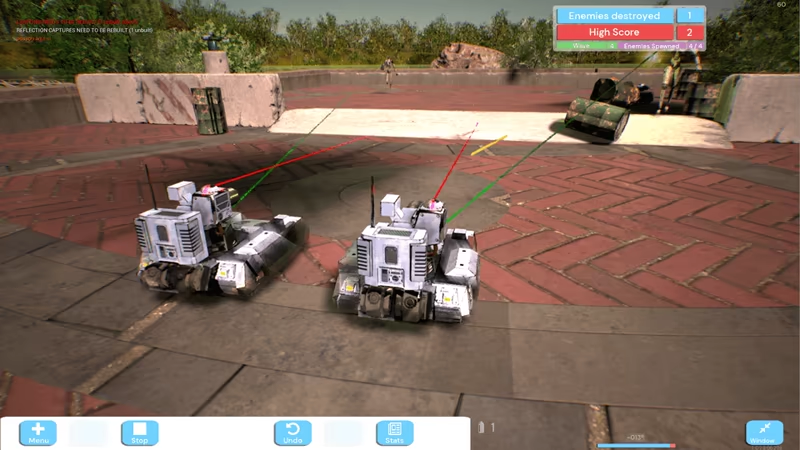
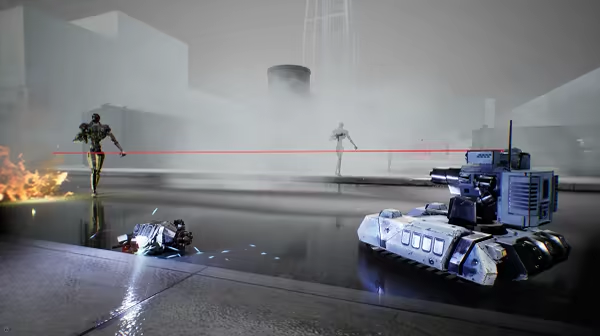
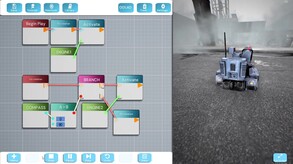
[h2]A Brief Summary[/h2]Code Rivals is a robotics programming game in which the player directs tanks to destroy enemy droids using a visual programming language, the procedures and operations not too far off from the flow diagrams of a high school robotics class. While the premise and presentation are great, the programming leaves much to be desired. Namely, the editor has a number of dysfunctional and un-intuitive controls while the scope of the solutions is heavily restricted by the limits of the tank’s sensors and the game itself. If you’re someone who dreams of ‘if’ statements and algorithms, you may enjoy parts of this game. [h2]The Basics[/h2][b][u]The Tank[/u][/b] The tank the player controls has a number of mechanisms that can be manipulated by the code. A tank has two engines to control its left and right treads. A single servo motor is used to rotate a turret carrying the laser sensor on top of the tank. The tank’s compass tracks its rotation relative to a fixed north. Offense and defence are accounted for by the gun and smokescreen respectively. Lastly, the impact sensor can detect if the tank is attacked. There are two models of tank, though only the Type-1 is used for the tutorial. The Type-1 wields a powerful single shot cannon fixed to its frame. The Type-2 has a fast firing long range cannon mounted on the turret with its sensor. Each has its own pros and cons. [b][u]Programming[/u][/b] Programs are collections of sequentially connected blocks on the grid. To move the tank, place a “game start” event and point its arrow to an “activate” action, with a component block to specify an engine. The blocks are organized into intuitive, color coded, groups. Actions are always blue, their targets dictated by green component blocks. Pink controls indicate when or if following blocks should be run. Red events can trigger sections of code in response to certain conditions, such when “play” is pressed. Custom events, variables, and functions can also be defined to get a little more leverage. Every block has a small and easily understood purpose. As with all programming, the challenge is in getting them to do something meaningful. https://steamcommunity.com/sharedfiles/filedetails/?id=3021432832 [b][u]When it does the thing~[/u][/b] Code Rivals excels in the feel of the tank. The engines and motors click and whir when their settings are changed, the tanks making immediate turns and smooth movements. The Type-1’s cannon violently destroys whatever is in front of it on demand, while the Type-2’s gun cleanly eliminates its targets from a safe distance. Success comes from a long chain of trials, errors, and improvements as a direct result of the player’s efforts. It feels [i]good[/i] when it does what it’s supposed to. [h2]Gamemodes[/h2] [b][u]Tutorials[/u][/b] The ten and a half tutorials make up the bulk of the game’s content, the first of which teaching the player the bare minimum to move the tank. Next is how to shoot, and then how to move the tank to a target. With the basic systems out of the way, the game starts requiring more tasks of the player, such as killing two enemies in succession, then three. Code can be tested quickly during the tutorials, allowing a player to work out how far the tank will need to move or turn before shooting. Later levels push the player to automate more of the process by suggesting basic methods of detecting and targeting mobile enemies. Broadly, the tutorial sufficiently explains what can be done with the tank's functions, though it takes a bit of a leap in the later levels. [b][u]Survival[/u][/b] Survival stands as the primary application for a player’s code in the game, generating fairly diverse arenas with enemies airlifted to random locations for each wave. The goal? Kill as many enemies as possible without losing your main tank. Clearing all enemy droids and tanks will advance to the next map and wave, restoring the player tank’s hp and leaving a moment to prepare for the next wave. Due to the random nature of each map (walls, hazards, and traps), players are also allowed to stop their tanks and reprogram them in the middle of waves, though their tanks are vulnerable to attack during this time. To make things a more interesting, each wave starting from the third will award the player an extra tank up to a maximum of three. It can be exhilarating during later waves, each new level requiring a new tune up on the fly to clear, getting that much closer to a high score. [h2]Problems[/h2]Every moment of triumph was met with at least two of frustration. The problems range from unintuitive controls to bugs, costing the player time and often interrupting or obscuring the development process. [b][u]Clunky Controls[/u][/b] One of the first things a player is likely to notice is that code blocks aren’t selected on click, they’re picked up and placed. Lacking the notion of a selected block, deleting a block is done by right clicking the target and selecting delete. Clicking and dragging on the grid will generate a text box centered on the mouse best thought of as a tray that can be slid under sections of code, allowing the user to move everything in the area by moving the box. Functions and copy operations place their code "somewhere" on the page, failing if that "somewhere" happens to intersect with existing code. Even when understood, the system is slow—especially with the large number of blocks needed to perform basic operations. The time lost to the editor is further compounded by the lack of a good way to quickly test and debug code. [b][u]Limitations[/u][/b] Limitations are half the fun of programming, shaping how problems must be approached. However, the limitations of Code Rivals are such that many problems cannot be meaningfully addressed at all. The tanks are practically blind and work best in flat, open areas—unable to detect walls, avoid traps, target enemies when on uneven ground, and identify that the piles of barrels aren’t enemies. Movement, largely, must be hard coded into the programs as a result. While the tanks still function in spite of these limitations, the only problem left to solve is target acquisition and what fixed location the tank should move to when doing so. Beyond the tank’s limited perception, doing anything fancy with more than one tank will bring the framerate to its knees, blinding tank sensors and turning the game into a slideshow. The challenge of survival isn’t about finding solutions smart enough to conquer ever greater challenges, but one that’s dumb enough to run while doing the bare minimum to keep losses down. The enemies face no such limitations. Their capacity to ignore decoys, engage targets at any elevation, and pathfind around walls, all regardless of lag, almost feels like cheating. [b][u]Bugs[/u][/b] After some time testing, scratching my head as to why my tank would always turn right when targeting an enemy, I discovered that boolean variables couldn’t be set dynamically as the action would suggest. Further, setting and then reading a variable using sequential actions is not a safe operation without a delay block. The save button doesn’t work in the tutorials, while survival mode has a tendency to forget what code the player had between waves. Chunks of code can turn into invisible blocks when reverting changes, resulting in lost code and clutter. The “start” button can be clicked when code is running, initializing a new instance of the code and demolishing the frame rate. And so on go the bugs. Some are sneaky, and some are obvious; most are trouble. [h2]Conclusion[/h2]Code Rivals poses interesting programming challenges, many of which cannot be addressed by the tools provided. The game is still being worked on, so it’s possible that some of the problems with the game will be rectified in the future. However, it’s not there yet.[quote]Follow our Curator page, [url=store.steampowered.com/curator/41449676/]Summit Reviews[/url], to see more reviews regularly.
Nowadays, with one big release coming after the other, and critically acclaimed titles regularly going on deep sales, the biggest issue becomes your incredibly limited available time. In order to make that time worth investing, games need to stand out in one way or another, whether it's the highly cinematic experience offered, the deeply emotional storytelling, or the well thought out gameplay mechanics. You need to leave feeling that you've gotten something out of them. But truth is, the overabundance of newly released games aiming to immerse you in in their worlds can only result in an increasing difficulty for them to offer something new on the table. Code Rivals took the bold leap and chose to offer a real word practical experience first and foremost instead. In this game, you'll be learning the basics of programming, by setting chains of commands for your robot in order to defeat enemies in various combat scenarios, with varied levels of difficulty. The programming used is similar to Lego Mindstorm's aprroach, if you have any familiarity with it. It's super fun watching a chain of commands you've been thinking through working out in the end, frustrating when it breaks for some reason, and even more rewarding when you find the issue and fix it. It's a game that makes learning fun by actively rewarding you during gameplay and serves as a neat introduction of the mindset you need to approach while programming by guiding you through it. Code Rivals is a very interesting case of a game. It doesn't have the flashier visuals, or the fame of AAA games, or some other indies, so it's not hard for it to go under your radar at first glance. But truth is, it doesn't need to, since it sets a league of it's own, one the developer aimed for from the start. If it's concept sounds interesting, or if you're looking for a truly fresh experience, or even to learn something new, i'd suggest trying it out.
Really fun flowchart programming puzzle game. Basically the highschool/college bot programming experiment but with the added fun of scrapping dangerous bots with a cannon. There are a lot of QoL stuff like custom blocks (basically loops/nested) and conditionals, so it's not just rudimentary commands and while I haven't played that much yet, it's easy to see that the developer put in a lot of thought into the flow of things since it's fairly smooth. As for the negatives, it's the usual early access complaints, repetitive music, some weird camera angles, UX polish, but I'm pretty sure those will eventually get ironed out eventually. Other stuff would be time/distance units during play since the time in delays can be dependent even down to milliseconds and a bit of camera exploration to allow for better workflow planning. Even in early access, it's easy to lose a couple hours figuring out some of the puzzles but at the same time, there's enough tools in the game to make an very smooth experience. As a Zachtronics fan, I highly recommend it, for two bucks, it's definitely a steal.
⠀
Научись программировать Боевых Роботов - для выполнения требуемых целей.[list][b]Понравилось:[/b][*]+ Наличие достижений[*]+ Обучение программированию[*]+ Реалистичная физика[/list][list][b]Не понравилось:[/b][*]- Завышенная цена[*]- Одна мелодия на повторе[/list][b]Вывод:[/b]Если Вы любитель Human Resource Machine - то эта игра именно для Вас.В данной игре нас познакомят с базовыми принципами программирования роботов, что позволят Вам выполнять разнообразнейшие миссии - в погоне за достижениями. Игра имеет высокий порог вхождения, так как от игроков требуется использовать голову, а не рефлексы.Данный проект нужен только детям, что обучаются в сфере программирования роботов, а также для людей, считающих себя "выше" серой массы окружающих их.Тем не менее, игра имеет завышенную цену, поэтому не рекомендуется приобретать ее менее чем за 90%
Only 4 variables!? , give me at least 10
I appreciate the dev for providing me a code to try it out. I love the tutorial explaining everything. You need to work harder on the levels after without the tips tho. Too bad i didnt get to try multiplayer but i enjoyed it so far :)
[h1]Before I played Code Rivals, I had a small pp, no friends, no gf, depression, and no life. These things havent changed, but the game is pretty good[/h1]
I found Code Rivals from the developer, Leandro, suggesting it to people who played Human Resource Machine, another programming game that I had played extensively to the point of speedrunning it, by offering keys. Considering that he stated in his post that HRM had inspired him and his game, I asked various questions about that subject matter as well his future plans of his game. I am aware that he would read this review, so I would be providing more feedback and questions with hopes that he reads it and thus responds in the perspective of taking to him. My biggest problem is how limited the scripting language could be, particularly in the connection between blocks (Nodes? Commands?) and their inputs and outputs; when you connect an output to an input, that output connector cannot be used for other things. To put this respective, if I want to write a branch that does two different things, like running another branch if true while unconditionally doing something else, I would have to create a duplicate of that branch in order to do something like that. Here’s an example of that problem in flowcharts that I made using diagrams.net, where there’s two problems that functions similarly. https://jumbosf.neocities.org/media/coderivials/coderivials1.png https://jumbosf.neocities.org/media/coderivials/coderivials1.svg Of course, I won’t mind that Leandro would keep this limitation in either of choice or limitations, as well I’m aware that everybody can address this example problem with functions (custom events) or organization (the first activation can be placed at the start and would hilariously eliminate the example problem completely), but this is just an example that I would like to show to demonstrate such a concept. After all, I would think this would help in reducing the amount of blocks and would be better helping people new to software programming and design. In addition, I keep noticing bugs with the blocks where I can’t place down the block or stop creating connections, which tends to fix itself once my mouse leaves the game’s environment, like pausing the game or switching windows. If you need a demonstration of these bugs, let me know and I would like to get around recording myself causing these bugs, but I cannot promise that I would be able to do that at all since they tend to happen at random. Then again, this could be fixed next week as Leandro had stated in his response to TBF. [quote=leandrro;3772364949839822699]lots of things i see in HRM that i dont see in other programming games make me change design, like use saves between levels etc,[/quote] Lastly in one of your answers, which I quoted above, I found this one quite vague, particularly in using “saves between levels.” In HRM and 7BH, you can save and load levels by copying their contents as text into your clipboard, which in turn you can paste into a text file to save it for later or to edit its contents and paste it back, but I could be reasonable and might think you never had use this feature before, or you had did and didn’t like how it was handled. Could you care to elaborate what you didn’t see in both games and how did you address it? That’s my review of the game so far, and I might check the game back and make corrections to my review as it improves, but I cannot make promises. Leandro, I wish you the best of the luck in making Code Rivals and I hope you can maintain a modest fanbase in the process!! If you wish to learn more about visual scripting languages, you can read this English Wikipedia article, and I recommend checking out Flowgorithm, a scripting tool that allows you to create code for multiple programming languages by using flowcharts, similar to your game. https://en.wikipedia.org/wiki/Visual_programming_language http://flowgorithm.org/
Related
Related
Trends
Concurrent players on Steam, sampled daily since tracking started.
Momentum
Pace estimated from the game's recent review growth (our daily snapshots) at its own sales-per-review ratio — a momentum signal, not booked sales.
Audience
Estimated from the language of this game's reviews — a proxy for where players are, not official Steam demographics.
Related
| Detective INNA DUKE | $5.8K | 50 | 100% | $5.99 |
| Hidden Cats in Rio de Janeiro | $5.8K | 90 | 97% | $3.99 |
| Wheelie Life | $5.8K | 69 | 58% | $2.99 |
| Colored Effects | $5.8K | 62 | 95% | $4.99 |
| The Mensional | $5.8K | 62 | 92% | $4.99 |
| Nayla's Fable: Lust & Rust | $5.8K | 54 | 93% | $5.99 |