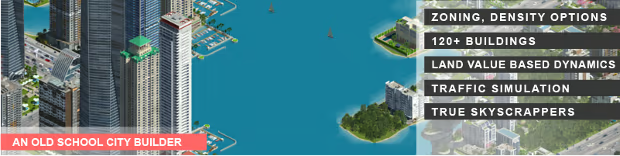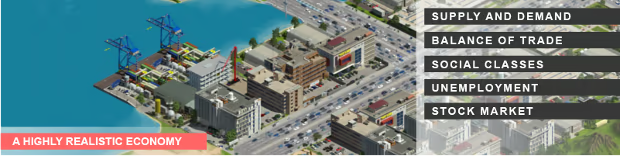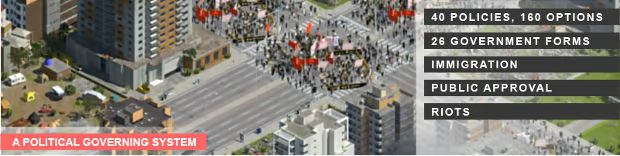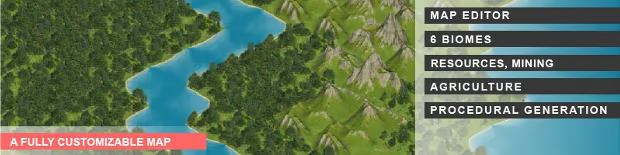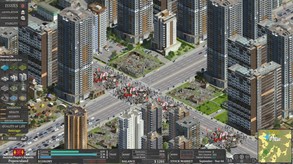
Create a 21st century micro-nation and experiment with economic and political ideals. Futuristic skyscrapers or spreading slums, the Nation relies on your economic and city planning skills.
Modeled estimate, not a reported figure. How we estimate →
Media

About


Genres
Stats
All-time low is the lowest price we've recorded for this game since we started tracking it.
Languages: English
Engagement
Hours played at review time, across 42 reviews with recorded playtime.
Reviews
Themes across 42 recent reviews and how positive each mention is. A keyword signal, not full sentiment analysis.
positive critical· bar length = how often the theme comes up
Reviews
I don't know. The game has a great concept of intertwining politics, economics and city building. When I was asked by advisers which school I prefer, Austrian or Keynesian, I was sure that I would love this game. However, after a few hours, I built all the buildings in the city and passed all the laws and... that's it. The game is essentially over. You can endlessly build arcologies and grow numbers, but nothing new happens. The whole idea of the region is to make several cities. The feature with space is the same city builder, only with slightly different rules. And that's it. It's disappointing. There is no sense of completion, no desire to continue. Every aspect of the game is not polished for the playable stage. 42 freedom index out of 100.
My communist state fails every time. 10/10
Citystate: Intergalactic Colonialism Does it count as colonialism if there's no one on the planet when I get there? I guess the corporate exploitation is a form of colonialism but they willingly chose to join the colony named after a Star Wars reference that I didn't get to choose. The spice must flow, but instead of fueling a jihad, it's fueling the IMF. While many city builders get more and more complex in their interpretations as time goes on, there's a certain point where you can feel a fuse in your brain pop. In-between organizing a bauxite mining operation or getting to the late stage of a HOI game where tactical nuclear strikes become mandatory. Aren't you interested in a city builder that takes it back to basics? Basics that are fun and enjoyable? Citystate almost has that. Until you leave the game running while you go warm up some coffee, accidentally miss 2-3 events on policy decisions and lead to a disaster spiral that leads to the young city state of Thug Huntopia to collapse into civil war. Your fault for not pausing, you idiot. Citystate is an interesting twist on your generic city builder, operating both simplistically in terms of your city layout and what you can build as well as a heavy interest in policy making. On one hand, the gameplay focuses mostly on the usage of simple roads and plots. It's very Simcity 2000 in approach in comparison to the Simcity 4 model of "COLOR THE SPOT NEAR A ROAD IN" or the Tropico planting of a building, with you mostly plopping zones in a 2-3 block radius of a road and watching it slowly build up from a trailer park into a solarpunk abomination building. Or in my case, a trailer park that I ignore, and come back to find has become a high rise. This is what I get for zoning out for five minutes fighting a war against my citystate's encroaching unemployment crisis. In place, you have the policy system that allows you to dictate what your town does or doesn't allow in local laws, alongside a court of "advisors" who exist to do two things. Elect the Austrians to tell you that you should ignore anything that doesn't help the free market and establish Rapture on dry land. Or use the Keynesians who exist to radically centrist your way into flip flopping between Socialist Welfare State and Liberal Welfare State because you passed an edict that banned the punching of cattle. It's a fun way to guide your policy, and the game does allow you to fix it later on, in case you felt like maybe cranking all of your options to max and establishing a Juche Paradise in the middle of your wider nation. You also get to play a balancing act of stability and public popularity, keeping you from Tropico maxxing. Even in this world, you need proper approval before raising the low income taxes to 40% gets you lynched like Gaddafi. Managing the city as a whole amounts to standard battles of land values, trade and immigration. The first is solved with a relentless campaign of strategically placed parks. The second is mostly through gambling on land surveys to find out if you're able to turn an idyllic mountain range into the Iron Range and go full Brazil on the rainforest for gold. And the third is solved by either being insanely paranoid and getting a military to use solely on protesters and immigrants. Or you accept the nonstop flood of terraforming barrios that will defy all rhyme or reason to build a slum on an island that you can't reach yet. Or turn every scenic beach and mountain range into a favela. It's astounding. At a certain point I just let it happen because it lets me deal with an annoying lake by just waiting for the Brazilians to do it for me. Basic? Absolutely, it's why I come back to play it every so often. And in comparison to the sequel, it was released in a finished state so you can actually completely enjoy this game. There's not a lot of elaborate larp to this game, from the libertarian paradise state to the socialsit dictatorship, you can make any kind of little state work if you're willing to put in the effort for it. Or in my case, rely on the space exploration minigame to help funnel intergalactic heavy metals into the IMF to offset the deficit of my mistakes. If it worked for the British Empire, it can work for the United States of Stankonia.
Citystate – "Build your dream nation, for better or for worse!" 🏙️💰 Welcome to Citystate, where you get to unleash your inner dictator—er, I mean, leader! This game lets you create a 21st-century micro-nation and explore all the economic and political ideologies you can dream up (or nightmares, depending on how things go). 🌍💡 Want a shiny metropolis with futuristic skyscrapers? Go for it! Prefer to embrace the charm of a crumbling slum? Who are we to judge? Your nation is a canvas, and you're the artist, even if your masterpiece looks like it was painted by a toddler with a crayon. 🎨✏️ The real fun comes from balancing your economy while juggling the demands of your citizens. Will they love you for providing top-notch services, or will they rise up because you forgot to fix the potholes? 🚧👥 The choices are endless, and the consequences are as satisfying as watching a poorly constructed bridge collapse! If you enjoy city-building games with a dash of political intrigue, Citystate is the perfect playground for your grand ideas—just remember, every great leader has to navigate a few bumpy roads! 🚦🌆 Created with <3
It's a fun city builder, but it is a little "over-simplistic" in some of its mechanics. But that is minor. The overall gameplay is engaging and has re-play-ability. It is interesting to play various types of cities just to see the variations.
Citystate, developed and published by Andy Sztark, is a city-building and political simulation game that stands out for its deep focus on governance, policy-making, and nation management. Released in 2018, the game offers players the opportunity to build and oversee a micro-nation, balancing urban development with complex political and economic systems. Unlike traditional city-builders that focus primarily on construction and resource management, Citystate emphasizes the consequences of decisions, allowing players to experiment with various forms of governance and observe their effects on society, the economy, and citizen satisfaction. At the heart of Citystate is a delicate balancing act between the needs of the population and available resources. Players manage essential services such as healthcare, education, infrastructure, and public safety while also navigating taxation, employment policies, and social welfare programs. The depth of the game’s policy system allows for significant customization and experimentation; for example, players can implement progressive or conservative economic measures, adjust public spending, and influence social dynamics. These decisions ripple through the nation, creating opportunities for strategic planning but also presenting challenges that can quickly become complex and demanding. Visually, the game employs a minimalist, top-down perspective that prioritizes clarity and functionality over flashy graphics. The interface is clean and well-organized, enabling players to monitor population metrics, city development, and policy outcomes efficiently. While the art style may not be highly detailed or visually striking, it effectively supports the game’s focus on strategy and management, ensuring that players remain engaged with the systems at play rather than being distracted by unnecessary visual elements. One of the game’s most distinctive features is its exploration of political ideology and governance models. Players are encouraged to experiment with different approaches, from free-market capitalism to socialized economies, observing how each choice affects their population and economy. This element adds depth and replayability, as no two playthroughs are likely to unfold in the same way. The game’s mechanics allow players to craft a nation that aligns with their personal vision or to challenge themselves by attempting unconventional strategies to maintain balance and growth. Despite its strengths, Citystate presents certain challenges. The game’s complexity can create a steep learning curve, particularly for newcomers to the city-building or simulation genre. Progression can sometimes feel slow, with tangible results of policies or infrastructure investments taking time to manifest, which may be frustrating for players seeking immediate feedback. However, for those willing to invest the time to understand its systems, the game rewards careful planning and strategic foresight, offering a nuanced and intellectually stimulating experience. In conclusion, Citystate delivers a unique and thoughtful take on city-building simulations by intertwining urban management with political strategy. Its focus on governance, policy experimentation, and the consequences of decision-making provides a depth rarely seen in the genre, appealing to players who enjoy complex simulations and strategic planning. While its pace and complexity may not suit everyone, for those seeking a challenging and engaging simulation that emphasizes the intricacies of nation-building, Citystate offers a rich and rewarding experience. Rating: 7/10
Way too shallow/simplistic looking. Lets see if 2 is any better
good
me when city builder
its, a game. havent really figured out the city building aspect of the game, def not on par with other titles. but, this game is more about having fun with policy, but, theres a whole like 50 citys you can make, and develop, make a 4 of them, let them trade, sometimes they prosper, sometimes they dont. i enjoy it cause i knew about the books and other similar games based on the book worth checking out? idk, but its fun if youve ever wanted more politics and policy in your city building adventures.
Related
Related
Trends
Modeled estimate over time, reconstructed from Steam's monthly review histogram.
Audience
Estimated from the language of this game's reviews — a proxy for where players are, not official Steam demographics.
Related
| Into the Stars | $385.4K | 541 | 40% | $19.99 |
| The Pioneers: Surviving Desolation | $385.8K | 440 | 67% | $29.99 |
| The Backrooms: Survival | $385.8K | 879 | 83% | $9.99 |
| Vox Machinae | $385.2K | 1.3K | 87% | $29.99 |
| Aotenjo: Infinite Hands | $385.2K | 1.1K | 88% | $9.99 |
| Sonicomi | $385.9K | 619 | 90% | $34.99 |
Related
| Factorio | $140.6M | 232.2K | 98% | $35.00 |
| House Flipper | $65.8M | 110.8K | 94% | $24.99 |
| Prison Architect | $63.1M | 73.6K | 89% | $29.99 |
| Dyson Sphere Program | $56M | 83K | 97% | $15.99 |
| The Scroll of Taiwu : Beyond The Dome | $51M | 56K | 66% | $29.99 |
| Tabletop Simulator | $42.2M | 73.8K | 96% | $19.99 |