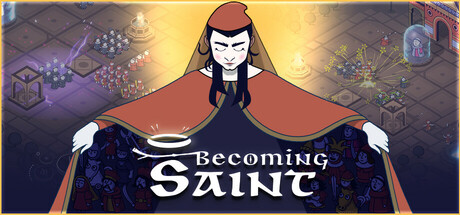
Becoming Saint, developed by Open Lab Games and published by Firesquid and 2P Games, is an unconventional strategy game that blends historical themes with roguelike structure and tactical gameplay. Set in medieval Italy, the game places players in the role of a charismatic preacher attempting to establish a new religious movement and ultimately achieve sainthood. Rather than focusing on traditional military conquest or empire management, the game explores the spread of belief and influence through persuasion, doctrine, and organization. This unusual premise immediately distinguishes it from most strategy games, offering a blend of historical satire, tactical encounters, and narrative decision-making that creates a surprisingly unique gameplay experience.
The structure of the game revolves around traveling across a fragmented medieval landscape composed of towns, cities, and territories that can be influenced or converted to the player’s ideology. Each playthrough begins with the formation of a new religious doctrine, which acts as the guiding philosophy for the movement the player will attempt to build. The doctrine defines how followers behave, what values they promote, and what strategies will be most effective when spreading the faith. Some doctrines encourage aggressive expansion and confrontation, while others favor diplomacy, charity, or subtle influence. Because these ideological choices shape the entire campaign, each playthrough develops its own identity, encouraging experimentation with different belief systems and approaches.
As the player travels through the world, they recruit followers who represent different roles within the movement. These followers form the core of the player’s influence during encounters with rival factions or opposing authorities. Instead of traditional warfare involving armies and large-scale battles, confrontations in Becoming Saint are represented through small tactical encounters where groups of followers face off against opposing forces. The game incorporates elements of real-time tactics and autobattler mechanics, meaning that positioning, unit composition, and timing all influence the outcome of these ideological clashes. Choosing the right combination of followers and abilities becomes essential when attempting to overcome stronger opposition or defend newly converted territories.
The roguelike structure adds another layer of depth to the experience. Campaigns unfold in runs where players attempt to expand their religious influence across Italy, but failure is always a possibility. Losing followers, failing critical encounters, or losing momentum in spreading belief can end a campaign prematurely. When this happens, the game encourages players to begin again with new ideas and strategies, experimenting with different doctrines and follower combinations. Over time, players learn how various systems interact and how different ideological paths affect the flow of the game. This repeated cycle of experimentation gives the game strong replay value despite its relatively focused scope.
Narrative events play an important role in shaping each run. As players move between cities and regions, they encounter story-driven situations that present moral choices or political dilemmas. These events often involve interactions with townspeople, rival preachers, local authorities, or influential figures who react to the growing presence of the new movement. The decisions made during these encounters can influence public perception, strengthen or weaken the player’s following, and alter the direction of the campaign. Because these narrative moments are dynamically generated rather than fixed, each playthrough develops its own sequence of events, turning the game into a constantly evolving story about influence, belief, and ambition.
The historical setting contributes significantly to the game’s atmosphere. Medieval Italy is portrayed as a patchwork of competing cities, religious factions, and political tensions. This environment creates fertile ground for a new religious movement to emerge, but it also means that resistance is inevitable. Established authorities may oppose the player’s influence, rival ideologies may challenge their doctrine, and communities may react unpredictably to attempts at conversion. The game balances historical inspiration with a touch of satire, often highlighting the strange and sometimes absurd nature of ideological struggles during the period.
Visually, Becoming Saint adopts a stylized art direction that combines historical elements with playful exaggeration. Characters are illustrated with distinctive designs that give personality to followers, rivals, and townspeople encountered throughout the journey. Environments depict medieval settlements and landscapes with a slightly cartoonish flair, emphasizing the game’s satirical tone. While the graphics are relatively modest compared to large strategy productions, the artistic style effectively supports the game’s themes and helps convey the strange mixture of devotion, ambition, and opportunism that defines the player’s quest for sainthood.
The audio design complements the setting with atmospheric music that evokes the medieval era while maintaining a subtle sense of tension. Soft instrumental tracks accompany exploration and narrative moments, while more energetic cues highlight tactical encounters or important decisions. Sound effects are minimal but functional, ensuring that combat actions and interactions remain clear without distracting from the strategic thinking required during gameplay.
One of the most interesting aspects of Becoming Saint is how it transforms the concept of ideological influence into a strategic challenge. Instead of managing traditional resources like gold or territory, the player manages belief, loyalty, and reputation. Convincing a town to embrace the movement requires careful planning and the right combination of followers and doctrine choices. These systems create a strategic layer that feels different from the usual conquest-based approach found in many strategy games.
However, the game’s experimental design also leads to some limitations. The tactical encounters, while engaging, can sometimes feel simplistic compared to larger real-time strategy titles. The relatively small scale of each battle means that depth comes more from strategic preparation than from complex battlefield tactics. Additionally, players who prefer structured campaigns or clearly defined objectives may find the roguelike structure somewhat unpredictable, as each run depends heavily on the decisions made along the way.
Despite these shortcomings, Becoming Saint remains a refreshing and creative entry in the strategy genre. Its blend of historical inspiration, roguelike experimentation, and ideological gameplay offers something genuinely different from typical strategy experiences. By turning the spread of belief into a tactical and narrative challenge, the game invites players to explore questions of influence, leadership, and conviction in a world where ideas can be just as powerful as armies.
Overall, Becoming Saint succeeds as a bold and imaginative strategy game that embraces its unusual concept with confidence. While its systems may not match the depth of large-scale strategy epics, its originality, replayability, and distinctive theme make it a memorable experience for players looking for something outside the conventional strategy formula.
Rating: 7/10