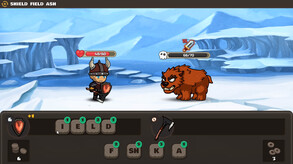
Just another boring word game? No. Words Can Kill is a roguelike deckbuilder. Travel through the world trying to build the strongest deck from letter tiles and find the perfect gear. And remember, here your tactical decisions matter, not your vocabulary!
Modeled estimate, not a reported figure. How we estimate →
Discounts
Every price cut of more than 20% we have observed, in each market that quoted one, with this game's chart position on either side of it. These are episodes, not a model: a sale is one event, and one event cannot tell you what the next one will do.
Reviews, worldwide (the counter carries no country): 0/day in the week to Aug 24 → 0.14/day in the week after.
For scale, across Steam · Top Sellers · Brazil over the last 30 days: the 26 chart moves that followed a price cut of more than 20% went a median of 7 places towards #1, and the 2,400 moves with no price cut behind them went 2 away. One store, one chart, one country — it is the only place we have enough observations to say even that.
Prices outside the United States have been collected since 6 August 2026 and chart positions since 19 July 2026, so a cut older than that has no market to compare and a market that joined later has no history yet. Nothing here is converted between currencies.
About
Genres
Engagement
Reviews
Themes across 44 recent reviews and how positive each mention is. A keyword signal, not full sentiment analysis.
Reviews
The art style doesn't quite appeal to me, but the gameplay looks really cool. The game forces you to really think about what you're doing
The word list is actual trash.
I like word games. I like rogue-likes. I enjoy slay the spire. This game is just not fun. Maybe if I could select targets I would enjoy it more. Too many mechanics are more irritating than difficult.
Media

Related
Related
Price dynamics, follower growth, revenue and sales trajectories with interactive tooltips
This and every other Pro feature is free until October 20, 2026. A free account is all it takes.
Stats
All-time low is the lowest price we've recorded for this game since we started tracking it.
Languages: English
Hours played at review time, across 44 reviews with recorded playtime.
positive critical· bar length = how often the theme comes up
8/10 A charming little roguelike with a novel concept. This is the perfect blend of scrabble word-building mechanics and the typical deckbuilder roguelike. It could probably do with a little more depth to make the runs feel more distinct from each other (i.e., an artifact layer, or an item choice after each boss of items that can't be obtained in shops or in normal encounters), but overall, it has been quite enjoyable.
Words can kill... ...but mine usually don't. Still a lot of fun.
There are quite a few deckbuilder / roguelike word games out there and this is one of the most original. It's really really tactical; it's not about knowing lots of words, it's about planning your moves and using the combos of gear and tiles synergistically. (I was really skeptical of the mode where the game simply tells you all the words you can make with your current hand, but actually hints don't make the game particularly easier, and anyway you can turn it off if you hate it.) The enemies feel genuinely different to each other and there's plenty of replayability and meta-game depth. The graphics are a bit rubbish, very generic cartoons, but aside from that a very satisfying game.
This game is great fun! I enjoy trying out the different weapon and armor enhancements, and trying to build my words around those strengths. I've played for just over 9 hours, and I have just now beat the first castle. I love seeing the new items that unlock after each run. Kudos on developing a keeper!
Basically, you put WORDS together and do damage to enemies. This is most definitely a ROGUE-like game but repetitive nature. Good casual game, but after a while gets kind of boring. There is basically levels that you fight different monsters in and you can block with certain words, get equipment that helps balance out to hit harder and block heavier but ULTIMATELY the game is more RNG than it is challenge per-say. It's BUILT to make you player longer and get KO'ed a lot and slowly unlock slightly better gear for the next run to make things a bit easier. RNG can be really cruel to you or REALLY good to you, but this is most definitely I would say RNG-based. You either have luck on your side or you dont. There is a bit more evolved stacks as you play the game later, and some equips IMO are somewhat broken. Overall that is basically the game. It isn't a BAD game by any means, just a pretty repetitive one. Definitely worth it ON A SALE but not at full price.
Words Can Kill is an inventive combination of word puzzle, roguelike progression, and tactical deckbuilding that manages to turn vocabulary into a genuine combat system. Instead of relying on conventional cards representing attacks, spells, or defenses, the game gives players letters and challenges them to assemble useful words while surviving a sequence of encounters. Developed and published by Typing Monkey, it takes an immediately understandable concept and surrounds it with enough resource management and strategic decision-making to become much more than a simple spelling exercise. The central combat system is where the game establishes its personality. Letters function much like cards in a traditional deckbuilder, and the words created from them determine what can be accomplished during a turn. Finding a valid word is only the beginning of the decision-making process. Players must consider word length, available equipment, enemy intentions, remaining letters, and what resources might be useful on subsequent turns. A perfectly valid word may therefore be strategically inferior to another combination that leaves better possibilities available for later. An especially interesting aspect is the ability to prepare rather than constantly pursuing immediate damage. Letters and actions can be arranged with future turns in mind, creating opportunities to defend against attacks or establish stronger offensive combinations. Knowing what an enemy intends to do becomes valuable information because it influences whether the current turn should focus on aggression, survival, or preparation. This gives battles a deliberate pace and makes foresight almost as important as vocabulary. Random letter draws naturally introduce uncertainty, but the game provides mechanisms for dealing with unfavorable situations. Players can replace unwanted tiles at the expense of health, creating an effective risk-versus-reward system. Spending health might rescue an otherwise terrible hand or provide the missing component of an important word, but excessive use can make later encounters much more dangerous. Health consequently operates as both survivability and a resource that can be exchanged for greater control over randomness. Deck refinement is equally important. Not every letter deserves to remain in the collection simply because it could theoretically create a useful word. Awkward letters can reduce consistency, especially when they require very specific combinations to function effectively. Removing troublesome tiles makes future draws more predictable and allows players to shape the deck around a particular strategy. This produces the satisfying deck-thinning decisions associated with strong roguelike card games, except the individual components are letters rather than conventional cards. Equipment introduces additional considerations because certain items work better with particular styles of word construction. An item that rewards longer words becomes significantly more useful when the deck contains flexible letters that can reliably produce them. Other combinations encourage different approaches, meaning equipment cannot always be judged solely by its immediate numerical strength. Building effective synergy between letters and gear becomes an important part of progressing through a run. The roguelike structure complements these mechanics through changing maps, enemies, rewards, and circumstances. Failure means beginning again, but repeated attempts gradually improve the player's understanding of the underlying systems. Experience teaches which letters are worth keeping, when replacing a hand is worth sacrificing health, how aggressively a deck should be streamlined, and which equipment combinations are practical. This learning process gives subsequent runs purpose even when previous attempts end unsuccessfully. Presentation is comparatively modest, but that works reasonably well for this type of game. The 2D visuals prioritize readability, allowing the player to concentrate on letters, equipment effects, enemy behavior, and tactical information without excessive visual clutter. The fantasy setting supplies an appropriate framework for fighting creatures and progressing through dangerous territory, although the mechanical systems remain the primary attraction. Players looking for elaborate storytelling or cinematic production will find those elements secondary to the puzzle and strategy components. The concept does have potential frustrations. Since word construction forms the foundation of practically every battle, players who do not enjoy spelling-oriented puzzles are unlikely to be converted by the surrounding roguelike mechanics. Random draws can occasionally create awkward situations, particularly before the deck has been properly optimized. Valid-word recognition can also produce moments where a player's expectations and the game's dictionary do not perfectly align. These issues are noticeable but generally do not erase the satisfaction of creating a strong word at exactly the right moment. Steam Deck compatibility is rated Playable rather than Verified. The turn-based nature of the game makes it well suited to portable sessions, and the default controller configuration can handle the core gameplay. Text is generally readable on the handheld display, while performance is not particularly demanding. However, players may encounter non-Steam-Deck button prompts, situations where the virtual keyboard must be manually opened, and a need to adjust the display resolution manually. These inconveniences prevent a completely seamless handheld experience, but the game remains practical to play on Steam Deck. Words Can Kill ultimately distinguishes itself by making language an integral part of tactical decision-making rather than treating spelling as a novelty layered over conventional combat. Its combination of letter management, deck optimization, equipment synergy, health expenditure, enemy prediction, and procedural runs creates an unusual strategic rhythm. It may have a narrower appeal than more traditional deckbuilders, but players who enjoy both word games and roguelike strategy will find an intelligently constructed crossover with considerable replay value. Rating: 7/10
Brutally difficult. And not in a fun way. This is basically you ramming your head against a wall, countless times, only for RNG to finally give you a run. The designers put WAY to much emphasis on random chance for this to feel fun or challenging or.. good. If you are the sort that likes your difficulty coming from pure RNG, no strategy, no skill, no nothing, just pure RNG, then go ahead. If not, stay far away from this title. After the dev so condescendingly thinks his customers are morons, let me add some more issues this game has here: Fights boil down to kill them before they kill you. Enemies have a lot more unfair ♥♥♥♥♥♥♥♥ to throw at you then you have a way to prevent or mitigate. You either kill in 3-4 turns or you might as well abandon the run, because they bleed you dry of ressources to the point you KNOW the run is screwed. Every fight you either dominate or loose the run. There is no in-between. And no "just re roll" does not help, since re rolling costs you hp. If the dev truly cared about reducing the RNG fiesta this is, re rolling would cost 0 hp, 1 hp, 2 hp.. each time and not start at 3hp. Also you CANNOT play around most enemy actions. There is no way to interrupt a summon, prevent them from destroying your tiles, lowering the value of your tiles, destroying your attack, destroying your block.. there is only blocking damage. That is what you can "play around". Incoming damage. That is it. Everything else mobs do is unavoidable. The dev's insistence on "adding tiles to the attack and defend box" each turn is suicide. You cannot influence what tiles you will get. So 90% of the time all that does is waste the tiles added to attack/block AND the tile you need to pay to reset them again. Which is suicide because you need EVERY tile to block the overblown damage from these mobs and kill the bags of hps they are, before they drain all your resources, dooming the run. Despite that, there is no way to turn of the annoying little popups that remind you to go for that suicide strategy... it has all the charm of clippy. This ain't some omega brain strategy or "just get better lol". The game is not balanced and relies on RNG to win. There is nothing fun about this.
Selling now
See how fast this game is selling right now — estimated copies and revenue per day from recent review growth.
Players by region
Where this game's players are, estimated from review languages.
Related
| Game | Estimated lifetime revenue | Reviews | Review score | Price |
|---|---|---|---|---|
| $20.2M | 218.5K | 97% | $6.24 | |
| $12.1M | 23.3K | 92% | $19.99 | |
| $1.1M | 1.4K | 75% | $19.99 | |
| $246.1K | 727 | 81% | $14.99 | |
| $13.6K | 264 | 60% | $2.79 | |
| $49.6K | 489 | 55% | $4.99 |
Related
| Game | Estimated lifetime revenue | Reviews | Review score | Price |
|---|---|---|---|---|
| $22.7K | 403 | 92% | $3.99 | |
| $22.7K | 213 | 76% | $4.99 | |
| $22.7K | 90 | 28% | $9.99 | |
| $22.7K | 193 | 93% | $4.99 | |
| $22.7K | 120 | 74% | $9.99 | |
| $22.7K | 138 | 62% | $4.99 |