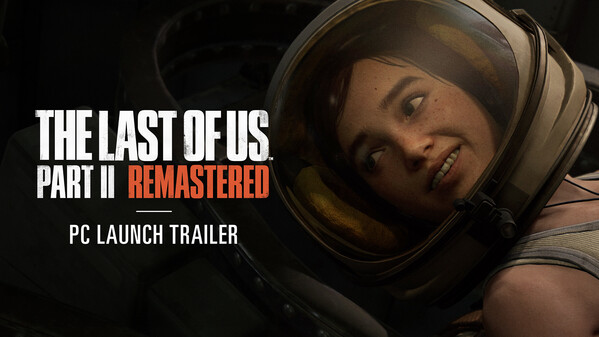
Experience the winner of over 300 Game of the Year awards, now on PC. Discover Ellie and Abby’s story with graphical enhancements, gameplay modes like the roguelike survival experience No Return, and more.
Modeled estimate, not a reported figure. How we estimate →
Media

About
Edition includes:
The Last of Us Part II Remastered
Experience the winner of over 300 Game of the Year awards now with an array of technical enhancements that make The Last of Us Part II Remastered the definitive way to play Ellie and Abby’s critically acclaimed story.
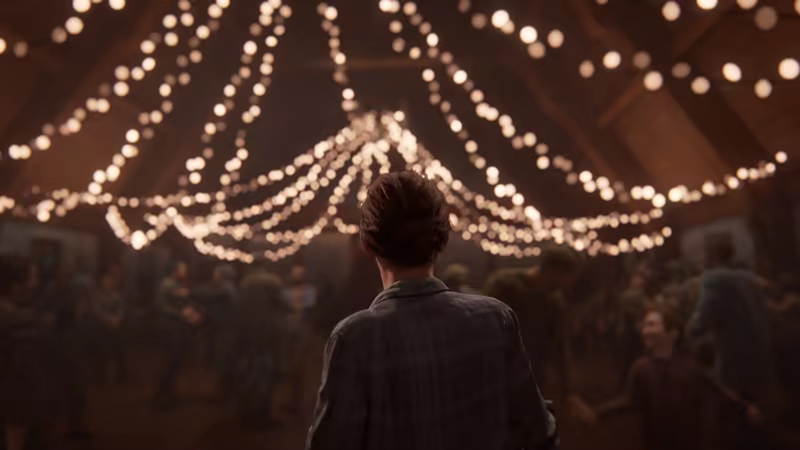
Five years after their dangerous journey across the post-pandemic United States, Ellie and Joel have settled down in Jackson, Wyoming. Living amongst a thriving community of survivors has allowed them peace and stability, despite the constant threat of the infected and other, more desperate survivors. When a violent event disrupts that peace, Ellie embarks on a relentless journey to carry out justice and find closure.
Added features
The Last of Us Part II Remastered enhances the original game in ways not possible before, including key PC features:
A host of graphical improvements bring the beautiful-yet-dangerous world to life.
Full PlayStation® DualSense controller integration with adaptive trigger and haptic feedback functionality.¹
Earn and collect exciting achievements on Steam as you progress through the game.
Widescreen and Ultrawide support.²
HDR support.³
PC Display and Graphics Menu for scalability.
DirectStorage support.
PC Optimized graphics
Performance enhancing technologies including NVIDIA DLSS 3, AMD FSR 3.1, and AMD FSR 4.0 with upscaling and frame generation. Intel XeSS is also supported⁴
Full gamepad support
Adjust the controls to suit your preferences for a smooth and intuitive experience throughout the game.
Mouse and keyboard mapping
Take full control and ensure personalized gameplay experience by tailoring mouse and keyboard mapping to suit your playstyle.
PlayStation® overlay and Trophy support
The PlayStation overlay is available for Windows PC players with an account for PlayStation Network to earn PlayStation Trophies and access Friends lists, settings, and player profile.
No Return – A Roguelike Survival Mode
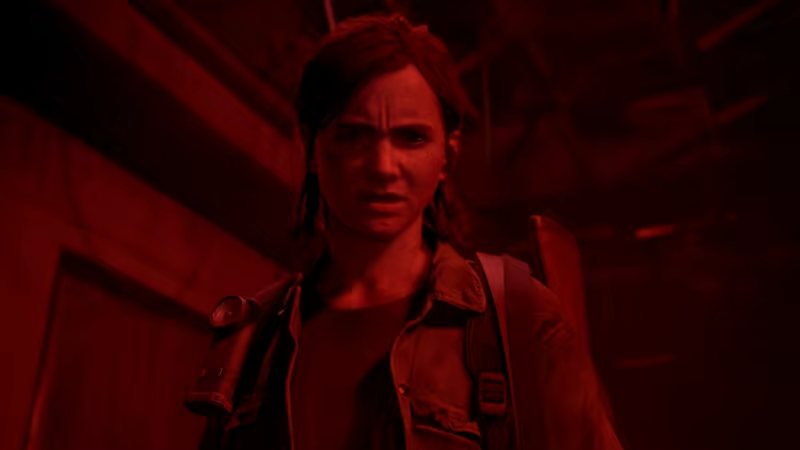
Experience The Last of Us Part II’s deep combat via an entirely new mode! Survive as long as you can in each run, as you choose your path through a series of randomized encounters. Play as a host of different unlockable characters, each with unique gameplay traits. The variety of challenges features different foes and memorable locations from throughout Part II, all culminating in tense boss battles.
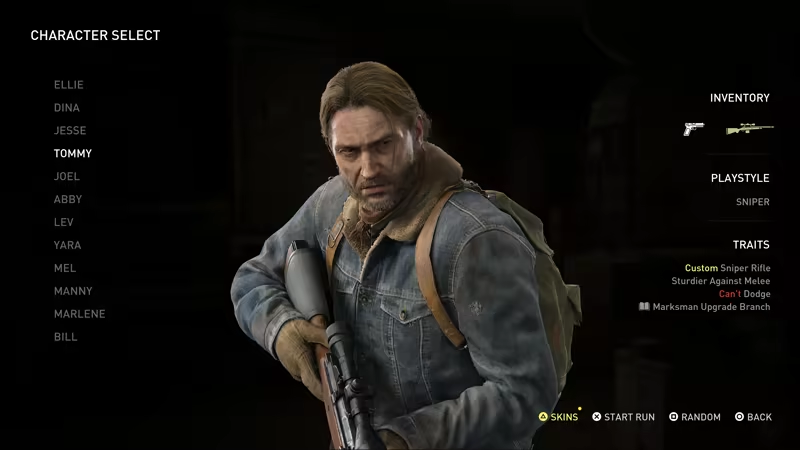
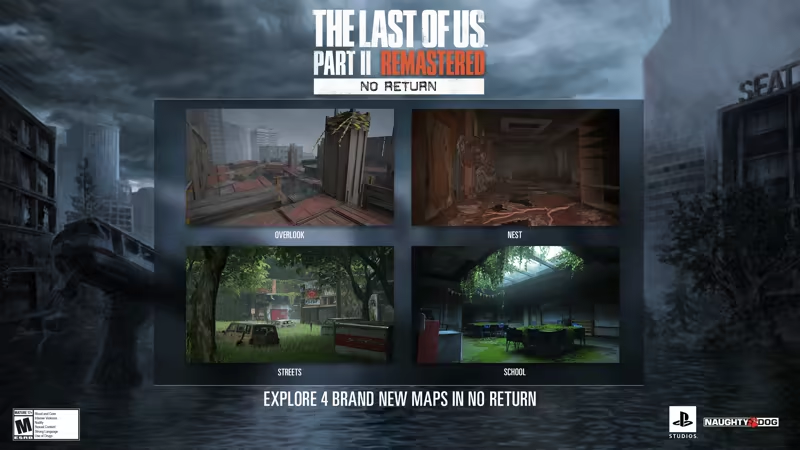
Two new unlockable No Return characters are included
Four new unlockable maps to challenge

More ways to play
Delve deeper into this beloved adventure and learn how the original game was created.
Lost Levels lets you explore early-development versions of three levels not seen in the original.
Enjoy hours of developer commentary to hear insights into Part II’s development as you experience the game.
Live up to your musical potential with Guitar Free Play, which includes unlockable instruments, or take on the Speedrun Mode⁵ and post your best times.
Descriptive Audio⁶ and Speech to Vibrations¹ have also been added to Part II's suite of accessibility features.
The Last of Us Part II Remastered also features unlockable character and weapon skins for players to use for both Ellie and Abby.
¹ Wired connection required to experience the full range of in-game DualSense controller features.
²Compatible PC and display device required.
³Compatible PC and HDR display device required.
⁴Compatible PC and graphics card required.
⁵Game progression required to unlock.
⁶Only available for audio supported languages.
Genres
Stats
All-time low is the lowest price we've recorded for this game since we started tracking it.
Languages: English*, French*, Italian*, German*, Spanish - Spain*, Czech, Danish, Dutch, Finnish, Greek*, Hungarian, Japanese* +13 more
Updates
Build ids and update times come straight from Steam's PICS — the same source SteamDB reads. Patch history grows as we record new builds.
Engagement
Hours played at review time, across 766 reviews with recorded playtime.
Reviews
Themes across 763 recent reviews and how positive each mention is. A keyword signal, not full sentiment analysis.
positive critical· bar length = how often the theme comes up
Reviews
I DIDNT GET AMMO FOR KILLING THE BIG ASS ♥♥♥♥♥♥♥ ZOMBIE THAT TOOK ALL MY ♥♥♥♥♥♥♥ AMMO AND MENTAL STABILITY FOR 500 ♥♥♥♥♥♥♥ RETRIES
Great game
игра клас но где много зелени в лесу или джексоне иногда 50 фпс а так везде на 80 играл на средних играбельно но если не хотите 40 фпс гдето то покупайте 4070 зотябы
MELHOR JOGO DA FACE DA TERRA.
Finalmente tive a oportunidade de jogar desde o lançamento em 2020, é simplesmente um dos melhores jogos que joguei na minha vida, vale muiiiiito a pena jogar, de verdade mesmo, parabéns Naughty Dog.
Every time I replay The Last of Us, the ending stays the same. What changes is the way I judge its characters. I’m a player from China. So far, I have completed both The Last of Us Part I and Part II four times. Very few games can make me want to walk the same path again after I already know every major event. But this series does. During my first playthrough, I mostly focused on what would happen next, whether the characters would survive, and what choices they would eventually make. After replaying the games, I began paying attention to much smaller details: a character’s expression, a pause before speaking, a change in tone, a nervous hand movement, a reaction after combat, and the gradual shift in the relationship between two people traveling together. What affected me most in Part I was the slow and believable development of Joel and Ellie’s relationship. At first, Joel treats Ellie as cargo—something that simply needs to be delivered. He refuses to talk about Sarah or Tess, and he refuses to risk caring deeply about someone again. Near Jackson, he tries to hand Ellie over to Tommy. In the past, I might have seen this as Joel avoiding responsibility. But after replaying the game, I began to understand it differently. Joel does not try to leave Ellie because he does not care about her. He tries to leave because he already cares too much. He once watched his own daughter die in his arms. Loving another child means accepting the possibility of losing her as well. Asking Tommy to continue the journey is not only a practical decision—it is also an emotional retreat. But from Ellie’s perspective, it means something completely different: Joel is preparing to abandon her too. The game never simply tells us that they have become father and daughter. It hides that transformation inside their conversations, gestures, silences, and the small moments they share along the road. Joel once tells Ellie that he wanted to become a singer. She asks him to sing for her. That promise is not fulfilled in Part I, but years later, in Part II, it finally is—through the guitar. The more I replay the series, the more attention I also give to Ellie herself. During my third playthrough of the David section, I suddenly realized something that should have been obvious: no matter how brave and capable Ellie is, she is still only fourteen years old. She is approached by someone who first appears kind and trustworthy, only to discover that he has been deceiving, manipulating, and trying to harm her. She barely escapes from the burning restaurant alive. Afterward, she becomes quiet, distant, and emotionally numb. She no longer talks and jokes the way she did before. This is not simply exhaustion after a difficult fight. It is a child shutting herself down after experiencing something far beyond what she is able to process. That also changed the way I understood the ending of Part I. When Ellie asks Joel to swear that he is telling the truth, she is not simply asking for information. She is testing the last person she still wants to trust. She wants to know whether the person she depends on most is also deceiving her. And in Part II, she eventually discovers that Joel did lie. Joel’s lie is completely different from David’s deception. David deceives Ellie in order to control and harm her. Joel lies because he loves her and cannot bear to lose her. But from Ellie’s perspective, both experiences touch the same wound: someone she trusted made a life-changing decision for her without giving her a choice. That made it much easier for me to understand why she could not simply forgive Joel. But the character who changed me most in Part II was Abby. The first time I was forced to control her, I hated her. I could not accept that the game wanted me to play as the person who killed Joel. I even deliberately allowed her to die during gameplay. But as the story continued, I began to see her father, her friends, the people she had lost, and the people she still wanted to protect. I began to understand that Abby was not simply a villain. She was also a daughter who had lost her father. She was also someone shaped by grief, trauma, and the desire for revenge. By the time I reached the final fight on the beach, I looked at Abby’s weakened body and found myself hesitating to press the attack button. That was the moment I realized that the game had not really changed Abby. It had changed the way I saw her. At the beginning, I viewed everything through Ellie’s perspective and believed Abby deserved to be punished. But after living inside Abby’s world, I could no longer judge her as easily as I once had. Understanding someone does not mean approving of everything they have done. But once I truly entered her perspective—once I saw the people she had lost and the people she was trying to protect—hatred no longer felt simple. That is what I find most brutal, and most extraordinary, about The Last of Us. As players, we possess information that the characters do not. We know everyone’s history. We know where every decision will lead. Because of that, it is easy to judge them from a godlike perspective: Joel should not have taken Ellie from the hospital. Abby should not have killed Joel. Ellie should not have continued pursuing revenge. But when I try to shut off that godlike perspective and truly place myself inside their situations, I have to admit something uncomfortable: I may not have made better choices. If I were a father who had once watched his daughter die in his arms, could I really allow Ellie to die on that operating table? If someone murdered my father, could I truly let go of revenge? If I had finally decided to try to forgive someone, only to watch them be taken from me the very next day, could I simply continue living in peace? That is the most painful part. Even if we know the entire ending, once we truly become these characters, we may still walk toward the same outcome. That is why this series deserves to be replayed. During my first playthrough, I was asking who was right and who was wrong. Later, I began asking why each person had reached that point. The story never changes, but my understanding of Joel, Ellie, Abby, and even Marlene continues to change. I have gradually come to understand that a person’s actions can be wrong while their emotions and motivations remain deeply human. Conflict is not always created because one side is purely evil. It often begins because every person is trapped inside their own experiences, trauma, love, fear, and loss. Thank you to the writers, actors, animators, level designers, and everyone else who helped create these two games. You did not simply create a game that ends once the credits roll. You created a story that can be understood differently as the player changes. Every time I replay The Last of Us, the ending stays the same. What changes is the way I understand its characters, hatred, forgiveness, and human nature. Thank you for this journey.
Beat this game on PlayStation and had to get it for PC. 10/10 game.
[b]A narrative masterpiece that surpasses its predecessor (which I absolutely loved).[/b] While the world-building and storytelling hold to the absolute highest standard, the game occasionally leans too heavily on extended cinematics. As a player who prefers agency over passive watching, I found some of the exposition-heavy sections dragged where they could have integrated gameplay. However, the narrative is so compelling that boredom never sets in. Supported by excellent voice acting, the game investment in its characters is total. It explores exceptionally dark, complex, and heavy themes with rare sensitivity and skill. The pacing is subverted in the best way possible; multiple times the narrative feels like it is reaching its conclusion, only to pull you back in. The ending is far from straightforward, and I was always happy when I realized that the story wasn't finished yet. It is an emotional roller-coaster that consistently takes unexpected turns, descending into the ugliest depths of the human psyche in a manner reminiscent of Joseph Conrad’s [i]Heart of Darkness[/i]. If you are looking for one the best story-driven games paired with tense, stimulating gameplay, you don't want to miss this one. Performance-wise, the game runs beautifully at maximum settings on a mid-range PC, marred only by sudden framerate drops here and there. As for the included roguelike survival mode, [i]No Return[/i], it wasn't for me. Because it lacks any narrative connection to the main campaign, it feels like an artificial piece of endgame content rather than a cohesive expansion of the world. While it may offer value to players solely seeking a mechanical challenge, it will likely disappoint those invested in the game's storytelling.
The Last of Goob, Part 2
The worst-ported PC game I've seen. The performance is terrible. The game basically crashed out in just 1 minute in the prologue.
Related
Related
Trends
Modeled estimate over time, reconstructed from Steam's monthly review histogram.
Engagement
DAU/MAU are modeled from peak concurrent players (≈×8 and ×28) — Steam publishes no active-user counts, so treat these as rough estimates, not reported figures.
Audience
Audience
Estimated from the language of this game's reviews — a proxy for where players are, not official Steam demographics.
Games most often reviewed by the same players — an audience-affinity signal from our review sample, not full ownership data.
Related
| Black Myth: Wukong | $794.9M | 1.2M | 97% | $59.99 |
| 7 Days to Die | $425.3M | 403.7K | 87% | $44.99 |
| DayZ | $531.7M | 465.9K | 78% | $49.99 |
| Hogwarts Legacy | $323.8M | 370K | 90% | $59.99 |
Related
| Sid Meier's Civilization VII | $55.6M | 57.6K | 48% | $34.99 |
| Balatro | $55.5M | 195.4K | 98% | $14.99 |
| No Rest for the Wicked | $55.5M | 79.9K | 80% | $39.99 |
| DYNASTY WARRIORS: ORIGINS | $55.4M | 29.7K | 93% | $69.99 |
| Warhammer 40,000: Space Marine 2 | $55.8M | 218.8K | 84% | $17.99 |
| STAR WARS™ Battlefront™ II | $55.9M | 99K | 88% | $39.99 |