The Emperor and State is a turn-based strategy game that simulates the rule of an ancient feudal monarch. It involves the administration, policy adjustment, diplomatic checks and balances, national wars, as well as the emperor's self-cultivation, the cultivation of successors and so on.
Modeled estimate, not a reported figure. How we estimate →
Discounts
Every price cut of more than 20% we have observed, in each market that quoted one, with this game's chart position on either side of it. These are episodes, not a model: a sale is one event, and one event cannot tell you what the next one will do.
Reviews, worldwide (the counter carries no country): 0.43/day in the week to Sep 13 → 0.2/day in the week after.
Reviews, worldwide (the counter carries no country): 0.43/day in the week to Jul 31 → 0/day in the week after.
For scale, across Steam · Top Sellers · Brazil over the last 30 days: the 26 chart moves that followed a price cut of more than 20% went a median of 7 places towards #1, and the 2,400 moves with no price cut behind them went 2 away. One store, one chart, one country — it is the only place we have enough observations to say even that.
Prices outside the United States have been collected since 6 August 2026 and chart positions since 19 July 2026, so a cut older than that has no market to compare and a market that joined later has no history yet. Nothing here is converted between currencies.
About
Pleases follow us and add the The Emperor and State to your wishlist! Your support is the greatest motivation for game development!
English localization is still in progress. We expect to provide English support in the update after the release of the Early Access version. We sincerely ask for your understanding and patience.

The Emperor and the State is a simulation game that combines elements of strategy, management, development, and collection. Players will portray ancient Chinese monarchs, governing the country, collecting renowned ministers and consorts from various eras, nurturing descendants, and ultimately building an enduring empire through generations.

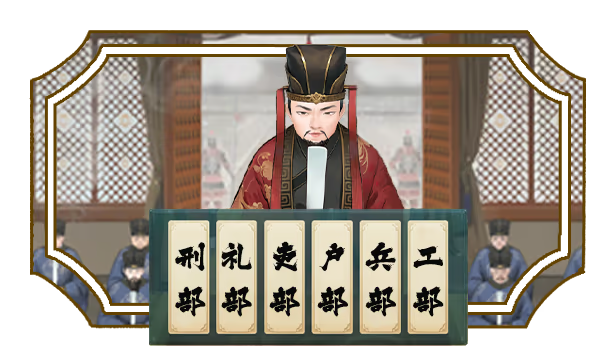
Conduct court sessions, handle memorials, and set national policies. The State includes over 20 different Indicators that interdepend and influence each other. By adjusting the relationships between these Indicators, stabilize and promote the development of the nation.
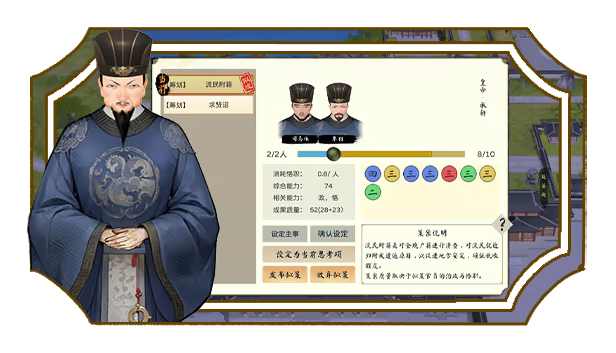
Issue decrees, contemplate strategies, appoint officials, and enforce decrees. Decrees are categorized into seven major types, requiring issuance by the Secretaries of the six Ministry: Personnel, Revenue, Rites, Military, Punishment, and Public Works, as well as the Prime Minister. These decrees contribute to the governance and development of the nation, with most requiring cooperation between the Emperor and ministers through policy proposals.

Making distant friends while attacking nearby in diplomacy. Send envoys to other countries, establish trade relationships, or initiate wars...
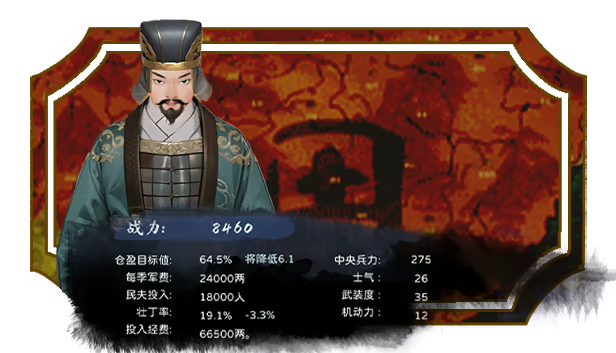
Train soldiers, prepare military supplies. When the time is right, seize cities and conquer territories. Influence the course of war by issuing military commands.

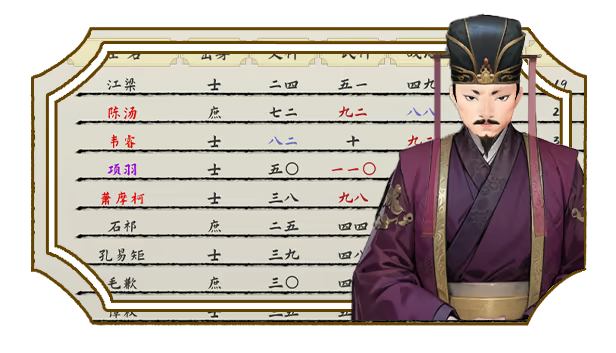
Promote education, advance imperial examinations, and gather talented ministers. Through the annual imperial exams and additional special exams, collect historically outstanding ministers and employ them according to their abilities.

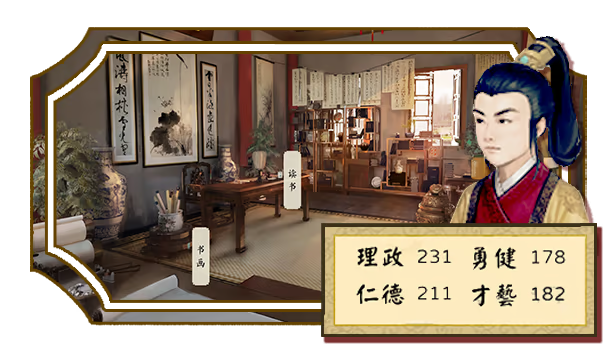
The Emperor possesses four attributes: governance, benevolence, valor, and talent. Engage in self-cultivation within various facilities in the imperial palace to enhance corresponding attributes. The Emperor's personal attributes greatly influence the efficiency of governance; therefore, properly schedule daily activities to exercise and improve oneself.

Gather beauties, bestow favor in the six palaces, and enjoy worldly splendor. Confer titles in the harem, bear imperial heirs, and relax to increase efficiency in other matters.
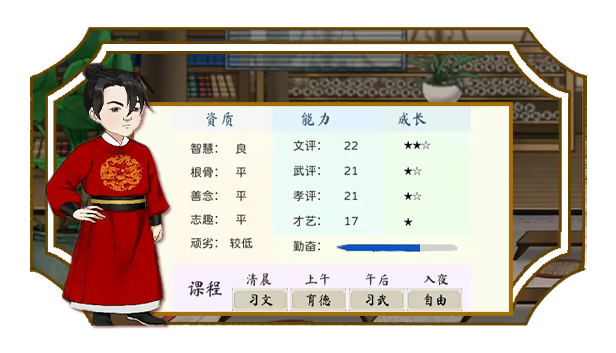
The Emperor is also mortal, and life has its limits. Choose the most talented prince in advance and focus on their cultivation. After the current Emperor's passing, the imperial heir will ascend the throne, and the game will continue! Through generations of inheritance, create your everlasting empire.

Through generations of inheritance, developing national strength, expanding territories, ultimately creating your eternal empire.
Add-ons
Each DLC is estimated with the same model as a game, then summed — a modeled figure, not reported DLC sales.
Engagement
Reviews
Themes across 50 recent reviews and how positive each mention is. A keyword signal, not full sentiment analysis.
Reviews
功能还是太少,继续努力更新吧。
666
最正统的dos皇帝精神
不错
Media

Related
Related
Price dynamics, follower growth, revenue and sales trajectories with interactive tooltips
This and every other Pro feature is free until October 20, 2026. A free account is all it takes.
Genres
Stats
All-time low is the lowest price we've recorded for this game since we started tracking it.
Languages: Simplified Chinese*, Traditional Chinese**languages with full audio support
Hours played at review time, across 50 reviews with recorded playtime.
positive critical· bar length = how often the theme comes up
平衡性做的挺好,就是上手有点难。。感觉内容完结算是SLG的神作了。
很好
我很喜欢,就是更新的太慢了。内容好少
The Emperor and State, developed by 涂途 and published by Hawthorn Games, is a grand strategy simulation that shifts the focus of empire-building away from conquest alone and toward the intricate, often exhausting reality of governance. Instead of presenting rulership as a straightforward path of expansion and military dominance, it places the player inside the machinery of a feudal state, where decisions ripple across bureaucracy, economy, and court politics in ways that are not always predictable. It’s a game that prioritizes systems and interdependence, asking the player not just to lead, but to manage, negotiate, and endure. The core experience revolves around assuming the role of a monarch tasked with maintaining stability across a complex and often fragile empire. Every aspect of rule falls under your control: appointing officials, issuing policies, balancing finances, managing military forces, and responding to crises. What makes the game distinctive is how interconnected these responsibilities are. Economic decisions influence public sentiment, which in turn affects political stability, which can impact military readiness. The systems are layered in such a way that there is rarely a single correct choice—only trade-offs that must be weighed carefully over time. A major part of this complexity comes from the game’s emphasis on bureaucracy. Governance is not handled through simple menus or abstract sliders but through a structured network of officials, each tied to specific administrative roles. Managing these individuals becomes a strategic challenge in itself, as their abilities, loyalties, and relationships can significantly influence how effectively policies are implemented. This creates a sense that the state is not just a system to control, but an entity that must be coordinated, with all the unpredictability that entails. It adds a level of realism that is rarely explored so deeply in strategy games. The inclusion of dynasty management further reinforces the long-term nature of the experience. Ruling is not confined to a single lifetime; it extends across generations, requiring players to think about succession, heirs, and the continuity of their policies. Decisions made early on can have consequences that unfold much later, making the game feel less like a series of isolated scenarios and more like an ongoing historical process. This generational aspect adds weight to the player’s actions, as maintaining stability over time becomes just as important as achieving immediate goals. However, the depth that defines The Emperor and State is also one of its biggest challenges. The game offers limited guidance in explaining how its systems interact, leaving players to learn through experimentation. Early sessions can feel overwhelming, as the sheer number of variables and responsibilities makes it difficult to identify priorities. Even when mistakes occur, the reasons behind them are not always clear, which can lead to frustration. This steep learning curve makes the game less accessible, particularly for those unfamiliar with complex strategy simulations. Pacing is another area where the game demands patience. Progress tends to be gradual, with success measured in stability and incremental improvement rather than rapid expansion or dramatic victories. This slower rhythm can be rewarding for players who enjoy careful planning and long-term strategy, but it can also feel stagnant during periods where little visible change occurs. Recurrent challenges, such as economic strain or political unrest, can further slow momentum, requiring constant attention to maintain balance. From a technical and presentation standpoint, the game is functional but modest. The interface focuses on delivering information, though it does not always do so clearly, especially when dealing with more advanced systems. Visuals are simple and utilitarian, prioritizing clarity over style. As an Early Access project, it also shows signs of ongoing development, with areas that feel unfinished or in need of refinement. These limitations do not undermine the core concept, but they do affect the overall experience, particularly for players expecting a more polished product. Despite these issues, the game’s ambition is evident. It attempts to simulate governance in a way that feels systemic and grounded, offering a perspective that goes beyond the typical focus on expansion and warfare. The sense of managing a living, breathing state—one that reacts to decisions in complex and sometimes unpredictable ways—is one of its strongest qualities. It is a game that rewards persistence and careful observation, even if it does not always make that process easy. Ultimately, The Emperor and State is a niche experience that will appeal most to players who enjoy deep, systems-driven strategy games. It is not designed for quick sessions or immediate gratification, but for those willing to invest the time to understand its mechanics, it offers a challenging and intellectually engaging simulation of rule. While its rough edges and steep learning curve limit its accessibility, its commitment to depth and realism gives it a distinct place within the genre. Rating: 6/10
買了遊戲好幾年, 開發者一直在更新, 這是不錯的, 可是一個遊戲一直更新, 增加和改變內容, 同時很多內容還沒實裝, 沒有說明, 又不回復玩家的問題, 這實在由想玩變成真的不想再玩。把遊戲做的太複雜, 也有點不合理, 這是把一個好遊戲做壞的節奏。
什么时代就搞民族主义?真被教傻了?
Selling now
See how fast this game is selling right now — estimated copies and revenue per day from recent review growth.
Active players
Estimated daily and monthly active players (DAU/MAU) modeled from peak concurrency.
Players by region
Where this game's players are, estimated from review languages.
Players also reviewed
The games this title's players most often review too — audience affinity.
Related
| Game | Estimated lifetime revenue | Reviews | Review score | Price |
|---|---|---|---|---|
| $50K | 82 | 90% | $12.99 | |
| $1.6K | 3 | 67% | $13.99 | |
| $725.6K | 2.6K | 84% | $9.99 | |
| $589.9K | 768 | 87% | $24.99 | |
| $156K | 366 | 80% | $7.99 | |
| $149.7K | 166 | 76% | $19.99 |
Related
| Game | Estimated lifetime revenue | Reviews | Review score | Price |
|---|---|---|---|---|
| $123.2K | 710 | 77% | $5.39 | |
| $123.2K | 294 | 72% | $24.99 | |
| $123.2K | 379 | 81% | $14.99 | |
| $123.2K | 519 | 98% | $9.99 | |
| $123.2K | 231 | 89% | $29.99 | |
| $123.2K | 266 | 78% | $19.99 |