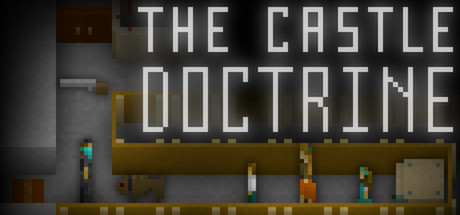
The Castle Doctrine is a massively-multiplayer game of burglary and home defense. It's 1991, and things are bad. You're a guy with a house and family. Other players are coming to take what's yours. Build security to stop them. Study their houses, buy tools, and break in to take what's theirs.
Modeled estimate, not a reported figure. How we estimate →
Media

About
Genres
Stats
All-time low is the lowest price we've recorded for this game since we started tracking it.
Languages: English
Engagement
Hours played at review time, across 40 reviews with recorded playtime.
Reviews
Themes across 40 recent reviews and how positive each mention is. A keyword signal, not full sentiment analysis.
positive critical· bar length = how often the theme comes up
Reviews
만원주고 샀던거같은데 아직도 생각날때마다 돈아깝다
This was an interesting experiment, but not so great as an actual game. The reason I say "was" is because I don't know that the game is even playable in its current state, due to a lack of players.
I have waited years for this game to go on sale YEARS i knew he would crack eventually this game was dead until the price drop now people are starting to come into the game again I GET WHAT I WANTED PVP instead of paying 15 bucks for 1 copy i got all my friends this game Building your own bunker is no small task mind games complex puzzles and mazes all made by fellow players The only thing this game was missing was more players but now it has them its fun if you die to your own dog you are trash
Perhaps the best game for atmosphere ever! Negatives Yes, the graphics are simple at best. The learning curve is extremely difficult Positives Gameplay is amazing! Dying matters more than anything! Your heart will be pumping unlike any other game. Successfully making a house is as exhilarating as successfully robbing a house. Recommendation Read the old forum and join the new discord. Don't build a house at first, but try robbing others and learn. When you think you have the basics, build your first place and let your heart start to race!
Try to outwit your opponents if you can
not going to lie, this game has most likely the MOST annoying building system of any game ive played so far, after you build your house you have to test it, and if you accidently die while testing it, do you get to redo it and adjust it so its actually possilbe? NO! you have to reset ALLLL your progress. like ALL OF IT! no saves, no undos, just gone. 0/20 would NOT reccomend :/
Need More
The Castle Doctrine, created by Jason Rohrer, is a game that deliberately rejects conventional ideas of comfort and accessibility in favor of something far more psychological and uncompromising. At its core, it operates on a simple premise: you build a home, protect your valuables, and attempt to steal from others doing the same. Yet this straightforward loop quickly evolves into a tense and often unsettling experience that revolves less around mechanical mastery and more around anticipation, fear, and the consequences of irreversible decisions. The structure of the game is built on a duality that constantly forces players to switch perspectives. On one side, you are a homeowner designing intricate defenses—laying down traps, wiring security systems, placing guard dogs, and shaping your house into a maze meant to confuse and punish intruders. On the other side, you become the intruder, carefully stepping through someone else’s creation, trying to interpret their logic and avoid fatal mistakes. Every house is designed by another player, which means every infiltration feels like a personal encounter with another human mind. Some layouts are straightforward, others are devious and almost cruel, and part of the game’s appeal lies in deciphering the intentions behind each design. What truly sets The Castle Doctrine apart is its unforgiving commitment to permanence. Failure carries absolute consequences—if your character dies during a break-in or even while testing your own defenses, your entire progress is erased. There are no second chances, no reloads, and no safety nets. This single design choice transforms the experience into something uniquely tense. Every movement feels heavy with risk, every decision is made with hesitation, and even the smallest miscalculation can end everything. It creates a constant undercurrent of anxiety that few games manage to sustain, making success feel genuinely earned but also making loss deeply discouraging. Gameplay unfolds at a slow, deliberate pace, almost like a puzzle game disguised as a multiplayer system. Movement is grid-based, and each step requires thought. Visibility is limited, forcing players to rely on logic and observation rather than reflexes. When breaking into a house, you’re essentially solving a deadly puzzle where the pieces are hidden and the cost of being wrong is permanent failure. There’s a purity to this design—there’s no randomness to blame, no external factor to excuse mistakes. Every success or failure can be traced back to your own decisions, which reinforces the game’s harsh but fair philosophy. The game also explores moral ambiguity in a way that feels intentional rather than incidental. While you are protecting your own household, you are simultaneously invading others, often leading to lethal outcomes for their characters. The game doesn’t frame these actions as right or wrong; instead, it places you in a system where survival and progress depend on choices that feel ethically uncomfortable. This creates an unusual emotional dynamic where triumph can feel slightly hollow, and loss can feel intensely personal, as if you’ve been outsmarted rather than simply defeated. Visually, The Castle Doctrine is extremely minimalistic, with simple, almost crude graphics that prioritize clarity over style. There is little in the way of visual flair or immersive detail, and the presentation can initially feel dated or underwhelming. However, this simplicity serves a purpose. By stripping away distractions, the game focuses entirely on its mechanics and the tension they create. The lack of polish becomes part of its identity, reinforcing the cold, calculated nature of its design. Despite its originality, the game is not easy to recommend to a broad audience. Its steep learning curve, punishing consequences, and reliance on a player-driven ecosystem make it a difficult experience for those looking for immediate gratification or forgiving gameplay. It demands patience, resilience, and a willingness to accept loss as part of the process. For some, this will be a deeply engaging and even thought-provoking experience; for others, it may feel frustrating and overly harsh. In the end, The Castle Doctrine stands as a bold experiment in game design, one that prioritizes tension, consequence, and player psychology over traditional entertainment value. It is a game that challenges not just your skills, but your mindset, asking you to embrace risk in a way few others dare to attempt. While it may not appeal to everyone, those who connect with its design will find something truly distinctive and memorable. Rating: 6/10
A cool idea in principle. Everyone builds a dungeon of traps and paths with a treasure hidden inside, and then tries to rob everyone else... except it's all dark and edgy. The reality is that people either half ass it or master building optimised unfun vaults. Personally I just wasn't down with the vibe it was putting out. Never struck me as fun at the time and has only gone on to become controversial.
The concept was amazing. It was really great when it first released. There is almost zero reason to play it now. Plenty of exploitable problems with the game that encourage never robbing houses or solving problems. Too many mechanics are instant death if abused view system.
Related
Related
Trends
Modeled estimate over time, reconstructed from Steam's monthly review histogram.
Momentum
Pace estimated from the game's recent review growth (our daily snapshots) at its own sales-per-review ratio — a momentum signal, not booked sales.
Audience
Estimated from the language of this game's reviews — a proxy for where players are, not official Steam demographics.
Related
| Toads of the Bayou | $40.1K | 159 | 75% | $9.99 |
| Corrosion: Cold Winter Waiting [Enhanced Edition] | $40.1K | 265 | 68% | $7.99 |
| Vilde | $40.1K | 100 | 77% | $15.99 |
| Guard Duty | $40.1K | 260 | 92% | $9.99 |
| Sex & Gun VR | $40.1K | 78 | 45% | $24.99 |
| The Inner World | $40.1K | 1.5K | 89% | $1.49 |
Related
| Squad | $166.3M | 240.4K | 81% | $39.99 |
| Raft | $144M | 375.8K | 93% | $19.99 |
| House Flipper | $65.8M | 110.8K | 94% | $24.99 |
| The Isle | $59.9M | 116.6K | 80% | $19.99 |
| Bodycam | $54.9M | 41.8K | 76% | $33.32 |
| Hell Let Loose | $51.5M | 148.7K | 82% | $17.49 |