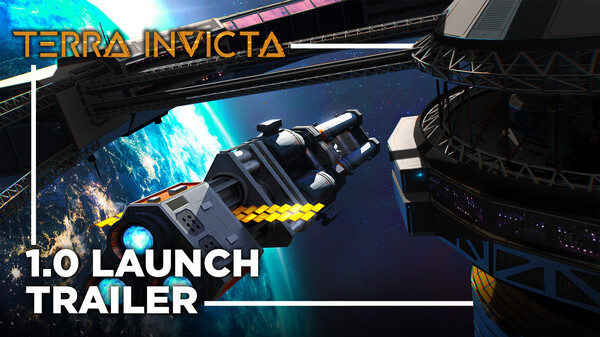
An alien invasion has fractured humanity into seven ideological factions each with a unique vision for the future. Lead your chosen faction to take control of Earth’s nations, expand across the Solar System, and battle enemy fleets in tactical combat.
Modeled estimate, not a reported figure. How we estimate →
Media

About
An extraterrestrial probe is detected approaching Earth. Unknown to humanity, an alien force has arrived in the far reaches of the icy Kuiper Belt and has begun mining a dwarf planet to prepare for an invasion.
With Earth’s nations unable to unite to address the alien arrival, transnational groups of like-minded political, military, and scientific leaders develop covert channels to coordinate a response. With the aliens' motives uncertain, factions emerge, driven by hope, fear, or greed.
You will control one of these factions.
The Resistance works to form an alliance of nations to mount a coordinated defense.
Humanity First vows to exterminate the aliens alongside any who sympathize with them.
The Servants worship the aliens and believe they will solve all the troubles of the world.
The Protectorate advocates negotiated surrender as the only means to avoid annihilation.
The Academy hopes the alien arrival heralds the opportunity to form an interstellar alliance.
The Initiative seeks to profit from the chaos and destruction.
Project Exodus plans to build a massive starship and flee the Solar System.

A distant anomaly, a mysterious crash site, and a spike in reported disappearances. Could this truly be humanity's first contact with extraterrestrial lifeforms? As your field agents investigate sightings and your scientists race to explore new fields of research, you will slowly learn the truth behind the alien arrival.
From early sightings and UFO crash sites to rampaging alien megafauna and robotic armies, it will rapidly become clear that the other six human factions are not your sole competition. Throughout the game, illustrated events will present you with difficult choices as you investigate growing alien activity on Earth. Uncover the mystery of the aliens’ origins and motives – unless, of course, you are Humanity First, and all that matters to you is extermination.
Terra Invicta has a global research system that creates opportunities for both competition and cooperation. Shared scientific advancement unlocks private engineering projects. Factions can choose to focus on private projects, at the cost of weakening Earth as a whole and ceding influence over global research direction to other factions with different priorities. Left unchecked, factions like the Servants or the Initiative may steer the world’s efforts toward developing methods of social control, rather than propulsion or weapon systems.

You begin on Earth as the head of a shadowy organization devoted to your chosen ideology. The aliens are coming – soon – but your first enemies (and perhaps allies) will be other human factions.
Lead a faction united by ideology, rather than a nation defined by territory. This is a stark change from most strategy games – in Terra Invicta, you will not paint the map with the colors of some chosen nation. Instead you will rule from the shadows and compete with other factions for control points representing a region's military, economic, and political leadership.
Geopolitics is your sandbox – unite or break apart nations as best serves your ends, while using those under your influence to conduct proxy wars against the other six factions. Earth’s regions are modeled in detail, from educational levels and unrest to GDP and inequality. Gaining command over regions with great monetary wealth and military power can allow you to implement your will on Earth, but the war for the Solar System will not be won without also securing regions containing space launch facilities.
Enact your will through a council of politicians, scientists, and operatives sent around the world (and even into space). The starting abilities of these councilors will improve through gaining experience and acquiring control over powerful organizations like intelligence agencies or wealthy corporations. A veteran commander may make the perfect choice to lead a tactical team under the council’s direction, while an experienced diplomat works to secure the funding needed to resist the alien invasion.
Seek out like-minded populations and politicians and take actions to convert followers of opposing ideologies. Public opinion is modeled along multiple axes – the Servants’ alien worship and the Protectorate’s advocacy of negotiated surrender may largely align in terms of support or opposition to the aliens, but events that show the aliens can be defeated have the potential to convince followers of the Protectorate that resistance is a realistic choice.

Terra Invicta bridges the gap between our modern-day world and the vast interstellar empires of other space strategy games, asking you to take humanity’s first steps in colonizing our Solar System, where over 300 asteroids, moons, and planets in constant motion create an ever-changing strategic map.
Start your campaign in the modern day and build your capabilities from the ground up, or begin in the near-future and push into the final frontier from the very start – build space stations and planetary bases, quickly gain control of the inner Solar System, and prepare for the existential threat growing at the far reaches of the system.
Take your faction beyond the confines of Earth, building space stations to act as shipyards and fuel depots, constructing mining stations to acquire advanced resources, and establishing bases to serve as research or construction facilities. Terra Invicta zooms into the strategic geography of the Solar System, presenting space not as a series of isolated stars that you order units to move to and from, but rather a rich and varied landscape of asteroids, moons, dwarf planets, gas giants, and other celestial bodies creating texture and tactical opportunities at every turn.
The expansive map is constantly shifting as celestial bodies orbit the Sun. This means your space stations and forward operating bases are constantly moving as well, forcing you to plan accordingly and adapt to the evolving circumstances – your colonies among the Jovian moons could find that a once-distant alien military outpost or Initiative privateering base has suddenly become a close neighbor.

Terra Invicta explores what might be – how colonies on Mars might function, what plausible engines could power our spaceships, and the nature of how space colonization and warfare might proceed. Players may find themselves establishing a mining base on the asteroid 16 Psyche after noticing it is rich in metals – and then learn that in our world NASA planned The Psyche Mission for the same reason.
Exploring and eventually colonizing space will require access to many resources: water for life support and propellant, metals for manufacturing, fissiles for nuclear drives and weapons, and more. At the start, you’ll have no choice but to acquire such resources on Earth and suffer the high cost of using rockets to escape Earth’s gravity, but over time you’ll increasingly choose to instead rely on asteroid mining and other means of securing local supply.
Spaceship design in Terra Invicta draws from the best of scientific speculation and hard science fiction. You can design your own ships, selecting from an array of weapons, drives, and other modules to place on a variety of hulls, ensuring each ship has the right mix of fuel capacity, maneuverability, and other capabilities.
Tactical combat is built around a realistic simulation of Newtonian physics, where momentum and maneuver in 3D space are just as important as the firepower your ships carry. Fire missiles and use point defense cannons to destroy incoming projectiles; build up momentum then swing hard to bring the enemy into your firing arcs; or grapple with the difficult decision to retract radiators and sacrifice heat dissipation to achieve better armor against an incoming enemy barrage.

Terra Invicta is built with modding support in mind, and much of the game is accessible to modders without a coding background. We hope that the Solar System setting and geopolitics simulation will provide a useful framework for modders to realize their own creative visions.
Genres
Stats
All-time low is the lowest price we've recorded for this game since we started tracking it.
Updates
Build ids and update times come straight from Steam's PICS — the same source SteamDB reads. Patch history grows as we record new builds.
Engagement
Hours played at review time, across 64 reviews with recorded playtime.
Reviews
Themes across 64 recent reviews and how positive each mention is. A keyword signal, not full sentiment analysis.
positive critical· bar length = how often the theme comes up
Reviews
While this game promises so much, has great atmosphere, and some very cool ideas, after about 100 hours I have come to the conclusion that none of these promises come to anything. I really REALLY want to like this game, but I've just spent an entire day with it (after spending every evening with it for the past week or so), and the state of the game is no different now than 8 hours ago, or indeed 2 days ago. Too much to research, and none of it offers a significant change or boost to how you play. Too much time spent on building ships, only for the aliens to pull a fleet out of their arse that is 4 times as strong as what they previously threw at you, and deleting 2 years of in-game build time. Too much micromanangement, too little enjoyment. I really want to like this game, but I don't. If you like realistic space mechanics, go play KSP. If you like fighting of an alien invasion, go play X-COM. If you like waiting hours and hours for fun that never comes, play this.
Possibly one of the worst game starts and tutorials in gaming history. I started the tutorial, and the girl tells me to investigate the UFO crash landing site, but gives absolutely zero instruction on how to actually do it. After roughly 10 minutes of clicking every active button on the screen and digging through the in-game "help" page, I still had no clue what to do. I actually had to go to the internet to find an external "how-to" guide just to progress. I found it, but then I realized: if the developers cannot even be bothered to implement a functional, basic tutorial, to value my time, they simply do not deserve my money. Refunded.
I absolutely would recommend TI, but I also absolutely would not recommend it to everyone. What you have here is almost a couple of different games. Firstly, you have your grand strategy game based on the Earth where you take command of one of seven factions - each of which have their own story and victory conditions - and control a small number of characters taking action each "turn" to work towards expanding your control over the planet, consolidating what you have, making friends or setting your rivals back. Personally, I think this is the part of the game with the tightest gameplay loop and I found it to be the most fun aspect. Yes, there are some confusing/tricky parts where I was sitting there trying to figure out why something didn't work or was going wrong and the answer was pretty much that I hadn't read a tooltip correctly or actually needed to go read through something properly in the game's encyclopaedia. For this part of the game, it does explain itself it's just that there's a lot of information because of the complexity and it can be difficult to digest. Accordingly, if you enjoy your complex GSGs where there's a bit of heavy reading and needing to refer to ledgers and the like, this part of the game is certainly a fairly easy recommendation. However, then we get on to the other part of the game - space. Not content with the starting point of a GSG, we have a full 4X game slapped on top with a solar system to explore and colonise and a whole bunch of aliens to fight (or just your fellow humans, depending on your faction). This is unfortunately also where the complexity starts to get dialled up to 11. Getting your first few bases or orbital platforms up are fairly straightforward and the resources you need to obtain and balance are fairly self-explanatory. Then you start to notice things like "oh, my probes to nearby asteroids can apparently take less time/resources if I launch them on a certain date" and a certain feeling of dread sets in as you realise it's a literally a simulation of the solar system and you now have wonderful things like deltaV to worry about and very quickly the game's learning curve is about to turn into a learning cliff. The first major roadblock you're about to wander into is designing your first ship. Rather than having preset designs, the game basically lets you research whatever components take your fancy (consisting of a drive, a compatible power source, a radiator, utility modules and weapons) and throw them all together to see if it works and has appropriate cruise and combat acceleration and deltaV to get around. Worse, the research topics will give you the raw numbers about, say, an engine's thrust but no actual indication of how it's going to perform with the chassis and other components you want to put it with. There are not even clear explainers of, say, "this drive is slow in combat but great to travel between planets" for most of them or even approximate tiers. Even worse, there are an incredible number of engine techs and some of them are more or less useless - whether actually lacking the power to really do anything or being so exorbitantly expensive on a particular resource that you could never afford to use it on more than a couple of ships. If there was one thing I'd love the developers to do it would be to at least offer some more guidance for players here because if you don't understand anything about the figures being thrown at you, your only option is to research a bunch of different techs and let the game's autodesigner pick out what the best components you researched actually are (and even then it's not always 100% correct). Well, at least with some ships designed, we can go fight some alien (or human) scum, right? Well, welcome to the second roadblock - space combat. I don't actually think this is as egregious as the whole mess around ship research and design, but as you might have already guessed from the depth of the rest of the game, space combats are fully 3D with realistic use of your fuel for manoeuvres. The tutorial itself for space combat might take you a solid 15 minutes or more to go through with all of the ways your ships can move and extra things to watch out for (e.g. how to fire off missile barrages or when you should retract your ships' radiators) and, whilst I love the attention to detail, it can be incredibly difficult to follow along with what is going on in a space battle. It is, as you might assume, tricky to properly track where things are or are going in a fully 3D environment that is presented on a 2D screen, not to mention the difficulty of controlling your ships in that environment. This is especially true when you might have, say, 20-30 ships from each side in the fight. This is not all to say that the space combats are bad - I have had some fun moments with them - so much as it is to say that it is very complex and I found myself just autoresolving in the later game whenever it gave an acceptable result. So, yep, TI is a game with a huge amount of depth and has very clearly had a great deal of time and effort put into making it but also has a learning curve for half of it that is more accurately described as a learning cliff. It is also a game that might take you a couple of hundred hours before you get your first victory. At least in that respect, there is no real question that the price tag is worth it if you enjoy it. It's just a question of whether you're the sort of person that enjoys this sort of game.
Has potential. Things move very, VERY slow. I find that most of the game is this sort of circular activity of defending a nation, losing a nation, getting it back. Spinning wheels and not really getting anywhere.
The best strategy game I've played in a very long time, reinvigorating my interest in a 4X genre that was becoming increasingly stale. The game has plenty of flaws, many of which could fairly be considered deal breakers. The tutorial and onboarding is atrocious: learning how the game works basically requires joining the discord, reading the wiki, and pestering a friend for explanations. The 3 main features of the game (Earthbound secret-society politics, expanding space mining infrastructure, and spaceship design & battles) aren't very well connected; the gameplay alternating between them can be distracting to the point of whiplash. Performance is worse than it ought to be, with the camera stuttering as it does big sweeping camera movements around. The pacing has issues, with 100h per campaign meaning the late game is stretched out far beyond the point it stops being interesting. The difficulty is also rocky, with a very sharp peak at the transition from the early to the middle game, while being comparatively easy before and after. And yet I've fallen in love with it. The strategy elements of the design are masterful. Lots of decisions with very long term consequences, endless trade offs, opportunities for synergy, and the feeling of a plan coming together despite your enemies throw a wrench in the works. While the game has a lot of depth and breadth, each individual element is (for the most part) no more complicated than it needs to be: the complexity comes from the way these different elements interact. This is a breath of fresh air compared to many other recent strategy games (Paradox - I'm looking at you) that bombard you with endless details and sub-sub systems that have no impact. Terra Invicta, for all its size, is mostly fat free, which translates to relatively little repetitive micromanagement and a focus on big decisions instead. On top of being a great strategy game, it also hits many of the notes of a good game in general. The UI/UX has a few omissions, but for the most part it's easy to get the information you want, when you want it, and common actions are only ever a few clicks away. The narrative is much better than a naive "Aliens invade the Earth" and, like all good sci-fi, shines a line on human society and the different philosophies we can live by. That almost everything you can build in the game follows, if not plausible, then at least possible physics is also nice. While it's definitely a spreadsheet game first and foremast, the whole thing is pretty enough to listen to and look at that it doesn't feel like just looking at spreadsheets. This game won't be for everyone. The learning curve is gruelling, The time commitment daunting. The hard sci-fi setting niche. But for those who want that experience, there's nothing else I've played that even comes close.
Complex with a learnign curve, but oh so fun and rewarding. Do not buy if you have a life, one playthrough can easily end up taking 100h!!
The game is fun and incredibly enjoyable as you discover and build things. It expects you to fail, learn from your mistakes and start over - a good concept. However, just the initial intro setup part to every campaign (think 1936 to 1939 in HoI4) is about 50 gameplay hours. Only after that do you get to play the "real" game of fighting the aliens, and see if you got your setup right or wrong. It's a game of snowballing and many mistakes are unrecoverable. Something suboptimal you did 30 hours in can make your game unrecoverable 100 hours in. The loop would have been fun, if it didn't take so long to get back to where you were. Councillor system is fun in the start, but turns into a busybody whack-a-mole of "Improve Opinion, Re-apply Defence, Reduce Unrest, Give Research Bonus", that you have to re-do every minute or two. You also have to min-max their stats and juggle their assigned "companies" every couple of minutes. You research many technologies, weapons, drives, etc. but you never use 90% of them. Shipbuilding is very unintuitive - you get to modify an excel sheet of stats that are used by the game calculations, but mean very little to you as a human being. It can take many hours from designing a fleet to actually seeing it fail in combat, at which point you have to backtrack a couple of hours and re-play everything else again as well. The game has very little "graphics", yet it stutters while just rotating the camera around earth. Some menus, like Research tab, takes a couple of seconds to open each time. You can't have multiple pop-ups/menus open, so you often need to switch back and forth between menus many times to make a decision, each menu forcing a 1-2 second hiccup. It's fun, I really liked the theme and concept but it's just so slow and sluggish to play, you can get a lot more for your 50 hours from other grand strategy games.
Sometimes a game has many complex mechanics and all of them are so opaque and confusing that it becomes difficult to enjoy. This is that type of game for me. The tutorial should guide you towards both successful outcomes, and understanding mechanics. I feel like it does neither. Other factions race into a lead and nothing explains WHY or if I'm doing something wrong. Did I not get as lucky on early RNG? Do the AI factions get boosts or benefits I don't get? Is my choice of research poor? My agents tell me I should invest in orgs, but all of the available orgs have costs I can't afford so why is it telling me about them? I see stuff about labs and habs and things I could "build" but I don't get directed at where to do that, and I can't find it in the UI. Are notifications telling me to build things I can't, yet? Its all so very confusing. I feel like I'll probably need to play this game several times with many hours dropped into it before its clear what actions are beneficial in a given phase of the game, and what actions are not. I'm not sure I want to spend my time trying to learn all that just to unlock whatever secret sauce might make this game fun later. I'll keep trying. Maybe my feelings on it will change, but for now I cannot recommend this game.
There is a truly great game to be found here, but it is buried underneath a layer of inexcusably poor design choices. I have a low tolerance for games that waste the player's time, and Terra Invicta has the be the single greatest sinner I've ever played in this regard. Performance is a bad joke, especially the loading times. "muh solar system with hundreds of celestial bodies" is not an excuse, despite being the frequent go-to response on forums by people trying to defend the indefensible. It only displays a poor lack of understanding of software and data. As a comparison, Factorio can load and handle MILLIONS of objects in real-time. The UI is extremely bad even when compared with Paradox titles. The games contains tons of second, third and higher order effects and interactions between systems, yet does nothing to effectively communicate this to the player. The Turn system seems built for a TTRPG with multiple human players, rather than a single-player PC game. I could into higher detail, and list further points, but I'm too disappointed and tired to do so. Everything boils down to: - The game breaks several core design principles related to the choice of being RNG-based, as well as it's massive scope. - These poor choices combined with zero understanding of good UI design, and mariana-trench-level subpar optimization, result in the game gladly wasting dozens upon dozens of player hours needlessly. Don't start playing it if you value your time.
I really hate doing this, but it's one of those rare cases when I feel obligated to leave an unflattering review. On paper, this game couldn't be any more up my alley, mother of all 4x games, million in-depth mechanics, as close to a realistic depiction of solar system wide space economy as you can get without it being just a mission control sim. But all these mechanics are held together by uh... sheer enthusiasm. Took me five campaign restarts to even get to late mid-game, and it initial learning curve felt very pleasant cause there's always an assumption in the back of your mind that it's a "tough but fair" gameplay balance of absurdly detailed 4x game screwing you over. And now here you are, you have finally beat the early game race and... and it's a gameplay imbalance uncanny valley as far as the eye can see. Setting up the same 4 or 5 tasks to your 6 operatives every two weeks until your brain turns into white noise. Manually upgrading all your 40 colonies and orbitals for some measly advantages in economy or production. Manually retrofitting your entire fleet. Manually keeping track on every single alien fleet if you don't want to get jump scared. Manually keeping track of enemy operatives. There's no decision-making in any of this, it's just dozens of hours of mind numbing micromanagement while you watch the science paint dry, hoping you don't get bombed into stone age before you reach late game fusion drives. And that brings me to the last point. The enemy is fully simulated. There's no rubber-banding or anything, you can make a strategic error cause you're not fully aware of how alien ai works, and you'll discover there's an alien doomstack in low earth orbit 40 hours later. Not 40 hours of captivating gameplay later, 40 hours of worse-than-retail-job soul crushing midgame grind later. I really really want to love this game. I've had a blast figuring out ship building and other in-depth mechanics. But to be an actual game, Terra Invicta needs a massive gameplay overhaul and rebalancing. AT LEAST some way to deal with operative and base micromanagement in mid-to-late game, because for now, this is more of a combination of brilliant game mechanic ideas than a complete game. PS yes I am writing this gameplay review right after alien doomstack destroyed my earth defense fleet right as I was beginning to build my late game outer system military expedition fleet, what of it, no I'm not salty, you get good.
Related
Related
Trends
Modeled estimate over time, reconstructed from Steam's monthly review histogram.
Engagement
DAU/MAU are modeled from peak concurrent players (≈×8 and ×28) — Steam publishes no active-user counts, so treat these as rough estimates, not reported figures.
Audience
Languages: English*, French, Spanish - Spain, Japanese, Simplified Chinese, Traditional Chinese, German, Polish, Portuguese - Brazil, Italian, Czech, Korean +2 more
Estimated from the language of this game's reviews — a proxy for where players are, not official Steam demographics.
Related
| Old World | $1.8M | 6.7K | 82% | $9.99 |
| Rebel Inc: Escalation | $742.2K | 7.4K | 82% | $4.49 |
| ENDLESS Legend™ 2 | $2.7M | 2.7K | 83% | $29.99 |
| Millennia | $1.8M | 3.8K | 67% | $14.79 |
| Europa Universalis IV | $215.5M | 136.9K | 88% | $49.99 |
| Heroes of Might and Magic: Olden Era | $28M | 20.8K | 88% | $39.99 |
Related
| A Total War Saga: THRONES OF BRITANNIA | $13.7M | 14.8K | 71% | $39.99 |
| Darksiders III | $13.7M | 17.3K | 76% | $39.99 |
| Darksiders II Deathinitive Edition | $13.6M | 20.5K | 79% | $29.99 |
| EARTH DEFENSE FORCE 5 | $13.7M | 11.5K | 94% | $59.99 |
| EA SPORTS™ Madden NFL 26 | $13.7M | 5.7K | 53% | $69.99 |
| The Last Caretaker | $13.6M | 12.4K | 86% | $34.99 |