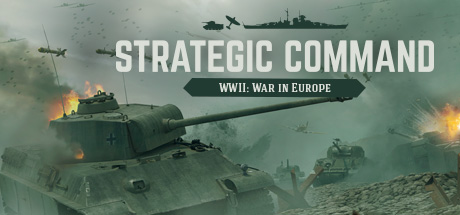
Strategic Command WWII: War in Europe is a deeply immersive turn based strategy game covering the greatest conflict in modern history!
Modeled estimate, not a reported figure. How we estimate →
Media

About
Genres
Stats
All-time low is the lowest price we've recorded for this game since we started tracking it.
Languages: English*, French*, German*, Spanish - Spain**languages with full audio support
Engagement
Hours played at review time, across 41 reviews with recorded playtime.
Reviews
Themes across 41 recent reviews and how positive each mention is. A keyword signal, not full sentiment analysis.
positive critical· bar length = how often the theme comes up
Reviews
Where to start... Well, since the community brings this up often, yes I did read the manual. I kept it open in a tab for hours to look up whatever I needed. It was often useless and vague or gave one-line descriptions that don't help. The game suffers from its railroading. Not to say railroading is fundamentally bad, but this particular brand of it is awful. Try playing the allies and damaging the German units. You have you HQ nearby, you're in good supply, you try to bomb them? Zero damage. Your first infantry army? Hits for zero damage but takes two damage back. Oh you didn't notice that artillery guns literally do ZERO damage at tech level 1? Well thanks for wasting your limited funds buying one to try and help soften up the enemy. Your tank trades 1 damage for 1 damage. Enemy turn. Germany perfectly cycles units in and out, hits your units for 2-4 damage every turn, even the Italian will do this as they are basically on-par with the Germans at the start of the game (Because historically Italian tanks were so good....), you are guaranteed to lose units permanently every time the enemy takes a turn because they always do a lot of damage and you often cannot even hit back, nevermind chipping away at them. It's an insanely effective cheese tactic that is baked into the AI and you basically cannot replicate it in the first half of the game. Half the game feels weak due to freely spawning things via events. I want to stress I am not criticising the production queue, that's obvious and you can plan for it as it tells you what is coming. But its things like "Oh no I don't have to worry as Britain because it will just freely spawn me 4-5 units in Egypt for the African campaign, defeating the entire point of worrying about shipping units over there". On the other side of the coin, as Italy you can't try and rush Britain in Egypt because they'll just get a bloated pile of free spawns. The USSR gets this en-masse as well once they join the war. What is the point of having a side of the game that is all about purchasing more units if you just keep dishing out freebies? It's hard to keep track of, you don't know when to expect it, and when it happens against you all you can do is sigh and try and cope with something you couldn't know was there before. A lot of the loss in immersion comes from just not being close to historical. The Germans conquered France with better tactics, but they were vastly outnumbered in real life. Why the hell does Germany attack the Benelux before invading Norway? Why the hell is the Norwegian campaign not here and instead Germany gets it all for free?! Wtf is this? Paratroopers feel overpowered as hell. Their transports have the same full 10 health as a proper fighter or bomber, and they are as a result guaranteed to make a successful landing. They are simply far too powerful and can take almost no damage achieving their goals. I'm 90% certain there's a bug with the AI being hyper-conservative with its navy, as Germany almost alway s keeps its navy in the baltic and you basically never see them even attempt to break out to raid you (except for all those submarines they get that are even pre-placed deep in the atlantic in one instance). Is this game unwinnable? No, of course not. But you'll find it's only winnable by complete obliteration of your enemy, overrunning them when they're out of new troops and simply driving around getting free captures of their territory. There's never enough units to form frontlines by the mid-point for anybody. The ranges for planes is very gimmicky. Strategic Bombers of World War 2 went extremely far, requiring heavier longer-range fighters to escort them. Instead it's normal fighters escorting them and the strategic bombers can barely cross the English Channel. They honestly should have +1 minimum range, and probably gain an additional +2 with each level of long range aircraft. There's often blatant ironies about who can go where. The axis can freely traverse Gibraltar as long as they wait one turn, the game literally has a special way added in for them to go past it. But can the UK or France send a single submarine past any route through Denmark? Nope, not allowed. Sorry you just can't raid Axis supply lines from Sweden. Sucks, huh? I strongly wish the game let me swap two units positions if both have the movement range to swap places. It's awkward having to force units to move into clearings in a busy frontline. The experience system seems entirely pointless. You must take losses to get exp, then you lose every single bit of experience to replenishment, not even keeping a shred of it. The decisions of the game basically break apart if you do not wish to control all nations. I tried a Britain only playthrough once, that is to say every other Allies nation is AI-controlled once I end my turn, and almost every decision was missing. France appears to dictate the majority of decisions that lead to British decisions and you don't even pressure them, so you get no Norway events, no Finland event, nothing. Why are so many decisions not available even with full control? Like if I play the UK, why am I forced to lend-lease the Soviets? Why are the soviets guaranteed to mobilize with about 20 free units and declare war in mid-1941 when that wasn't Stalin's plan irl, even if the germans aren't ready to go to war? Why does Japan always get Indochina off-map if France is still alive during the event? And especially, how come there's no impact on the German economy related to oil shortage as the war goes on, especially if they get bogged down early? A personal issue I had with this game was the UI Scaling. It forces me to use my desktop UI scaling. I have a 4K monitor and use 150% DPI Scaling. The game is still difficult to read and play without further scaling and really needs its own internal UI / Text scaling solutions. I want to like this game. I think it sort of lacks any structures related to warfare (e.g. radar installations), and I think there is some really BS imbalance going on. The early game is both punitive and not fun, with many unit types suffering doing zero damage and others being vastly overpowered for what they should be. There's too many freebies dished out, and great excuses for a new front to fight in are just not allowed (i.e. Norway). On a sale, ehh maybe. It could be so much better.
Here is a wargame that I believe almost gets it perfect. PERFECT! It's very easy to learn, especially when compared to Hearts of Iron IV or GG's War in the East. It's AI is fairly challenging, loads of scenarios and full campaigns, very editable with a good editor (this is so important as allows the player to play as they wish not how they must) and is still, after 10 years, enthusiastically supported by the Developers. I've asked two questions, at two different times, and had an answer the very next day. Amazing in this world of game companies that simply take your money and run. It has very simple to add or subtract Scripts, via a click, that allows you to tune certain aspects of your campaign at anytime. For example, don't want the USA sticking its nose into WW2 Europe and declaring war on you - CLICK. They won't. Loads of scripts already written and embedded within the game all to scratch that 'What if' itch. Honestly, as a hex based, wargame focused specifically on Army down to Brigade level - it's about as perfect as you're going to get. It is less detail-oriented than GG-WitE and focuses more on war fighting than HOI4. Yes, you have logistics issues, defining research priorities, upgrading and reinforcing units but it's a simplified system which doesn't swamp you with details so you focus on the fun stuff - fighting. It's great as the blend is perfect. The only con I can give, and I admit it is nitpicking, is its graphics quality of its map and it's counters; however, the game released in 2016! Nevertheless, this is quickly resolved with a mod or two. I think the Developers have left it like this to allow the user to choose what they prefer since the mods are super easy to install and turn on/off. I use the 'Iron Cross' counters, absolutely gorgeous and definitely made by a professional artist, and a map mod (Bleached Map_v2.1) which gives me the clarity and detail I need (so I don't end up in the marshes thinking it was forest) while greatly improving it's appearance. Done! That's it. I am thrilled I found this wargame as it fills for me the gap of not being too complex nor too simple - its almost perfect - well - as perfect as we'll get until true AI is integrated into games.
Strategic Command is a decent game, but it has limited replay value and many of its mechanics are intentionally simplified to make the game more approachable. Many World War II strategy games address this through vibrant modding communities. Unfortunately, Strategic Command does not. For years I assumed the surprisingly small modding community and limited amount of community content meant the editor must be difficult to use. After finally trying it, I discovered the opposite. The editor is remarkably approachable, the event system is flexible, and implementing new mechanics is much easier than I expected. I started by fixing a broken version of an existing mod for my own games. As the project grew, I naturally assumed I'd eventually share it with the community. That's when I discovered the community's attitude toward derivative work. The expectation from many long-time community members on the forums—the primary place where Strategic Command mods are shared—seems to be that derivative mods should not be released, even if the original author is fully credited. After spending a lot of time reading the forums, I also found very little evidence of collaborative development, shared projects, or people building on each other's work. Most major mods appear to remain the work of a single individual. That genuinely surprised me, especially given that the subject matter is World War II. History belongs to everyone. While original artwork, writing, and other creative assets deserve credit and respect, I struggle with the idea that someone can claim broad ownership over a historical scenario in a way that discourages others from building on it. Strategic Command is a niche game, but so is Hex of Steel. One has developed a collaborative modding ecosystem; the other, in my opinion, has developed a culture that discourages new contributors from building on existing work. Ultimately, this is a criticism of the developers. They built one of the most approachable editors I've seen in a World War II strategy game, yet they have allowed—and in some cases appeared to encourage—a community culture that discourages new modders from contributing and discourages collaboration between existing ones. For a niche game, that is a missed opportunity. I wanted to become part of the community. Instead, I left feeling that creating a derivative mod—even one that fully credits the original author and substantially expands upon the original—is viewed as something to discourage rather than celebrate. That's disappointing, because I think Strategic Command deserves a much larger and more collaborative modding community than it has today. ===================================================================== EDIT: The developer responded to this review on July 3rd accusing me of being an individual who created a derivative work off another mod then rather egregiously didn't credit the original author for years of work. I am not that individual, my response to the developer is in the comments below.
LO BUENO QUE NO EXISTÍA EL ESTADO DE ISRAEL
Strategic Command WWII: War in Europe is a deep and intricate grand strategy game that offers a comprehensive simulation of the European theater during the Second World War. Developed by Fury Software and published by Battlefront.com, it invites players to step into the shoes of either the Axis or Allied powers, managing vast military campaigns, resource allocation, and diplomatic maneuvers over a sprawling and historically rich map. For fans of strategy and history, this title delivers a detailed and rewarding experience that challenges both tactical skill and long-term strategic planning. At its core, the game combines turn-based operational warfare with high-level strategic management. Players are responsible for commanding armies, navies, and air forces across multiple fronts, with an emphasis on realistic military logistics, production, and supply lines. The scale of the game is impressive, covering not only major battles but also the complex interplay of economic and political factors that influenced the war’s outcome. Every decision—from where to deploy reinforcements to how to allocate industrial capacity—carries weight, and a misstep can cascade into strategic disaster. The depth of simulation ensures that veterans of grand strategy titles will find plenty to sink their teeth into, while newcomers may appreciate the gradual learning curve facilitated by detailed tutorials and scenario guides. Graphically, Strategic Command WWII opts for a functional, map-focused presentation rather than flashy visuals. The interface, while utilitarian, is well-organized and provides players with a wealth of information at a glance, including unit stats, terrain effects, and supply statuses. The map is divided into regions and provinces, each influencing movement and combat effectiveness. Although the visuals lack the polish of some modern strategy games, this clarity helps players focus on tactical and strategic decisions without unnecessary distraction. The user interface is customizable, allowing players to adjust how much information they see, which is critical given the game’s complexity. The game’s combat system emphasizes operational realism. Battles unfold over multiple turns, with terrain, weather, and unit composition affecting outcomes significantly. Players must consider not just brute force but also positioning, combined arms tactics, and maintaining supply lines. The inclusion of naval and air units adds further layers to combat strategy, as controlling the seas and skies can shift the balance of power. AI opponents generally offer a challenging experience, reacting dynamically to player actions and pushing for strategic advantages. Additionally, the game includes several historical and hypothetical scenarios, allowing players to explore alternate outcomes of key moments in the war. Diplomacy and production are equally crucial to success. Managing resources and industrial output requires careful balancing to maintain a steady flow of troops and equipment. Players must decide how to prioritize research and development, whether to bolster tank production or invest in air power, for example. Diplomatic actions can alter alliances and open new fronts, introducing an additional strategic dimension. While these systems are complex, they are well-integrated, and the game’s pacing ensures that players have the time to make thoughtful decisions. One potential challenge for players is the steep learning curve and the sheer amount of information to process. While tutorials and documentation are available, mastering all the nuances of warfare, production, and diplomacy requires patience and dedication. The game’s depth may initially seem overwhelming, but for those willing to invest the time, it offers a richly rewarding strategic experience that few other WWII titles match in scope and detail. In conclusion, Strategic Command WWII: War in Europe stands as a robust and detailed grand strategy game that delivers an authentic simulation of the European conflict during World War II. Its focus on operational realism, combined with strategic resource management and diplomatic complexity, offers a challenging and immersive experience for history buffs and strategy enthusiasts alike. Though it demands a significant time investment and a willingness to learn, the game rewards players with a deeply satisfying sense of control and accomplishment as they rewrite history on a grand scale. Rating: 8/10
This game punishes mistakes. I actually had this game in my library for years.. I fired it up once shortly after I purchased it and for some reason it just didn't connect with me. I fired it up again recently looking for something that I could play over PBEM with a disabled friend in a longterm care facility. Man.. am I ever glad I did. I ended up loving this game so much that I went and bought us the WW1 and American Civil War titles as well. Never could get the PBEM++ working but that is probably due to my friend's terrible internet connection. But I can see him playing this constantly as well.. Wonderful gem of a game. Even though we can't get the PBEM working for us, we share screenshots of our troubles and victories, so its still a good way to connect.
In diesem Rundenstrategiespiel kann alles einzeln gesteuert werden. Das gibt einerseits die ultimative Kontrolle, andererseits artet es für mich in Fleissarbeit aus. 5 U-Boote jeweils 4 Runden lang in den Atlantik schicken, dann wieder 4 Runden händisch zurück zum reparieren. Das man über mehrere Runden Wegpunkte setzt: Fehlanzeige. Und wenn man dann eine Runde endlich erledigt ist, kann man minutenlang die Züge des Gegners beobachten, weil es zusätzlich "Berechnungs-Pausen" gibt. Da bleibe ich lieber bei HoI4.
Good game. I am an civil engineer, amateur war historian, and old school wargamer. I recommend this game highly.
LOVE IT
it very goodd
Related
Related
Trends
Modeled estimate over time, reconstructed from Steam's monthly review histogram.
Momentum
Pace estimated from the game's recent review growth (our daily snapshots) at its own sales-per-review ratio — a momentum signal, not booked sales.
Engagement
DAU/MAU are modeled from peak concurrent players (≈×8 and ×28) — Steam publishes no active-user counts, so treat these as rough estimates, not reported figures.
Audience
Estimated from the language of this game's reviews — a proxy for where players are, not official Steam demographics.
Related
| Section 13 | $429.6K | 903 | 70% | $19.99 |
| Tiny Terry's Turbo Trip | $429.5K | 2.2K | 94% | $8.99 |
| Legendary | $429.4K | 2.7K | 56% | $5.99 |
| Nights of Azure | $429.4K | 678 | 70% | $29.99 |
| Lunar Flight | $429.3K | 680 | 81% | $14.99 |
| Syberia - Remastered | $429.8K | 802 | 72% | $29.99 |