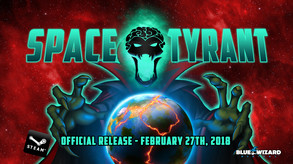
Terrorize the galaxy for fun and profit! Space Tyrant is a surprisingly deep beer & pretzels strategy game set in a darkly humorous future. Build a mighty space force, disintegrate peaceful aliens, and rule irresponsibly on your relentless march to total domination.
Modeled estimate, not a reported figure. How we estimate →
Media

About
Stats
All-time low is the lowest price we've recorded for this game since we started tracking it.
Languages: English**languages with full audio support
Engagement
Hours played at review time, across 40 reviews with recorded playtime.
Reviews
Themes across 40 recent reviews and how positive each mention is. A keyword signal, not full sentiment analysis.
positive critical· bar length = how often the theme comes up
Reviews
An interesting game that can be played in short sessions, or for longer marathons. Multiple factions and different card, commander, and unit options (upon unlock) provide replayability for future playthroughs.
Space Tyrant is a bold reinterpretation of the 4X strategy formula, taking a genre known for its complexity and long playtimes and compressing it into something fast, aggressive, and immediately accessible. Developed and published by Blue Wizard Digital, the game casts you not as a careful empire builder, but as an outright galactic tyrant whose goal is simple: conquer everything as quickly and ruthlessly as possible. It strips away much of the traditional micromanagement associated with 4X games and replaces it with a streamlined system that prioritizes momentum, making each session feel more like a rapid escalation than a slow burn. The structure of the game revolves around quick, self-contained campaigns where players expand across a galactic map by capturing planets and eliminating rival factions. Unlike more traditional strategy titles, there is little emphasis on gradual development or long-term infrastructure planning. Instead, the game pushes players toward constant action, rewarding aggressive expansion and punishing hesitation. This design creates a sense of urgency that is present from the very beginning, as the balance of power can shift quickly and opportunities must be seized before they disappear. The result is a gameplay loop that feels energetic and focused, where decisions are made rapidly and their consequences are felt almost immediately. One of the most defining mechanics is the tyranny system, which acts as both a resource and a measure of your dominance. Tyranny increases as you conquer planets and assert control, but it also decays over time due to unrest and resistance. If it falls too low, your empire collapses, bringing the game to an abrupt end. This system forces players to maintain a steady pace of conquest, preventing passive or overly cautious strategies. It also reinforces the game’s theme, as maintaining power requires constant expansion and suppression, creating a cycle where aggression is not just encouraged but necessary. Combat and conquest are handled through simplified systems that emphasize speed over detail. Battles resolve quickly, often influenced by a combination of fleet strength, upgrades, and a degree of randomness. While this reduces the level of direct control players have during engagements, it keeps the focus on broader strategic decisions rather than tactical micromanagement. The inclusion of cards and special abilities adds a layer of flexibility, allowing players to influence outcomes, disrupt opponents, or gain temporary advantages. These elements introduce variety without complicating the core mechanics, helping to maintain the game’s fast pace. Progression is tied to a campaign structure that gradually introduces new factions, abilities, and upgrades. Each faction offers unique traits that slightly alter how the game is played, encouraging experimentation and replayability. Over time, players unlock additional tools that expand their strategic options, creating a sense of growth that carries across multiple runs. This progression system helps offset the game’s relatively short sessions, giving players a reason to return and refine their approach even after failure. Visually, Space Tyrant adopts a colorful and stylized aesthetic that contrasts with its theme of domination. The exaggerated designs and playful animations give the game a distinct personality, while the interface remains clean and easy to navigate. This clarity is essential given the speed of gameplay, allowing players to quickly assess situations and make decisions without unnecessary distractions. The overall presentation supports the game’s tone, balancing humor with its underlying mechanics in a way that feels cohesive. The tone itself is one of the game’s most distinctive features. It embraces its premise with a sense of dark humor, encouraging players to act as a merciless ruler without moral hesitation. Events and decisions often present exaggerated scenarios that highlight the absurdity of absolute power, reinforcing the idea that the game is not meant to be taken too seriously. This approach adds charm, though it may not appeal to players looking for a more serious or immersive narrative experience. Despite its strengths, the game does have some limitations. The reliance on randomness in combat and events can lead to moments where outcomes feel outside the player’s control, occasionally undermining the sense of strategy. The streamlined design, while making the game accessible, also limits its depth compared to more traditional 4X titles. Once the core systems are understood, the lack of significant variation can make the experience feel repetitive over time, particularly for players seeking more complex or evolving mechanics. Even with these drawbacks, Space Tyrant succeeds in carving out a unique space within the strategy genre. It offers a version of 4X gameplay that is approachable, fast-paced, and consistently engaging, making it an excellent entry point for newcomers while still providing enough challenge to keep experienced players interested. Its focus on momentum and decision-making creates a satisfying loop that is easy to pick up and difficult to put down. In the end, Space Tyrant stands as a compelling example of how a well-defined concept can reshape a genre. By removing unnecessary complexity and emphasizing speed and accessibility, it delivers a streamlined experience that retains the essence of strategic play while making it more immediate and dynamic. It may not replace deeper strategy games, but it offers a refreshing alternative that is both entertaining and easy to revisit. Rating: 8/10
[i]Space Tyrant[/i] is a casual game that almost, [b]almost[/b] succeeds at smooth untaxing gameplay, but then proceeds to snatch failure from the jaws of victory. Shortly after the tutorial, the game introduces a new pause screen: at the start of each battle, you're forced to choose one out of three one-off activable effects. The effects are presented as pure white text descriptions with no icons and no colour coding. And you need to read them carefully, since while most of them are either situationally useless or actively harmful (and you're likely to get a completely useless hand), precious few can be a great boon. Amazingly, this tiny change turns combat tedious, and consequently completely kneecaps the flow of the game. And that pause didn't even need to be there! The game could've just as well just assigned one effect instead of forcing you to pick, or use easily identifiable icons and have time flow normally (there is, after all, an active pause for players that would need to read the tooltip descriptions). But now there's too much tedium such a shallow experience.
How do you reset back to start over once you learn how to play?
Ne se lance pas sous Steam OS.
A simple 4X-Card Game with meta-unlocks and a fun theme. A bit too easy in places, but quite fun to pass the time and especially for the price; Don't expect much complexity (!) It's a fun time killer, but certainly nothing more, there's not gonna be many things to discover or game mechanic complexity.
A fantastically made game. The music really sells the pulpy atmosphere, and the graphics are very crisp and clean. Very easy to enjoy. 10/10
Muy entretenido, aunque a veces demasiado difícil. De todas formas muy recomendable.
Fun
TL;DR: One of the three mission types can be so hard to win due to bad design and RNG that I can't recommend the game. I really wanted to like this game more. However, there are aspects that I just find so off-putting I can't recommend it. This is too bad, as there a number of things to like in terms of writing and art. However.... There are three basic mission types, two of which work pretty well. The third is at the mercy of the random set up and can be very difficult to win if you get a bad layout. This is so pronounced that, in order to win a campaign, I had to avoid this mission type entirely. The problem mission is the "Control the Omega Points", where you have to control two of three special planets for a number of turns. When playing this mission, the AI gets a lot of troops and is set to be very aggressive. Due to the nature of the combat system, sometimes the only way to beat the large AI fleets is to attack them multiple fleets and wear them down in waves. This means every fleet you send except the last one will be unavailable for a few turns, and some of the money you've spent will be lost. The main consequence of this is it will take time just to wipe out the enemy's initial advantage. During that time, if the victory planets spawned in bad locations for you, the enemy will easily get to them and conquer the two it needs to win. These missions come in difficulty for two to four stars. I lost every such mission I tried on four stars, and many of the three star ones as well. I almost never lost anything else on less than four stars once I learned how the game works. Losing one mission isn't the absolute end of your campaign, but it can be hard to recover from. Losing two missions is game over. The game doesn't have enough variety to make playing the early, lower difficulty missions over and over again fun. That coupled with the unbalanced difficulty spike represented by the Omega points mission causes me to give this a thumbs down.
Related
Related
Trends
Modeled estimate over time, reconstructed from Steam's monthly review histogram.
Momentum
Pace estimated from the game's recent review growth (our daily snapshots) at its own sales-per-review ratio — a momentum signal, not booked sales.
Audience
Estimated from the language of this game's reviews — a proxy for where players are, not official Steam demographics.
Related
| Initial Drift Online | $302.8K | 5.8K | 62% | $1.99 |
| Operencia: The Stolen Sun | $302.9K | 575 | 77% | $29.99 |
| Sandwalkers | $302.8K | 547 | 76% | $19.99 |
| Isekai Sex Boutique | $302.8K | 771 | 89% | $10.99 |
| Stranger of Sword City | $303K | 638 | 66% | $19.99 |
| Subterrain | $303K | 1K | 79% | $16.99 |