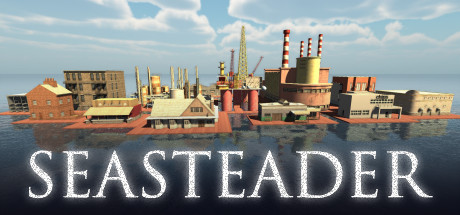
Seasteader is a city building and management strategy game that allows you to develop and rule over your own seastead, a floating community.
Modeled estimate, not a reported figure. How we estimate →
Media

About
Genres
Stats
All-time low is the lowest price we've recorded for this game since we started tracking it.
Languages: English
Engagement
Reviews
Interesting concept, but definitely not worth $30. Yeah, I'm still only in the tutorial, but: - It looks like a ghost town. You don't see anyone working. The only people movement I've seen is when they run single file at the same time between buildings at the start or end of day the day, to eat, or to deal with new construction. http://steamcommunity.com/sharedfiles/filedetails/?id=882548038 - For construction, a building looks like it's burnt until it changes to color. That means construction's done. - Night comes, the sky is black (no stars or moon), and there are no lights on or in any of the buildings. - Informational windows can't be moved and use a small thin font. - You can only have one window open at a time. However, it really seems like you need to be able to have multiple open so you can manage resources effectively. - There's no workshop. This game definitely needs modders adding content. Honestly, this feels more like early access to me. I'll see if I feel any different after spending, say, 10 hours in the game.
The game features a campaign mode that offers different objectives (income, population) for each scenario and an open-ended sandbox mode. The interface is very basic, allowing for access to construction menus and trading values, with simple overlays for resource locations. There is a limited number of buildings to choose from that either gather resources (fish, sand, oysters, oil, fruit, cotton, corn) or process them into other things (glass, plastic, gasoline, alcohol). You will end up building the same general structures in the same order each time through, based on which specialized areas (sand or oil deposits) are available. Once you are able to export enough goods to offset your daily maintenance, expansion is easy. Eventually, entertainment structures must be built or people will start to leave. There are random missions that pop up occasionally, but they involve simply producing a set amount of a specific good. Despite the unique setting, Seasteader doesn’t offer enough gameplay variety or innovation to make it stand out. https://www.youtube.com/watch?v=R0OLmG4Z7cs
Related
Related
Trends
Modeled estimate over time, reconstructed from Steam's monthly review histogram.
Hours played at review time, across 33 reviews with recorded playtime.
All in all, not bad, but probably too little content to be worth the pricetag. Seasteader is a kind of Tropico clone, only set at sea so there's no limitations on your building placement. You have a series of buildings which generate income. Each of these buildings needs some level of population to run it and costs money in maintenance, and may or may not require goods as income. They produce goods as output, which you can then sell periodically on the market to turn a profit. There's about 10-15 goods to trade in, like oil and fruit, and your population have a number of 'needs' like housing or entertainment that need to be topped up via service buildings. There's also hints of a class structure, though this is little-used in the game. Occasionally, you'll get a mission, like 'build an oil refinery', or an event will occur, like a price collapse in a given good. These are pretty solid mechanics and the game is nicely balanced. However, there's not really that much to do. You have 25-30 building types, and it's not that hard to build all of them within an hour or so. It's fun, but it's hard to see anyone streching the game out for more than 5-6 hours before they feel they've seen everyhting and done everything. This would be OK for a $15 game, but this is selling for twice that. Of course, Cozygoat might add more content over time, and there's a very solid basis for them to build on; it doesn't appear to crash - like, ever - and the socio-economic model is both reasonably comlpex and tightly balanced. A few additional features, like more varied and interesting events (disasters anyone?), or a loans or stockmarket system would add some much-needed challenge, since presently all the difficulty seeps out after you've been running a Seastead for 2 hours or so - it just becomes a matter of waiting for the net massive export wave. More high-end buildings would be cool, too, as would some greater gameplay impact from the highly detailed population model (some government simulation aspects, perhaps, with a degree of competition in the population). All in all, it's well worth picking up on sale - but I wouldn't recommend paying full price.
Seasteader: where you can make a town in the open ocean on wooden planks, just like I know we all want to do. The game is easy to pick up in terms of how to build but takes a deep dive with its market economy. The biggest drawback, by far, is the price tag. Seasteader has yet to show that it is a $30 game. There aren't a lot of individual assets that I noticed. Around 35-40 unique buildings and the task to manage people, wages, rent, and a market economy. Yet the game lacks the polish for their asking price. Don't get me wrong it IS a fun, casual, city-builder; I don't know if it is a $30 city-builder though. Pros: + Easy to learn building controls + Unique city-builder concept + Good soundtrack + Excellent Dev response time with patches Cons: - Game price is too high - Market economy makes me feel dumb Check out my in-game review: https://www.youtube.com/watch?v=Lt3nbHBCLxc
I normally wait until I've finished a game before I review it, but I've had a good 8 or more hours playing it, and I think I can give it a fair review now. Seasteader plays like may other city sim games: You have buildings, citizens, and so on. The citizens have needs, as does the city (not the least of which is liquidity (pun intended). You begin with a 'hub', and are required to balance the various aspects of your 'stead as you grow it towards passing the mission goals (or just making a humungous seaborne metropolis). The game allows a sandbox mode where everything's unlocked, and you can just freely build your city, or campaign mode where you get 'missions' to achieve goals. I think there are only about 15 campaign missions, and I've finished the first three, which are relatively easy once you understand the game mechanics. As you can see from the graphics, the game focusses less on being pretty with lots of animations and stuff, and primarily on the economic aspects. In this regard, Seasteader strikes a nice balance between clarity and functionality. You won't get all the amazing effects of Anno2050, or the huge array of building types of Tropico, but all the basic building types are there: Production chains, housing, entertainment, city upkeep, etc. What you will get is a game which provides you the ability to build a city much the same as any other CitySim, but which allows to really tweak the economic and employment aspects which most other games won't. This can be by price gouging for exports, making your citizens live in slums and pay huge rent, or forcing them to work every hour god sends... For me, one of the interesting aspects is building a new building, and then sourcing the right people to 'staff' it. You'll get an influx of immigrants, all of whom have their own skills. You can rob the mediocre fishermen to staff your glassworks, but that'll impact your fishing quotas.. You may, later, choose to move them back, to continue their fishermen training as you don't need so much glassware... Proper tweaking like this isn't needed in the first few levels, but I can see it coming into its own later. The game is 'complete', insofar as it's not "early access". However it's clear that there's a LOT of spare space in the UI and dropdowns for more options. Some buildings only make one resource type, but are flexibly built to support more. So what you see in the images above is a fraction of what's available, and only gives a wee flavour of the game itself. Because it's an indie game, it can be a little 'raw'. Like I said, don't expect the polish of a AAA game... There are some aspects you're just expected to play with yourself. If you like just tweaking sliders to see what happens, then you'll enjoy this. Some of the impact of changes to a few variables aren't laid out in simple terms, so you have to tweak them and see what happens. Sometimes the effects aren't obvious for a while. Having a team of "0%" skill level glassblowers will still produce you some glassware, whereas in real life they'd just suck up cash while they trained, and then you'd get a slowly increasing yield.. I think that realism needs to be tempered a bit with these things, so has taken a back-seat to allow clarity and simplicity to prevail. I'm giving it a 75% thumbs up: It does need a little work to be more accessible to the general gamer, and a little tweaking. There are a few unusual design choices which can give the learning curve a slightly steeper slope than you'd expect, but it's a solid core with some interesting challenge. UPDATE(Dec 2019) Unfortunately the game has been abandoned by the developer due to some very negative personal remarks by players. Sadly, the game was released at full price while still under development, and a lot of people took exception to the issues still present, and the general indie-feel to the game, expecting something more polished. It's a real shame because there are many different resource types, and the focus of the game is on people, rather than buildings, which is nice. Unfortunately, because the game has been abandoned, the later levels aren't quite as balanced as they need to be. If the game is on sale for under a fiver it'd be worth it just to experiment with the economy, but at the moment it's still over £10. If the developer ever comes back and implements all the features on the original roadmap, this'd be a fab game.
Seasteader in its current form is WAY to slow to keep your attention for longer than 30 minutes. I tried to tough it out by telling myself it will get better. But 30 days into the game and with only a population of 33 people to supply jobs of 45 people. I had to say enough time has been wasted and stop playing. Gameplay has to be played on fastest speed to get anything done, and money needs to be made faster so the players can feel like we are building something. In its current form I say 2/10 and don't bother. I will of course say that it is still early and this game may become a great title.
It's a good game overall. However, the game would benefit from more production and manufactering options, such as a cannery, and perhaps the ability to grow tobacco and manufacture cigars.
Jeu de construction de ville sur l'océan est interéssant, mais pas fini. le système de construction est facile à comprendre et à utiliser. Les moyens de faire de l'argent avec la production restent encore un mystère... Le réglage de la vitesse du temps reste a optimiser (le temps réel est vraiment réel!), les nuits ne peuvent être utilisées pour finaliser les constructions entreprises (35 heures obligent). Quelques bugs mais jouable en l'état (le prix en fait partie!). Note: 7/10
[i] This Review Originally Appeared on IndieHangover at: http://www.indiehangover.com/review-seasteader-by-cosy-goat/[/i] I’ve followed Seasteader for quite some time, and was eager to finally found my own sea based colony. Rich in micro management, and with surprising depth, Seasteader is a solid simulation game that fans of the genre will love, despite a few mechanical issues. Seasteader puts you in the role of designing and managing a seastead, a largely self-sufficient community based on the open ocean. Seasteads are a real world endeavor, most often being built on derelict oil platforms, but your’s is built on an ever expanding raft of sorts. Each story mission gives you a set of goals, mainly to reach a certain population and profit, to meet in order to be considered a viable investment. The main things you’ll be working against in Seasteader is your budget and your people’s happiness. Your budget is pretty self-explanatory: money in (trade profit and rent) versus money out (construction and upkeep expenses). Happiness is a little more nuanced though. At first, your initial colonists will be happy just to have a paying job, a roof to sleep under and food to eat, and having these things will always guarantee some immigrants are eager to come to your seastead. However, as your colony grows, you’ll need to provide other forms of diversion and entertainment. While things start slowly and are relatively manageable, as you progress you’ll see things get more and more complex. Supply chains combine to let you make incredible profits by manufacturing more complicated good. You’ll become more and more self reliant, producing the different parts each of your buildings need. The depth of Seasteader is really quite impressive. One of the things that set Seasteader apart from other simulation games is the lack of terrain. There are no mountains in your way, no streams to build along, no forest to be situated near: there is only the sea. The game only has two resources (oil and shallow water) the effect the placement of a few key production buildings, but otherwise, you have free reign to design your seastead however you’d like. It’s quite liberating to be able to build on a blank canvas, and it’s a very nice change of pace. Seasteader’s controls aren’t incredibly intuitive. I wouldn’t in any way call them bad or impossible to use, but they do make a departure from many standard keybindings and layouts to other games. This means that it may take you a little bit of time to get use to what does what. All of the controls are explained very clearly in the game’s tutorial, and it didn’t take me long to adapt, but it was something the stood out to me. The only parts of the game that gave me significant trouble was the Demolish and Walkway mechanics, which I found incredibly difficult to make work correctly. Certain tiles just could not be deleted no mater what I did, and walkways were very finicky to get laid down where I wanted them. The frustration that these two pieces of the game gave me was significant enough to cause me to restart more than once. Seasteader is, like its counterparts, a micro management heavy game. You’ll be spending a lot of time looking at different windows, adjusting work shift, wages, and rents. Some people will eat this up, and others wouldn’t dare touch it with a ten foot pole. That’s fine, and Seasteader won’t be a game for everyone, just know that this is a slower paced game focused on numbers. In fact, I particularly like the pacing of Seasteader. You’re punished horribly for over expanding too early in the game, and it is very important to watch your profit and expenses, figure out what your growing seastead can bear, and not be too tempted by every investment opportunitty that comes along. Everything is focused on getting the most economic efficiency out of every part of this seastead, and the game very quickly becomes a very dense, numbers focused affair, less about providing food to people and more about rent and wage control. Visually, Seasteader doesn’t push any artistic boundaries, but matches the aesthetic it is aiming for perfectly. All of the buildings, people and environments are depicted in a style that reminds me of an architectural program, which fits with the general aesthetic of this kind of simulation and management game fantastically. Once things get on there way, it’s enjoyable to watch your carefully crafted seastead bustling away, watching people going to and from work, or to get food at the canteen. One thing that particularly surprised me was the quality of Seasteader’s music. It’s an incredibly peaceful soundtrack, with a distinct seas shanty vibe I absolutely fell in love with. Seasteader is a niche game that fans of dense simulation games will enjoy. This goes doubly so if you enjoy the economic side of colony management, as this is where Seasteader really shines. Despite a few rather glaring mechanical issues, I found the process of planning and constructing a seastead both incredibly calming and stimulation, where the serene environment combined with some intense number crunching and micro-management. [i] Find More Reviews, Interviews and Previews from the world of Indie Games and Indie Game Development at www.IndieHangover.com | On Twitter at [url=https://twitter.com/IndieHangover]@IndieHangover[/url][/i]
I haven't played this type of game for a very long time, so it was a nice change of pace. Easy to get into, and I didnt want to quit. Definitely glad I purchased this.
Momentum
Pace estimated from the game's recent review growth (our daily snapshots) at its own sales-per-review ratio — a momentum signal, not booked sales.
Audience
Estimated from the language of this game's reviews — a proxy for where players are, not official Steam demographics.
Related
| Secrets of Me | $16.7K | 55 | 69% | $15.99 |
| Sole Saga | $16.7K | 115 | 75% | $6.99 |
| Bloodsports.TV | $16.7K | 675 | 78% | $0.99 |
| God of Light: Remastered | $16.7K | 99 | 91% | $9.99 |
| Midnight's Blessing | $16.7K | 66 | 55% | $9.99 |
| Battle Planet - Judgement Day | $16.7K | 81 | 89% | $9.99 |