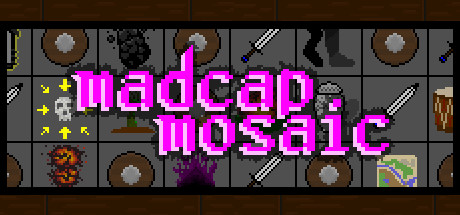
Carefully craft your Mosaic in this fantasy themed deckbuilding game. Battle by battle, tile by tile, you'll form synergies and build up your Mosaic's combo potential, hoping to beat the curve as you forge deeper into enemy territory.
Modeled estimate, not a reported figure. How we estimate →
Media
About
Stats
All-time low is the lowest price we've recorded for this game since we started tracking it.
Languages: English
Engagement
Hours played at review time, across 40 reviews with recorded playtime.
Reviews
Themes across 40 recent reviews and how positive each mention is. A keyword signal, not full sentiment analysis.
positive critical· bar length = how often the theme comes up
Reviews
Madcap Mosaic: the Selected Works Review Selected Works Curator Page: https://store.steampowered.com/curator/44858736/ The Dream Quest parallels are real: a homespun look, a trailblazing suite of mechanics, and a positive blurb from Magic the Gathering creator Richard Garfield...if you've found your way to this store page, if you're reading this review, you don't need to keep reading, you should just buy Madcap Mosaic. Current theory: all deckbuilders, whether they know it or not, trace their lineage - and a key part of their appeal - back to Solitaire; although denser, and expanded, every element in a deckbuilder, including (but not limited to!) the cards themselves, are dealt out to you [i] like [/i] cards; possibilities disbursed from a central stack of possibilities that it is your job to manipulate in hopes of achieving a win state. The 'one more run' magnetism of these kinds of games comes from the friction between your external choices and their effect against this little world of premade, limited possibility. In a tabletop game like solitaire, that possibility space is much smaller, which allows your choices to take center stage; most deckbuilders operate on the extreme other end of the spectrum. Think of the way in which your class in Slay the Spire, before you've even started playing, winnows your avenues of play down to (admittedly many) variations on a couple of game concepts (poison, block, channeling, etc). Putting the awesome, pioneering mosaic/lattice mechanics to one side, Madcap Mosaic's other major success is in landing between these two extremes. Compared to higher-profile stablemates like StS, it channels a purer stream of tabletop/board/card game energy, while at the same time remaining fully infused with the expanded possibility space that its digital nature allows for. Opening MM, you can almost hear the tiles spilling out out onto a big table and, when you take your two starting perks and start to work on killing your first Bear (ursus arctos is a chump in MM), you get that same ancient-feeling frisson that you do when you deal yourself into a game of Klondike. But then you start to draft more interesting tiles into your mosaic, tiles that transform or manipulate or respond to other tiles, and a few battles later you're doing things that you could never do in a meatspace production without a brain-flattening amount of fiddliness. Less abstractly, those Perks are another major stroke of genius in Madcap. Rather than pick a class, you always start with the same basic collection of Shield and Sword tiles, but you have two Perks, randomly assigned, that give you a clutch of advantages, suggesting possible things you may want to look for in the Lattice interludes between each battle, where you replace a pair of tiles with new ones. Sometimes the perks shout a particular strategy, sometimes they merely nudge your thoughts in a specific direction; sometimes they synergize together in a way that seems almost TOO good, while at others times they almost move at cross-purposes, with counter-forces that can trip you up without some serious lateral thinking. Maybe a better player than I am can win more often, but when I play Madcap I'm reminded of Klondike solitaire, which has a win percentage of something like 30% with (presumably perfect) play. The more I played Madcap, the more I learned healthy strategies to nudge things in my favor, but you have to be philosophical in your approach here, because sometimes the tiles just aren't favoring you; and that's okay, better than okay actually, because it makes you appreciate the game in itself, the richness of its mechanics, the way it can refresh itself over & over and give you that satisfying, brain-massaging feel that is one of the things that only games (tabletop and digital) can give you. Your choices and the game's mechanics share center stage; neither takes precedence, and that's a joyful thing indeed. Man, what a game. Madcap Mosaic should have been extolled loudly by every gaming site. Of course, 'games journalists' are less writers/thinkers/gamers than reference-artisans, cobbling together articles to garner clicks, assembling their 'reviews' out of a tired, etiolated corral of SEO-approved buzzwords rather than their actual human thoughts about the art in front of them... Good news is, if you're here already, it doesn't matter; you can just buy Madcap and enjoy it. Like Dream Quest, it will definitely inspire other games; I think in a year or two there will be bigger indie productions with a glossier take on the mosaic concept, something that may be very good in itself but obviously more palatable to the mainstream games site brain. And like Dream Quest, Madcap will still stand on its own as one of the peaks in a field of imitators, no matter those imitators' qualities. It's an absolute gem.
Original. Madcap Mosaic calls itself a «deckbuilder roguelite», but I think its mechanics are innovative enough for it to be considered a separate, brand new genre. You don't have cards, you have tiles, and your tiles get randomly placed on a board each battle. Then, moving over the tiles (usually) uses them. You add new tiles to the board after the battle, and there are a -lot- of tiles to choose from. There's depth and strategic thinking -- just have a look at the game's Steam achievements and see how interesting they sound. There aren't a lot of enemy types, but each one is unique and distinct. Once you learn how the game works and gain some experience with it, it's very much on the easy side -- as long as you don't stop thinking and don't get extremely bad luck, you'll win. But it's still engaging and far from trivial, which makes it a nice way to spend your time while keeping your brain engaged. I'm sure that whatever wins this years' «Most Innovative Gameplay» Steam award will have nothing on this gem.
This is an example of a game filled with great ideas, but a poor interface and lack of information make it frustrating to understand. The developer may know what certain keywords and effects do, but don't assume we can read minds. https://www.youtube.com/watch?v=ZZAKU9A1_h0
Recommended only for the novelty of the concept. Not worth buying for any reason other than that it does something you've not seen in other roguelikes. The art and sound design are practically non-existant, and the gameplay itself is exceedingly rough. It is needlessly restrictive, hostile towards the player, and overly reliant on RNG. When the novelty wears off, it's actually very un-fun to play. These design flaws could be easily solved, so I held off on this review to give the developer some time to work on the game. But several months down the line, we still don't have base backtracking to give more agency to the player, and enemies are still 60% RNG. I don't recommend this game. But I commend the developer for being the first to stumble upon this mechanic. I hope to see it implemented successfully in the future.
Getting to progression parts seems difficult as all hell. It's hard to know a strategy when you can't really get the info you need easily. RNGesus praying is needed to secure some foothold to allow skill to take over.
This game is such a gem. It looks dated as fug but the core idea is amazing. Anyone who enjoys strategy, synergy, randomness and thinking through your next move should insta-buy this. You will get much more bang for the buck out of this than many other in the genre. Game is also very challenging, it will take you a while to finish it with lots to unlock.
牌库和抓牌都以棋盘展现的卡组构筑游戏。游戏机制整体上很有趣,有不小潜力。 让人不爽的是,抓牌时随机性太强,往往一局里有近一半的牌都是点问号随机抓的。 解锁系统也比较无聊,宝箱解锁的牌和被动大多平平无奇,为什么要把它们锁起来呢?
Madcap Mosaic is an impressively inventive roguelike strategy game that reimagines traditional deckbuilding mechanics through a completely unique movement-based combat system. Developed and published by 1classydude, the game abandons familiar card-hand management in favor of a tactical grid called the Mosaic, where every tile represents attacks, defensive abilities, movement effects, or powerful combo mechanics. Instead of simply selecting cards from a hand each turn, players physically move across their grid to activate abilities in carefully planned sequences. This unusual design creates a combat system that feels part deckbuilder, part puzzle game, and part tactical strategy experience, resulting in one of the more original indie roguelikes released in recent years. The Mosaic mechanic is the core of the entire experience and easily its greatest strength. Every movement across the grid matters because the path players take determines which abilities activate and in what order. Offensive tiles trigger attacks, defensive spaces generate shields, and specialized tiles introduce more advanced effects capable of reshaping entire turns. Planning routes through the Mosaic becomes increasingly complex as new mechanics are introduced, forcing players to constantly think ahead and anticipate how enemy encounters will unfold. Unlike many deckbuilders where players react moment to moment, Madcap Mosaic rewards long-term planning and spatial awareness, making victories feel deeply satisfying when complicated combos finally work exactly as intended. One of the most interesting aspects of the game is how naturally its strategic depth evolves over time. Early runs begin with relatively simple movement and attack patterns, but the system gradually expands into something far more elaborate once players unlock advanced tiles and stronger synergies. Some builds revolve around chaining together huge offensive routes, while others focus on manipulation, survivability, or efficient resource generation. Because every new tile changes how the Mosaic functions, progression constantly feels meaningful. Discovering combinations that completely transform a build becomes incredibly addictive, especially when players begin understanding how seemingly unrelated effects can create devastating chain reactions. The game’s drafting system also deserves significant praise because it avoids relying entirely on random card rewards. Instead of simply choosing from generic post-battle upgrades, players expand their builds through a branching progression system called the Lattice. Every decision affects future opportunities, creating a stronger sense of long-term planning than most roguelikes offer. This structure encourages experimentation while still forcing players to adapt when ideal combinations fail to appear. Runs rarely unfold the same way twice, which gives the game excellent replayability without relying solely on randomization. Enemy encounters remain consistently engaging because combat is built around movement and positioning rather than passive number trading. Enemies attack in distinct patterns that force players to rethink routes and prioritize survival alongside damage output. Some opponents punish overly aggressive strategies, while others pressure slower defensive builds by limiting movement opportunities. Boss encounters are particularly strong because they fully test the player’s understanding of the Mosaic system. By the later stages of a successful run, battles become tense tactical puzzles where every step can determine survival or failure. Visually, Madcap Mosaic uses a relatively minimalist retro-inspired style that emphasizes clarity over graphical complexity. At first glance, the presentation may appear simple compared to larger deckbuilders, but the clean design quickly proves beneficial once the combat mechanics become more complicated. The grid remains easy to read even during chaotic turns filled with multiple activations and chain effects, preventing visual clutter from interfering with strategy. Enemy designs and environments may not be highly detailed, but they still contain enough personality to support the fantasy atmosphere effectively. The soundtrack and audio design complement the gameplay nicely without overwhelming it. Music tracks maintain a calm but focused energy that fits the thoughtful pacing of combat, while sound effects tied to movement and tile activations provide satisfying feedback during successful combos. The audio package is subtle overall, but that restraint works in the game’s favor because the gameplay itself already demands considerable concentration. The biggest challenge for many players will likely be the learning curve. Madcap Mosaic introduces mechanics that differ significantly from traditional roguelike deckbuilders, and understanding efficient movement planning can initially feel overwhelming. Early runs may seem confusing or punishing until players fully grasp how route optimization and tile interactions function together. Some starting builds also feel slower and less exciting compared to the complex strategies available later in the game. However, once the mechanics click, the depth of the system becomes one of the game’s most rewarding qualities. The game’s smaller indie scope also means certain elements lack variety over extended play sessions. While the strategic systems remain excellent, some enemy types and visual environments eventually begin to repeat. The presentation, though functional, may also feel too minimalist for players who prefer larger-scale roguelikes with extensive narrative content or cinematic flair. Still, the gameplay systems are strong enough that these shortcomings rarely damage the overall experience significantly. What makes Madcap Mosaic stand out so strongly is its willingness to experiment with genre conventions in a meaningful way. Many indie deckbuilders borrow heavily from existing formulas, but this game introduces mechanics that genuinely feel fresh and mechanically distinct. It captures the addictive progression and experimentation that make roguelikes enjoyable while adding a layer of spatial strategy rarely explored within the genre. Madcap Mosaic is ultimately a smart, creative, and highly replayable indie strategy game that rewards patience, experimentation, and careful planning. Players willing to invest time into learning its systems will discover an incredibly satisfying tactical experience built around one of the most original combat concepts seen in modern roguelikes. While its minimalist presentation and steep learning curve may not appeal to everyone, fans of strategic deckbuilders looking for something genuinely different will likely find it exceptionally rewarding. Rating: 8/10
There are some criminally overlooked games on this platform and this is one of the most egregious. It's part of the silly but popular genre of deckbuilder roguelikes where you play mtg against a series of monsters. What sets it apart is that instead of a linear deck of cards, you have a 2D grid of tiles that you move over. Your "hand" is the adjacent tiles and you "draw" more by revealing new ones as you move. Going from 1D to 2D vastly increases your freedom of decision and allows for a ton of interesting mechanics and interactions not possible in a normal deckbuilder. This is an inherently superior game to slay the spire et al.
Edit 10/09/23: Yup. Still applicable. Such an addicting gameplay loop. I can’t stop at all. It’s really difficult. I’ve played A LOT of runs and maybe 3 wins. I’m ok with it. Very very ok with it. Original Review: Honest assessment after finding this game just the other day by a random chance through a bundle offer here on steam. I haven’t sunk a lot of hours into madcap mosaic quite yet, but can immediately recognize it’s unique concepts and gameplay within the roguelike/lite and deckbuilding genres. If you’re a fan of these types of games I can not implore you enough to support this dev by giving this game a try. This is a dev that deserves to be supported for such a novel presentation of deckbuilding mechanisms. It may not be an aesthetically beautiful game, but it doesn’t have to be at all with such engaging gameplay. Don’t make the mistake of allowing graphics to deter you from experiencing Madcap Mosaic. This game should be much bigger and on the radars of fans of these genres. My only thought early on in my time with this game is that I wish there was a little more clarity on the acronyms/effects and what they do. Maybe a menu or something that breaks down exactly what those effects and abbreviations do/stand for. I’m a sucker for achievements and steam cards/badges, so I’ll cast a vote for more of those, but know they aren’t necessary. Playing on steamdeck and works great. Zero crashing or weirdness. Responsive and awesome developer to boot!
Related
Related
Trends
Concurrent players on Steam, sampled daily since tracking started.
Momentum
Pace estimated from the game's recent review growth (our daily snapshots) at its own sales-per-review ratio — a momentum signal, not booked sales.
Audience
Estimated from the language of this game's reviews — a proxy for where players are, not official Steam demographics.
Related
| 7 Days to Die | $425.3M | 403.5K | 87% | $44.99 |
| Mount & Blade II: Bannerlord | $309.8M | 293.9K | 88% | $49.99 |
| Squad | $166.3M | 240.4K | 81% | $39.99 |
| Satisfactory | $164.4M | 275.8K | 97% | $27.99 |
| Kerbal Space Program | $154.7M | 144.7K | 96% | $39.99 |
| RimWorld | $149.6M | 205.9K | 98% | $34.99 |
Related
| Puzzle Compound | $11.9K | 68 | 93% | $11.99 |
| Drift Reign | $11.9K | 64 | 55% | $5.99 |
| My Little Kitties | $11.9K | 63 | 95% | $9.99 |
| Word Rescue | $11.9K | 105 | 74% | $4.99 |
| Skullborn | $11.9K | 64 | 77% | $8.99 |
| Transporter Truck Simulator | $11.9K | 86 | 80% | $0.54 |