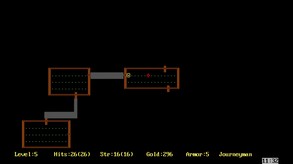
Experience the commercial port of the game that spawned a thousand 'Rogue-likes'. Venture into the Dungeons of Doom in search of the legendary Amulet of Yendor, and hopefully escape with your life! Randomly generated dungeons await you, full of nasty monsters, insidious traps, and glittering loot.
Modeled estimate, not a reported figure. How we estimate →
Media

About
Stats
All-time low is the lowest price we've recorded for this game since we started tracking it.
Languages: English
Engagement
Hours played at review time, across 40 reviews with recorded playtime.
Reviews
Themes across 40 recent reviews and how positive each mention is. A keyword signal, not full sentiment analysis.
positive critical· bar length = how often the theme comes up
Reviews
i think this is a roguelike
I don't know why I payed 3 € for this. I could have simply looked for a way to play Rogue and would have found the Retro Rogue Collection which does virtually the same thing, but is free.
Rogue, originally developed by Epyx, Inc. and later published on Steam by Pixel Games UK, stands as one of the most historically significant titles ever released in the medium. This is not merely a retro curiosity or a nostalgic re-release; it is the foundational blueprint for the entire roguelike genre. Nearly every modern procedural dungeon crawler, from traditional turn-based descendants to fast-paced roguelites, traces its lineage back to this stark, uncompromising experience. Playing it today is less about spectacle and more about engaging directly with the DNA of systemic game design. At its core, Rogue is a dungeon exploration game built around procedural generation and permadeath. Each time you begin a run, the Dungeons of Doom are assembled anew: rooms, corridors, monsters, traps, treasure, and loot are arranged unpredictably. There are no scripted layouts to memorize, no guaranteed item placements, and no safety nets once danger escalates. If your character dies, the adventure ends permanently. This structure creates an intensity that feels remarkably modern despite the game’s age. Every decision—whether to open a suspicious door, descend another level, drink an unidentified potion, or engage a monster—carries meaningful risk. The tension arises not from cinematic storytelling but from the awareness that progress is fragile and survival depends entirely on judgment and planning. Visually, Rogue is famously composed of ASCII characters. The player character, enemies, items, walls, and floors are represented by letters and symbols rather than sprites or textures. What initially appears primitive quickly reveals a kind of elegant abstraction. Because the graphics are symbolic, the imagination fills in the details. A capital “D” becomes a dragon not because of animation but because of context and consequence. This abstraction focuses attention squarely on mechanics: resource management, positioning, inventory choices, and tactical movement. Without visual noise, players are forced to think strategically, learning to read the dungeon like a language of symbols rather than a painted world. The game’s systems are deceptively deep. Equipment identification is not automatic; potions, scrolls, and magical items often have unknown effects until tested. A scroll might strengthen your weapon—or curse it. A potion might restore health—or poison you. This uncertainty encourages experimentation and memory-building across multiple runs. Over time, players begin to recognize patterns and develop instincts about risk mitigation. Food management adds another layer of pressure, as starvation is a constant threat if exploration is inefficient. Combat itself is straightforward in execution but complex in implication, as positioning and preparation frequently matter more than raw statistics. What makes Rogue enduring is how cleanly its mechanics interlock. Procedural generation ensures unpredictability, permadeath ensures consequence, and limited information ensures tension. These three pillars create emergent storytelling long before that term became common in design discourse. A narrow escape from a powerful monster, a desperate gamble with an unidentified scroll, or a catastrophic miscalculation that ends a promising run all become memorable anecdotes shaped entirely by systems rather than scripted events. This quality gives Rogue a timeless feel; even decades later, the core loop remains compelling for players who appreciate challenge-driven design. However, the same qualities that define Rogue’s brilliance can also make it inaccessible to some modern players. The interface relies heavily on keyboard commands, and there is little in the way of tutorials or onboarding. It expects patience, curiosity, and a willingness to fail repeatedly. There are no modern conveniences such as extensive tooltips, autosaves, or guided objectives. For players accustomed to contemporary design philosophies that prioritize accessibility and gradual progression, Rogue can feel harsh or opaque. Yet for those who embrace its ethos, this austerity becomes part of its charm. The absence of hand-holding reinforces the feeling that survival is earned rather than granted. Experiencing Rogue through this Steam release provides a convenient way to access a piece of gaming history in its original form. While free versions and open-source derivatives exist, this commercial edition preserves the classic Epyx iteration, allowing players to engage with the title as it was presented during the early era of home computing. It serves both as a playable artifact and as a reminder of how much modern game design owes to its innovations. The very term “roguelike” exists because of this game’s influence, and its structural principles continue to inform titles across genres. Ultimately, Rogue is less about visual spectacle and more about design purity. It distills dungeon crawling to its essential components: exploration, uncertainty, consequence, and mastery through repetition. For players interested in the origins of procedural generation and permadeath mechanics, it offers an unfiltered experience that still holds up as a strategic challenge. While it may not appeal to everyone, particularly those seeking narrative depth or audiovisual immersion, it remains a landmark achievement. Its simplicity is not a limitation but a testament to how powerful carefully constructed systems can be when stripped of excess and allowed to stand on their own. Rating: 8/10
Seems like a rogue if you ask me
it's like if peglin didn't suck complete ass
Rogue
An innovative take on the classic formula of Roguelikes. Definitely not genre defining, but it's pretty close. Hard to say that some games won't take atleast some inspiration from it.
The one who started it all
very fun the further you go and gets more and more challenging.... recommended
classic game that started a whole genre, and for good reason. And despite all of the amazing games this laid the path for, I often find myself drawn back to the original. It still holds up very well once you learn the controls and UI. the loop is addicting. there is a good mix of luck and skill required to progress. The turn based movement and battles really let you think every action through, so the deaths feel pretty fair. It's brutally difficult, in fact it's one of the hardest games I've played. but at the same time it's short and easy to hop back into another run. This game was designed as a role playing game, and despite starting the rogue-like genre it is an 80s RPG at it's core. You name your rogue, level them up and choose what gear to use, with options between melee, ranged and magic found throughout the dungeons. The mechanics are very heavily inspired by DnD as with most early role playing games. These roleplaying mechanics add a lot of depth to each run. As with most old games, the manual is practically required. The controls and UI are archaic by today's standards, but they still work for the game. There is no tutorial. All of the game's info from controls, mechanics, UI to even story and lore are all found in the manual. I highly recommend this game to fans of rogue-likes who want to see where the genre started, and to fans of old school RPGs.
Related
Related
Trends
Concurrent players on Steam, sampled daily since tracking started.
Audience
Estimated from the language of this game's reviews — a proxy for where players are, not official Steam demographics.
Related
| 7 Days to Die | $425.3M | 403.5K | 87% | $44.99 |
| Mount & Blade II: Bannerlord | $309.8M | 293.9K | 88% | $49.99 |
| Divinity: Original Sin 2 - Definitive Edition | $169.5M | 204.5K | 96% | $44.99 |
| Don't Starve Together | $130.6M | 373.1K | 95% | $14.99 |
| Middle-earth™: Shadow of War™ | $118M | 116.1K | 89% | $49.99 |
| Mount & Blade: Warband | $101.9M | 171.6K | 98% | $19.99 |
Related
| Cat Girl Survivor | $27.7K | 73 | 70% | $14.99 |
| Dancin' Divas | $27.7K | 73 | 95% | $14.99 |
| Strangers on Paper | $27.7K | 73 | 85% | $9.99 |
| HER TREES : THE PUZZLE HOUSE | $27.7K | 955 | 95% | $1.99 |
| Runehaven | $27.7K | 108 | 92% | $9.99 |
| Eleanor in Miami: Chains of depravity | $27.7K | 108 | 84% | $9.99 |