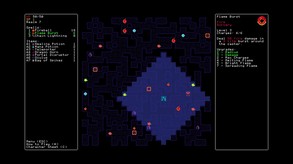
Rift Wizard by Dylan White is a rigorously designed traditional roguelike that strips away nearly everything extraneous to focus entirely on tactical combat and spell-driven build creation. It presents only the barest narrative framing—you are a powerful wizard moving through hostile realms toward an ultimate confrontation—but that premise exists mainly to justify the gameplay rather than to carry it. From the outset, the game makes its priorities clear: it is about systems, choices, and consequences, and it expects the player to engage with those systems on a deep level.
Each run is structured as a sequence of contained combat arenas, where the objective is to eliminate all enemies before moving on to the next stage. There are no towns, no inventory management in the traditional sense, and very little downtime between encounters. This creates a constant forward momentum where every level is another tactical problem to solve. The simplicity of this structure is deceptive, because within it lies an enormous amount of complexity. Every encounter demands careful positioning, awareness of enemy behavior, and thoughtful use of abilities, and the game rarely allows for careless play.
The spell system is the heart of the experience and the primary source of its depth. Players have access to a large and varied selection of spells across different schools of magic, each with unique effects and interactions. As you progress through a run, you earn points that can be invested into expanding your spell repertoire or enhancing existing abilities. This creates a strong sense of ownership over your build, as you are constantly shaping how your character functions. The game encourages experimentation, allowing for a wide range of strategies—from direct damage and area control to summoning allies or manipulating the battlefield in more indirect ways.
What makes this system particularly compelling is how interconnected everything feels. Spells are not isolated tools; they often interact in ways that create powerful synergies or unexpected outcomes. Learning how these interactions work is a key part of mastering the game, and it adds a layer of discovery that keeps each run engaging. At the same time, the freedom to specialize comes with risk. Focusing too heavily on a single approach can leave you vulnerable to certain enemy types, forcing you to think ahead and build with flexibility in mind.
Combat unfolds in a turn-based format that emphasizes deliberate decision-making. Every action matters, and the consequences of a mistake can be immediate and severe. Enemy design plays a crucial role in maintaining this tension, with each type introducing distinct abilities and patterns that must be accounted for. As the game progresses, encounters become increasingly complex, combining multiple threats in ways that require careful planning and adaptation. The result is a series of battles that feel more like intricate puzzles than straightforward fights, rewarding players who take the time to understand the systems at play.
Difficulty is one of the game’s defining characteristics. Rift Wizard is unapologetically challenging, offering little in the way of forgiveness for errors. Runs can end quickly, sometimes due to a single misjudgment or an interaction that was not fully understood. This can be frustrating, especially for new players, but it also reinforces the game’s emphasis on learning and mastery. Each failure provides information that can be applied to future attempts, creating a cycle of experimentation and improvement. Over time, the challenge shifts from feeling overwhelming to feeling precise, as players gain a deeper understanding of the mechanics.
Visually, the game adopts a minimalist approach that prioritizes clarity over detail. The graphics are simple, with a focus on readability that ensures players can easily interpret the state of the battlefield. While this presentation lacks the visual flair of more modern roguelikes, it serves the gameplay well, keeping the player’s attention on decision-making rather than on aesthetic distractions. The interface follows a similar philosophy, presenting information in a clear and functional way that supports the complexity of the systems without becoming overwhelming.
Replayability is one of Rift Wizard’s strongest qualities. The combination of procedural generation and a vast array of possible builds ensures that no two runs feel identical. The desire to experiment with new spell combinations or refine existing strategies provides a strong incentive to keep playing. There is a sense that the game always has more to offer, whether through discovering new synergies or finding more efficient ways to approach familiar challenges. This depth gives the game a longevity that extends far beyond its simple structure.
At the same time, the game’s narrow focus can be a double-edged sword. The absence of narrative, world-building, or variety outside of combat means that the experience may feel repetitive for players who are not fully invested in its systems. There is little in the way of external progression or rewards beyond the satisfaction of improving your skills. For some, this purity is part of its appeal, offering a distilled experience that values gameplay above all else. For others, it may feel lacking in context or variety.
Ultimately, Rift Wizard is a game that commits completely to its design philosophy and executes it with precision. It is not concerned with accessibility or broad appeal, instead offering a deeply strategic experience that rewards curiosity, experimentation, and persistence. Its systems are rich and interconnected, its challenge is demanding but fair, and its replayability is driven by the sheer number of possibilities it presents.
For players who enjoy dissecting mechanics, building strategies, and overcoming difficult challenges through understanding rather than luck, it stands as an exceptional example of the roguelike genre. For those seeking narrative depth or a more forgiving experience, it may feel too austere and demanding. Within its chosen scope, however, it delivers a focused and highly satisfying experience that leaves a lasting impression.
Rating: 8/10