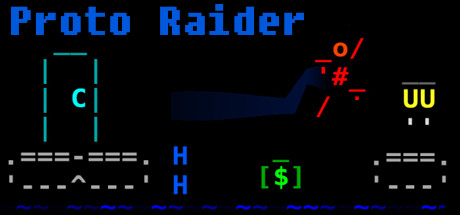
Proto Raider is a single screen auto-running puzzle platformer covered in ASCII beauty. Immerse yourself in this colorful and imaginative world. Ride waterfalls, fly into tornadoes, solve puzzles, and fight monsters to complete quests and collect your treasure!
Modeled estimate, not a reported figure. How we estimate →
Media

About
Stats
All-time low is the lowest price we've recorded for this game since we started tracking it.
Languages: English, French, Italian, German, Spanish - Spain, Portuguese - Portugal, Portuguese - Brazil, Russian
Engagement
Hours played at review time, across 44 reviews with recorded playtime.
Reviews
Themes across 44 recent reviews and how positive each mention is. A keyword signal, not full sentiment analysis.
positive critical· bar length = how often the theme comes up
Reviews
¨/\_/\ ♥ >^,^< ¨¨/ \ ’¨(__)__
♥♥♥♥
This game is the perfect example of good gameplay with minimum graphics. 虽然画面简单但满屏的都是游戏性
nice ASCII text platform jumper with Megaman sounds
Very nice game
If you like calculator-style games, with exploration, puzzle-solving and action, this game is for you. Simple, but quite interesting.
Good
Proto Raider is a minimalist yet remarkably inventive puzzle-platformer that captures the spirit of classic design through its use of ASCII-inspired visuals and one-button simplicity. Developed and published by Puzzle Lab, the game manages to transform its stripped-down presentation into a dense playground of logic, timing, and precision. It tells no story, features no dialogue, and relies entirely on mechanics and environmental cues to convey its challenges. Each level is a compact test of reflexes and perception, where the player’s character automatically runs forward through traps, enemies, and shifting terrain. The task is to jump, react, and adapt in time with the rhythm of the stage, all while navigating an intricate single-screen puzzle that demands both planning and instinct. The aesthetic of Proto Raider is its most striking feature. The world is built out of symbols, characters, and geometric abstractions that evoke the charm of early text-based computer games. Despite this minimalism, the design manages to express surprising variety. Rivers, caves, fire, monsters, and mechanical contraptions are all conveyed through clever use of symbols, giving each level a distinct personality. The game’s visuals feel simultaneously archaic and modern, as though Puzzle Lab deliberately embraced the restrictions of old technology to uncover new creative solutions. The effect is hypnotic; the eye begins to decode the patterns behind the symbols, turning what looks like chaos into recognizable terrain. This sense of visual discovery is reinforced by the soundtrack, a mix of retro-inspired tones and ambient melodies that complements the game’s rhythm without overwhelming it. Gameplay in Proto Raider is deceptively simple. The character’s automatic running limits direct control, forcing the player to focus on timing rather than free movement. The challenge lies not in memorizing patterns but in interpreting them quickly enough to survive. Each stage is entirely visible from the start, meaning that the puzzle element is less about exploration and more about comprehension—understanding how the moving parts of the level interact and when to act to avoid danger. There are treasures, keys, and special items scattered throughout, as well as hazards that can kill instantly, ranging from falling stones and spikes to pools of acid and deadly creatures. The precision required can be unforgiving, and a single mistake often forces a complete restart of the level. This repetition, while potentially frustrating, encourages mastery and rewards patience. As the levels progress, the game introduces environmental and mechanical variations that keep the experience fresh. Some stages involve swimming underwater or sliding down waterfalls, while others feature gusts of wind, lava flows, or switches that alter the level’s structure. There are moments that almost resemble rhythm games, where jumps and movements must synchronize with the stage’s momentum. The balance between platforming and puzzle-solving is tight; each level feels like a small clockwork mechanism where every action triggers another reaction. Proto Raider’s design philosophy embraces economy—it teaches through play without tutorials, trusting the player to experiment and learn through failure. This approach gives every completed level a sense of accomplishment that feels hard-earned rather than handed out. Puzzle Lab’s approach to difficulty is deliberate and old-school in nature. The game rarely explains its rules, and players are left to intuit how each mechanic functions. There are no checkpoints within levels, which heightens tension but also amplifies the satisfaction of success. The difficulty curve is steady, introducing new elements gradually, though later stages can become intense tests of reaction time and memorization. The game’s design philosophy values rhythm and flow, and players who appreciate high-precision timing will find a meditative pleasure in its patterns. Those seeking a more relaxed experience may find the pace punishing, but for enthusiasts of minimalist challenge, it fits neatly into the tradition of games that strip mechanics down to their essence. Beyond its gameplay, Proto Raider also stands out for its personality. There is a playful intelligence behind its structure—a sense that every obstacle and trap has been carefully crafted to mislead, surprise, or delight. Its ASCII aesthetic is not a gimmick but an integral part of its identity, creating a timeless, abstract world that could exist on any machine. The simplicity of the presentation invites the imagination to fill in the blanks, turning letters and symbols into landscapes and adventures. The fact that such an abstract style can generate immersion speaks to the effectiveness of Puzzle Lab’s design. The game’s world feels both digital and organic, mechanical and alive, as if it were an ancient program rediscovered and given new purpose. From a technical standpoint, Proto Raider runs flawlessly on nearly any hardware, embodying the lightweight efficiency of its design. Its short loading times and smooth transitions make it ideal for quick sessions, but its addictive nature often leads to extended play. The lack of extraneous menus or distractions reinforces its purity—each run begins immediately, each failure teaches something tangible, and every success builds confidence for the next challenge. The developers’ restraint is admirable; instead of padding the game with filler content, they focus on crafting levels that are precise, readable, and cleverly layered. This clarity of vision helps it stand out in a genre often crowded with derivative platformers chasing nostalgia without innovation. Proto Raider ultimately succeeds because it proves that creativity thrives within constraints. By reducing control to a single input and visuals to a handful of symbols, it achieves a focus few modern games dare to pursue. Every element serves the experience—movement, rhythm, and visual pattern align into a cohesive whole. It may lack the spectacle of contemporary titles, but it delivers something rarer: a distilled form of interactive design that feels both ancient and fresh. For players who appreciate elegant simplicity, sharp reflexes, and the satisfaction of mastering small, self-contained challenges, Proto Raider is a shining example of how minimalism can be endlessly expressive. It is a short game, but one whose ingenuity and personality linger long after the final screen fades. Rating: 7/10
Sinceramente! Eu não recomendaria esse jogo pelo preço que ele ta agora, porque, basicamente você só precisa apertar “espaço” e ponto, não tem mais nada. O personagem anda sozinho e sempre pra frente, e também o jogo não tem nada de atrativo. É só um joguinho de pular e apreciar. Mas como eu comprei ele por R$: 1,25 em 2016, eu não posso reclamar. Eu só posso dizer que o jogo é relaxante. Você só precisa apertar espaço, curtir a musiquinha e apreciar o gráfico diferenciado... O jogo não é ruim, mas se você pagar mais de 2 reais nele, eu tenho certeza de que você vai se arrepender.
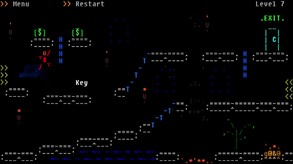
I almost recommend this game. Almost! I like the graphics, it's ASCII-Art imitation of a text-based display, but with smooth movement outside the grid (which means it's clearly not a text-based display, but also means smoother visuals). The gameplay is one button: start moving, and then jump. Your character (or, dare I say, 3x3 grid of characters!) moves automatically to the right, and can climb stairs if you jump onto them, and switches direction (lef/right) upon hitting the arrows. Thus, the levels are half puzzle (figure out how to traverse the level with such limited controls) and half reaction (I must press jump at the right time). These restrictions make the gameplay quite interesting. However, the game falls apart at later levels, where you either need perfect reactions or a lot of luck. Let me give some examples (minor spoilers): - 26: [spoiler]Random deadly objects fall from the sky, but thankfully random clouds move horizontally to protect you. However, you move too fast, you will out run those clouds, and die. And die. And die.[/spoiler] [spoiler]Until you realize that you can change the movement speed in the options screen. (WTF!)[/spoiler] - 31: [spoiler]You have to jump perfectly in a tight space to leave enough holes to let some debris fall through, while leaving enough floor for you to jump on. Then you have to hope the random-ish nature of the physics simulation will not leave any debris in the path. Then you have to execute perfect jumps.[/spoiler] Well, that's what I believe is the solution, and I watched a video of someone playing this level many times trying to perfect the movement. The person had more patience and more luck than me: I gave up. It's a shame, I mostly liked the game, but some terrible levels ruined my enjoyment.
Related
Related
Trends
Modeled estimate over time, reconstructed from Steam's monthly review histogram.
Momentum
Pace estimated from the game's recent review growth (our daily snapshots) at its own sales-per-review ratio — a momentum signal, not booked sales.
Audience
Estimated from the language of this game's reviews — a proxy for where players are, not official Steam demographics.
Related
| CoffeeBiz Tycoon | $33.3K | 66 | 64% | $14.99 |
| Luckslinger | $33.3K | 132 | 80% | $9.99 |
| Ninja Legends | $33.3K | 54 | 94% | $19.99 |
| Y. Village - The Visitors | $33.3K | 182 | 79% | $7.99 |
| CD Market - Music Label Sim | $33.4K | 57 | 98% | $14.99 |
| Kotodama: The 7 Mysteries of Fujisawa | $33.4K | 72 | 57% | $29.99 |