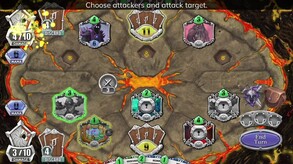
Primateria, developed by Yfrit Games and published by Surefire.Games, is a roguelike deck-builder that embraces unpredictability, experimentation, and mechanical freedom as its defining traits. Rather than mimicking the structure of more rigid card battlers, it builds itself around a fusion-based system where cards can be combined, transformed, empowered, and even reimagined mid-combat. This design makes Primateria feel far more fluid than the typical turn-based deck-builder. The game encourages improvisation not only because you can play multiple cards without the usual mana restrictions, but because card evolution — and de-evolution — is part of its core loop. Each run becomes a sandbox of shifting strategies, a place where even weak cards can grow into powerhouse tools with the right fusion or where a strong card may revert and force you to pivot quickly.
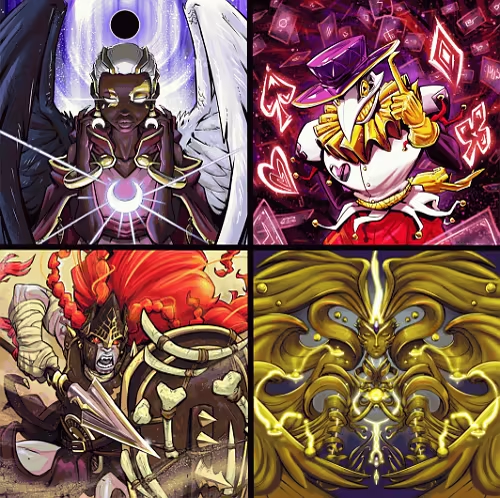
The world that frames these mechanics is equally imaginative. Primateria casts you as a “Polupus,” a strange being navigating a mythic, surreal universe populated by gods, esoteric creatures, and cosmic threats. The story mode gives this strange universe context, but it’s the visual direction and conceptual creativity that make the world feel alive. Enemies, abilities, relics, and even card art reflect the game’s surreal themes, giving the experience a sense of mystical tension. Rather than being a simple backdrop, the world serves as a thematic extension of the game’s chaotic philosophy: everything is mutable, everything changes form, and nothing remains fixed for long. This reinforces the idea that each run isn’t merely a sequence of battles but a journey through a volatile universe where adaptability is the ultimate skill.
Primateria’s greatest strength lies in its variety and flexibility. With more than a hundred cards spanning multiple abilities, elemental synergies, and fusion paths, no two decks play the same. The roguelike structure ensures that even a strong knowledge of the card pool doesn’t guarantee predictable outcomes. Some runs feel blessed with perfect synergies; others demand ingenuity and resourcefulness. The ability to fuse cards mid-battle creates dynamic turns where a single decision can snowball into powerful combos or collapse into unintended consequences. These moments — the improvised victories, the narrow escapes, the accidental power spikes — are the heart of Primateria’s appeal. They make each run feel distinctive, rewarding players who enjoy discovery and experimentation.
The game also benefits from a generous suite of modes. Beyond the main story, there are prebuilt decks for learning, endless modes for pushing limits, and later updates added features like a deck editor and boss rush. These additions significantly extend replay value, providing multiple ways to explore the fusion system and the card pool. For players who enjoy tuning builds, experimenting with archetypes, or pushing themselves against escalating difficulty, the game offers a solid amount of content and customization. The steady stream of updates and patches also reflects a clear commitment from the developers, helping balance out mechanics and adding features requested by the community.
However, the same elements that make Primateria feel fresh can also make it uneven or overwhelming. The randomness at the core of its design — from card rewards to combat pacing — can sometimes make runs feel more dependent on luck than strategy. While many roguelikes embrace randomness, Primateria’s fusion-driven system can amplify that volatility, especially when a few unlucky fusions derail a promising deck. Players who prefer structured, controlled deck-building may find this philosophy frustrating. Similarly, the learning curve may feel steep, not because the rules are complicated individually, but because there are so many interacting systems: adaptive mana, dual graveyard mechanics, card evolution tiers, positioning, and varying combat synergies all contribute to its complexity.
Thematically, the game’s surreal world and dark-fantasy aesthetic are distinctive but might not appeal to everyone. While they add personality and atmosphere, they can also make the experience feel abstract and detached. Additionally, the absence of a strong narrative throughline means that the emotional stakes rely more on mechanics and worldbuilding than on story. For some, this lack of narrative depth complements the roguelike structure; for others, it may make the journey feel less anchored.
Despite these shortcomings, Primateria shines as a creative, imaginative, and bold entry in the roguelike deck-builder genre. It thrives on chaos — not carelessly, but intentionally — inviting players into a system that rewards flexibility, experimentation, and creative problem-solving. It is a game that encourages you to try wild combinations, embrace the unpredictable, and refine your understanding of its mechanics through repeated failure and experimentation. While not ideal for players seeking highly controlled, mathematically rigid deck-building experiences, it is an excellent choice for those who enjoy the thrill of discovery, the surprise of emergent strategies, and the satisfaction of turning an improvised idea into a triumphant win.
In the end, Primateria stands out because it is unafraid to be different. It combines a surreal world, a fusion-driven card system, and a roguelike structure into an experience that feels alive, unstable, and creatively rewarding. For players who appreciate games that challenge traditional design boundaries, it offers a distinctive and deeply replayable journey.
Rating: 8/10