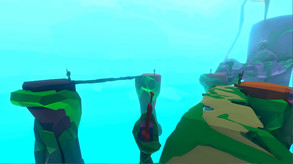
Platonic, developed and published by FidgetBear Games, is a deliberately cerebral puzzle-exploration experience that places thought, observation, and quiet persistence above spectacle or narrative exposition. From the outset, the game makes it clear that it has little interest in guiding the player with tutorials, dialogue, or explicit objectives. Instead, it invites you into an abstract world governed by internal logic, asking you to engage with its spaces as both a puzzle and a philosophical exercise. The result is an experience that feels closer to an interactive thought experiment than a traditional video game, one that rewards patience and attentiveness above all else.
Platonic is structured around a series of interconnected worlds inspired by the Platonic solids, and while the game never explicitly lectures the player on mathematical theory, the influence of geometry and symmetry is present in nearly every interaction. Each environment is self-contained yet subtly linked to others, encouraging players to consider how individual discoveries fit into a larger framework. Progression is rarely linear in a straightforward sense; instead, it unfolds as understanding accumulates. Early moments can feel disorienting, as the game drops you into spaces with no obvious direction, but this sense of uncertainty is intentional, mirroring the process of learning through observation rather than instruction.
The core gameplay revolves around environmental puzzles that demand logical reasoning, spatial awareness, and a willingness to experiment. Mechanisms often appear simple at first glance—panels, symbols, pathways, or devices—but their true function only becomes clear once you begin to notice patterns across different areas. Platonic excels at teaching through repetition and variation, gradually layering complexity without ever breaking immersion. There are no overt hints, no flashing indicators, and no safety nets; understanding emerges organically as you test assumptions and reflect on previous solutions. This can be deeply satisfying for players who enjoy “aha” moments earned through insight rather than trial-and-error brute force.
Exploration plays a central role, but it is tightly controlled and purpose-driven. The environments are not large, open landscapes meant for wandering aimlessly, but carefully designed spaces where every corridor, platform, and visual cue carries meaning. Backtracking is common, yet rarely feels wasteful, as revisiting earlier areas with new knowledge often reveals details that were previously overlooked. This design fosters a strong sense of cohesion, making the world feel like a single, interconnected puzzle rather than a sequence of isolated challenges.
Visually, Platonic adopts a minimalist aesthetic that reinforces its intellectual focus. Clean geometry, restrained color palettes, and uncluttered spaces ensure that attention remains fixed on structure and form rather than decoration. Each world maintains a distinct visual identity, subtly guiding perception and reinforcing the themes of abstraction and order. The lack of visual excess is not a limitation but a deliberate choice, allowing clarity and readability to take precedence. Paired with a subdued sound design that favors ambient tones over melody, the game cultivates an atmosphere of calm introspection that encourages slow, deliberate play.
One of Platonic’s defining characteristics is its absence of traditional narrative. There are no characters, no spoken words, and no explicit story beats to follow. Any sense of meaning is derived from the environment itself and the player’s interpretation of its symbols and structures. For some, this ambiguity will feel liberating, allowing space for personal reflection and interpretation. For others, it may feel emotionally distant or overly abstract. The game makes no attempt to appeal to everyone, instead committing fully to its vision of interactive minimalism and intellectual engagement.
In terms of pacing and length, Platonic is compact but dense. It does not overstay its welcome, yet it demands sustained concentration throughout its runtime. The difficulty curve is steady rather than steep, though moments of confusion are inevitable due to the game’s refusal to explain itself. When solutions finally click, however, the satisfaction is profound, driven by the realization that the answer was always present, waiting to be understood rather than discovered.
Ultimately, Platonic is a game designed for a very specific audience: players who relish pure puzzle design, abstract worlds, and the joy of deciphering systems without guidance. It is not flashy, emotional, or narrative-driven, but it is thoughtful, cohesive, and quietly confident in its approach. For those willing to meet it on its own terms, Platonic offers a deeply rewarding experience that lingers in the mind long after completion, serving as a reminder that games can challenge not just reflexes, but perception and understanding itself.
Rating: 7/10