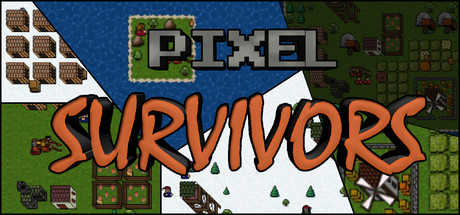
Pixel Survivors is a small-scale settlement management and survival strategy game developed and published by Patagoniart. Released in 2016, it takes the basic principles of colony building and condenses them into an accessible pixel-art experience centered on keeping a growing community alive. Instead of controlling individual characters in the manner of an action game, the player takes responsibility for the settlement as a whole. Land must be prepared, resources gathered, buildings constructed, and production maintained while the population steadily develops. The premise is uncomplicated, but it establishes a satisfying management loop in which every expansion creates new responsibilities that must be addressed before the community can safely continue growing.
The settlement begins with only a handful of inhabitants and limited infrastructure, making basic survival the immediate priority. Houses provide living space, while farms and chicken pens establish the food supply necessary to sustain the population. These simple requirements create the foundation of the entire experience. Increasing the number of villagers without strengthening food production can quickly place pressure on available supplies, so expansion works best when approached gradually. The player is encouraged to consider what the village needs rather than simply constructing buildings whenever resources become available. This gives the early game a pleasant sense of vulnerability, as even a modest community requires careful preparation before it can become self-sufficient.
Resource management becomes more interesting once the settlement moves beyond its earliest stage. Surface materials are useful initially, but they are not an unlimited solution to continued growth. Mines and forestry towers provide ways to maintain access to important materials as easily available resources disappear. This creates a natural transition from simple gathering toward a more organized economy. Windmills and sawmills further improve production, allowing the settlement to operate more efficiently. The progression is straightforward enough to understand quickly, yet there is still satisfaction in seeing an improvised collection of structures gradually develop into an organized village capable of sustaining itself.
The economic system also extends beyond food and raw materials. Forges and tailors allow villagers to receive useful equipment such as tools and clothing, giving the production network additional purpose. These structures make the community feel more developed because the player is no longer dealing exclusively with immediate survival. Instead, the settlement begins producing goods that support its inhabitants and improve its overall functionality. Deciding when to invest in these facilities adds another consideration to expansion, since resources committed to one area cannot necessarily be used elsewhere. The strongest moments occur when several production systems begin functioning together and the village finally feels stable.
Pixel Survivors ultimately focuses on maintaining that stability while supporting an increasingly large population. Once the basic economy is functioning, the central challenge shifts from simply surviving to determining how far the settlement can expand without collapsing under its own demands. This open-ended direction gives players considerable freedom to establish their own objectives. Rather than relying heavily on a scripted campaign or elaborate storyline, the game makes the development of the settlement itself the primary source of progression. Watching a tiny group of survivors turn into a larger functioning community can be rewarding, particularly for players who enjoy optimization and gradual improvement.
The visual design uses simple pixel graphics that match the modest scope of the simulation. Buildings, terrain, resources, and inhabitants are presented clearly without excessive detail, giving the game a recognizable independent style. The graphics are functional rather than spectacular, but they make it relatively easy to understand what is happening throughout the settlement. Benjamin Baldassini's music accompanies the management process and contributes some atmosphere to what can otherwise become a repetitive cycle of gathering, construction, production, and expansion. The overall presentation feels appropriate for a lightweight strategy game rather than an attempt at an elaborate city-building spectacle.
Its greatest limitation is that the underlying systems do not develop into an especially deep simulation. Once players understand how food, housing, resource collection, manufacturing, and population growth interact, much of the later experience revolves around repeating and optimizing familiar processes. There is enjoyment in pushing the village toward greater efficiency, but players accustomed to complex colony simulators may miss deeper economic relationships, extensive technological development, sophisticated citizen behavior, or a more substantial variety of long-term challenges. The absence of a heavily structured narrative also means that players need to enjoy self-directed expansion for the experience to remain compelling.
That simplicity can also be considered one of Pixel Survivors' advantages. It does not require the player to memorize enormous technology trees or manage dozens of complicated statistical systems before understanding how to succeed. The fundamentals are approachable, and the relationship between expansion and survival is easy to grasp. This makes it better suited to players looking for a casual settlement-building experience than those searching for an extremely demanding strategy simulation. Steam achievements and leaderboards provide additional objectives for anyone interested in accomplishing goals beyond maintaining a successful settlement, while the single-player focus allows the game to proceed entirely at the player's preferred pace.
Pixel Survivors succeeds most effectively as a compact management game about transforming a vulnerable settlement into a sustainable community. Patagoniart created a straightforward mixture of resource gathering, construction, production, population management, and survival that can be enjoyable without becoming unnecessarily complicated. Its progression from basic houses and food production toward mines, forestry operations, manufacturing facilities, and efficiency improvements gives the settlement a meaningful sense of development. However, the limited complexity of these systems becomes increasingly noticeable during extended play, when expansion and optimization begin replacing the discovery of genuinely new mechanics.
For players who appreciate minimalist pixel-art strategy games, Pixel Survivors offers a charming and reasonably engaging interpretation of settlement management. Its accessible mechanics make building a functioning village satisfying, particularly during the period when every new structure noticeably improves the community's chances of survival. The experience eventually becomes repetitive and lacks the depth required to compete with more elaborate colony simulations, but its modest ambitions and uncomplicated design still give it a distinct appeal.
Rating: 6/10