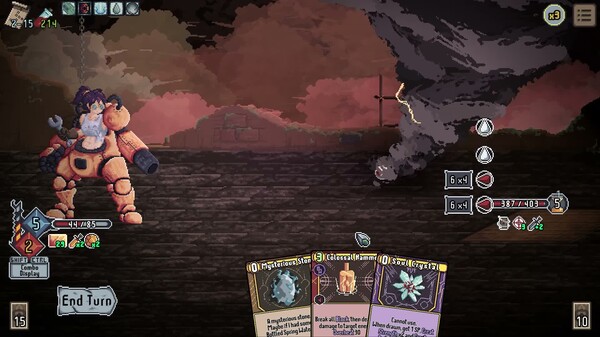
A combo-based deckbuilding roguelike through a space-time loop: collect cards, receive blessings, add pets to your party, and grow stronger. Chain together cards in the right order for max power, and act before the enemy does. Build synergistic decks, find many secrets, and make BIG numbers!
Modeled estimate, not a reported figure. How we estimate →
Media

About
Novus Orbis is a roguelike deckbuilder that encourages complex builds with deep deck combos, powerful Blessings, and a with a wealth of secrets to discover.
Advance through the last pieces of this broken world, against an out-of-reach entity.
Your goal is to explore, battle, and strengthen your might and knowledge to bring order back to your land.
Combo System: Every card has a cost and a combo value: Play your cards in the right order to achieve their full potential, or break the combo to get a more favorable outcome.
Countdown System: Every time you play a card and when you end your turn enemies will get closer to attacking you. They can and will attack during your turn!
Multiple Classes: Three classes with completely different sets of cards and mechanics.
Deck Building: More than 80 cards per class, more than 300 cards in total! Cards come in six types: Attack, Skill, Equipment, Item, Special, and Affliction.
Blessings: More than 100 powerful upgrades to your character. Get them from bosses, special rooms, shops, and secret interactions!
Pets: Find multiple companions per run, who will attack, support, heal , and more every turn.
Please be sure to add Novus Orbis to your Wishlist!
Genres
Stats
All-time low is the lowest price we've recorded for this game since we started tracking it.
Languages: English, Japanese, Italian
Engagement
Hours played at review time, across 40 reviews with recorded playtime.
Reviews
Themes across 40 recent reviews and how positive each mention is. A keyword signal, not full sentiment analysis.
positive critical· bar length = how often the theme comes up
Reviews
Novus Orbis is a striking entry in the roguelike deck-builder genre, offering a thoughtful blend of familiar card-based mechanics with several inventive twists that give the experience a sharp identity of its own. Developed by Seizo Games and published by 2 Left Thumbs, the game opens with a straightforward premise—a hero trapped in a looping cycle of encounters across a mysterious cosmic realm—but quickly reveals a strategic depth that rewards experimentation, planning, and adaptability. Even in its Early Access state, Novus Orbis feels surprisingly refined, supported by a cleverly layered combat system and a strong foundation of cards, blessings, pets, and enemies that establish its long-term potential. The core gameplay revolves around the interplay between deck construction, combo sequencing, and a unique countdown mechanic that redefines the pace of battles. Each card has both a cost and a combo value, encouraging players to think several steps ahead when deciding what to play and in what order. Executing the right sequence can dramatically amplify your impact in a turn, turning weak individual cards into devastating chains when used together. Layered on top of this is the countdown system—an ever-ticking timer that advances both when you act and when you end your turn. This means that enemies may attack in the middle of your carefully planned sequence, forcing you to constantly evaluate whether pressing your luck or retreating early is the safer strategy. Together, these elements inject tension and urgency into every battle, setting Novus Orbis apart from more methodical, hands-off deck-builders. Content-wise, the game launches with a surprisingly robust set of tools for players to explore. Two playable classes offer distinct approaches to combat—each with its own suite of cards, resource dynamics, and mechanical quirks. The starting class provides a more straightforward introduction to the game’s systems, while the mage-like class demands careful manipulation of elements and resource decay, creating a deeper puzzle of balancing conditions and planning multi-step turns. More than 200 cards, dozens of blessings, a variety of pets with passive bonuses, and a sizable roster of enemies help give each run its own texture. Blessings persist across runs, providing a meaningful sense of progression, but not so much that they undermine the core roguelike challenge. The developer’s stated roadmap promises additional classes, bosses, card sets, and alternate paths, signaling long-term growth for an already solid foundation. Visually, Novus Orbis embraces a clean pixel-art aesthetic that fits its cosmic-fantasy theme well. Its minimalist but striking backdrops—evoking nebulas, astral anomalies, and dreamlike realms—support the game’s atmosphere without cluttering the screen with unnecessary detail. The user interface is designed for clarity, with well-organized card descriptions and readable layouts that help players quickly parse their options. While not pushing any graphical boundaries, the art direction complements the gameplay and supports the sense of diving into a surreal world governed by strange cosmic rules. The game’s performance is smooth even on modest hardware, making it accessible for a broad range of players. However, no Early Access title is without areas that need refinement. Some players have noted that class balancing still needs work, especially for the more complex class whose card pool relies heavily on conditional triggers and resource manipulation. The same complexity that makes this class rewarding also makes it punishing to learn, and runs can fall apart quickly if synergy doesn’t develop. Additionally, while the available card pool is large for an early build, it may still feel limited compared to long-running genre staples—especially for players accustomed to massive card libraries or endless procedural content. The countdown mechanic, while innovative, can also feel unforgiving to those who prefer slower-paced, tactical decision-making. A handful of UI quirks, missing conveniences, and occasional difficulty spikes further remind players that the game is still in active development. Despite these imperfections, Novus Orbis distinguishes itself through smart ideas, clean execution, and a combat system that feels genuinely fresh. Its blend of pressure-based turn pacing, combo-driven card play, and layered decision-making gives the game a rhythm all its own—one that encourages risk-taking, rewards mastery, and keeps individual encounters tense and engaging. For deck-builder fans looking for something different from the usual cycle of mana curves and passive scaling, Novus Orbis provides a compelling alternative that challenges players to rethink how turns unfold and how synergy is built. Ultimately, Novus Orbis stands as a promising and already enjoyable entry in the genre. It offers enough content to satisfy early adopters, enough innovation to distinguish itself from competitors, and enough potential to grow into something even more impressive. For players willing to invest in an evolving but already thoughtfully designed roguelike deck-builder, it’s an easy recommendation—and one worth watching closely as its world expands. Rating: 8/10

This is a very solid roguelike deck-builder, well worth the modest cost, especially if you get it on sale. It mostly plays just like Slay the Spire but it does two things that make it stand out as different. The first thing it does different is that enemies have an activation countdown timer, and the countdown timer can be different for each enemy in any particular fight (so they don't all activate at the same time). They don't activate when you end your turn, they activate when their countdown timer reaches 0. The timer counts down one click each time you play a card, and two clicks when you end your turn. While you do have energy needed to play cards, and you have a hand of cards, the timer creates a whole new level of tactical decisions. Playing a card costs not just energy, it moves the enemy closer to activating, so that the order of card plays, when to skip card plays, when to pass (e.g., passing despite still having energy and cards in hand), are a whole new set of considerations. It's really great and makes the game stand out from others in the genre. The second new mechanic is that cards can combo if you play them in a specific order. Each card has a number designating its rank, from 0 to 3. Playing a rank 0 card makes all rank 1 cards cheaper to play and more powerful. Playing a rank 1 card after a rank 0 card makes rank 2 cards cheaper and more powerful, etc, with you getting bonuses on all cards if you reach combo level 4. But if you play cards out of order, e.g., play a rank 0 after a rank 1, you break the combo and have to start over. In principal this is pretty neat but it didn't work well for me. Despite building my deck to have a mix of card ranks I found it uncommon for me to be able to make chains more than 2 cards long (though I did reach combo-level 4 a couple times). So, a neat mechanic that was less impactful on my game than I'd have liked. As of now the game has just two character classes, a fighter and mage. The fighter is straightforward to play. The mage is more complex in that you have to generate various magical elements to play cards; those elements are both pre-reqs for cards and make cards stronger. That was all neat but I found it subject to a lot of luck. Because you acquire cards through random draw (e.g., in chests and at the end of battles, just like in most similar games), it was really hard to build a deck that synergized well, and fairly common for me to be stuck choosing between cards I couldn't even play due to lack of an ability to generate the right color magic. If my first mage playthrough I felt like my deck was synergizing ok, but my second and third mage playthroughs were unsatisfying because of poor card options. So, in summary, this is a really neat game. The activation countdown timer is fantastic, and the combo mechanic interesting but not as impactful as it could be. The two character classes are quite different; the mage is the more interesting of the two but also requires a lot of luck to get cards to synergize well. Overall I highly recommend the game.
first deck builder I've played. It's awesome. The fun is allowed. They don't stop you from doing infinite combos and it's awesome. Also, no ♥♥♥♥♥♥ diversity. 10/10
This is a fun deckbuilder with some unique twists. I appreciate the option to choose a font that is easily readable. I need to find some time to delve deeper.
Gawd dammed bird poops on you. 10/10 would get pooped on again.
I didn't like this when I tried it the first two times but when I booted it up for the third time a week or so later, something just clicked and I played about two and a half hours straight. On a work night, no less. The thing I like about it is that it does some things differently than any other deckbuilder I've played. First off, instead of you have a turn/the enemy has their turn their is a kind of timer system. So, you'll have a set of action points, and the enemy will have a set of... charge up points. Every time you play a card, the enemy timer counts down by one. When you end your turn it counts down by two. This means that you can almost always take multiple actions before the enemies do. The trade off is that there are either multiple enemies on screen, and/or enemies have more HP and varied, strong attacks. The other thing it does is a kind of chain system. If you play cards in ascending order by cost: 0, 1, 2, 3, etc you can chain together attacks for increased damage. It's a lot more nuanced than I'm making it sound. I honestly like this better than Monster Train 1 and 2. I've put probably 50 hours in the first one on GOG, and over 100 for the sequel on Steam. This doesn't come close to Slay the Spire or Downfall, but that's a high bar to clear. The only downside is that it's still in early access. There's still a lot of content to be had. As of this review the dev just released the third playable character a week or so ago, so it is in active development. I just wish there was more. I'm not sure how many more hours I'll play this before I do everything that can be done. Regardless, whenever the dev adds more content I'll be right back to it. This game deserves more eyes than it currently seems to be getting. This is an extremely good game now, but I can only see it getting even better. I would highly recommend this to any fan of roguelike deckbuilders.
i have always been into card game and rogulikes. despite not being the first in the genre, it has its really own combo mechanic adding some depth in the deckbuilding. Still an early access, but really promising !
有点dream quest味道的打牌游戏,画面不行,但玩法非常扎实。局外没有数值,只有各种成就解锁的卡牌、宠物、遗物。 多种关卡和隐藏BOSS做的挺有意思,最有趣的是combo机制,按combo顺序出牌能减费和强化卡牌效果。战斗采用了时序机制,出一张牌怪物时序减一,归零时采取行动,结束回合所有怪物时序减二,玩家重新抽牌。 爽点方面,某些遗物和道具的效果过于离谱(放弃选牌+10最大血量,SP+1和最大血量加100),拿到就保送通关。删牌是百分比卖血删牌,根据提示多次删牌后能额外拿到一个遗物。由于可以多次删牌,做出强力构筑还是很简单的,战士就无脑堆攻防,法师各种元素左脚踩右脚循环,机械师=鸡煲启动中。 友情提示,洞穴关boss会每回合塞牌,玩无限华丽登场的别把卡组压缩的太极限,否则碰到必死。普难第四章太空boss 6000hp+1500hp+2000hp,一轮200-400攻,抓牌尽量搞攻防一体的方便配合指数增长卡。 打折30以下推荐试试
There are a lot of roguelike deckbuilders on the market, but this is one of the most unique and original. The combo system sets it apart from many others alone. I really appreciate the excellent visuals and music. The dev is also very passionate about taking player feedback into account when making updates. Highly recommend for fans of the genre!
Amazing deck builder! The combo system is super interesting and leads to a lot of neat turns. Can’t wait for full game :d
Related
Related
Trends
Concurrent players on Steam, sampled daily since tracking started.
Audience
Estimated from the language of this game's reviews — a proxy for where players are, not official Steam demographics.
Related
| Bleak Haven | $50.5K | 133 | 43% | $14.99 |
| Skygard Arena | $50.5K | 114 | 79% | $14.99 |
| Sharks and Minnows | $50.5K | 322 | 93% | $7.99 |
| Amelia and the Erotic Tentacle Trap Dungeon | $50.5K | 193 | 73% | $10.99 |
| Lovish | $50.5K | 131 | 86% | $14.99 |
| q.u.q. | $50.5K | 1.9K | 95% | $1.99 |