A Tale of Three Beautiful Maidens Drawn to Each Other. When three friends, deceived and separated by the tricks of darkness, find each other again, their bond shall become the light that will clear away the shadows and guide them towards the truth...
Modeled estimate, not a reported figure. How we estimate →
About
Genres
Stats
All-time low is the lowest price we've recorded for this game since we started tracking it.
Languages: English, Japanese*, Traditional Chinese*languages with full audio support
Engagement
Hours played at review time, across 40 reviews with recorded playtime.
Reviews
Themes across 40 recent reviews and how positive each mention is. A keyword signal, not full sentiment analysis.
positive critical· bar length = how often the theme comes up
Reviews
We need a better standard for lesbian games than 'hyper skimpy hot girls who aren't allowed to be honest about their feelings'
為什麼Windows 10 無法玩? 會出現閃退??
boobies !!!
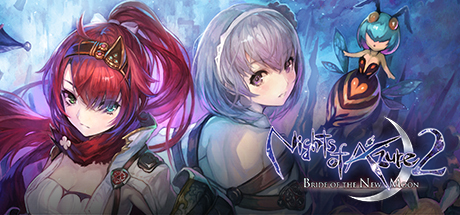
Nights of Azure 2: Bride of the New Moon, developed and published by KOEI TECMO GAMES CO., LTD., is an action role-playing game that blends gothic fantasy with a strong emphasis on character relationships. Set in a world consumed by darkness and overrun by demonic creatures, the story follows Aluche, a holy knight assigned to escort her childhood friend Liliana, who has been chosen as a sacrificial figure meant to bring an end to the night. What begins as a tragic duty quickly turns into something more personal, especially after Aluche is resurrected as a half-demon, forcing her to navigate the conflict between her mission and her own emotions. The narrative places a heavy focus on the bond between its central characters, and much of the experience revolves around strengthening these relationships. The game introduces a cast of companions known as Lilies, each with their own personalities and backstories, and players can build affinity with them through events and shared missions. These interactions are meant to add emotional weight to the story, and at times they succeed, particularly in quieter moments where the characters are allowed to develop naturally. However, the overall plot follows familiar genre patterns, and while it has a strong premise, it rarely pushes beyond predictable territory. The pacing can feel uneven, with emotional beats occasionally losing impact due to the way the story unfolds. Combat forms the backbone of the gameplay, offering a fast-paced and accessible system built around combos, special abilities, and cooperative attacks with companions. Battles are visually energetic, with flashy effects and responsive controls that make it easy to engage with enemies. The inclusion of partner mechanics adds a layer of coordination, allowing players to trigger joint attacks and take advantage of different combat styles. There is also a time limit imposed on exploration segments, which introduces a sense of urgency and encourages players to move efficiently through areas rather than lingering indefinitely. Despite its initial appeal, the combat system begins to show its limitations over time. Encounters tend to follow similar patterns, and the lack of significant variation in enemy behavior or mission design can make the experience feel repetitive. While new abilities and upgrades are introduced as the game progresses, they do not fundamentally change how combat is approached. As a result, what starts as an engaging system can gradually become routine, especially during longer play sessions where the repetition becomes more noticeable. The game’s visual style is one of its more distinctive qualities, combining dark, gothic environments with brightly designed anime-inspired characters. This contrast creates a unique atmosphere that sets it apart from other titles in the genre. The environments convey a sense of decay and mystery, while the character designs lean toward a more stylized and expressive look. The soundtrack and voice performances contribute positively to the overall presentation, helping to reinforce both the somber tone of the world and the emotional connections between characters. However, technical issues such as inconsistent performance and occasional frame drops can detract from the immersion, particularly during more demanding scenes. Another aspect that may divide players is the tonal balance. The game shifts between serious, dramatic storytelling and lighter, more fanservice-driven moments, and these transitions are not always seamless. For some, this contrast adds variety and personality, while for others it can feel inconsistent, especially when it interrupts more emotional scenes. This uneven tone reflects a broader sense of the game struggling to fully commit to a single identity, as it tries to blend multiple styles and themes without always integrating them smoothly. In the end, Nights of Azure 2: Bride of the New Moon offers a mix of engaging ideas and uneven execution. Its focus on character relationships and accessible combat provides a solid foundation, but repetition and a lack of narrative depth prevent it from reaching its full potential. It is a game that can be enjoyable, particularly for those who appreciate anime-inspired storytelling and character-driven experiences, but it does not fully capitalize on its more ambitious elements. Rating: 7/10
🤝🏻✂️✂️👌
This is a very mixed title, it's only barely a recommend and only if you get it on a very rare sale. Action RPG in a small 2-game series by Atelier creator Gust. This title uses a combo oriented system, with fairly large hordes of enemies. Most of the time mobs aren't a threat but a few enemies are dangerous enough to break out of your stunlocks. Only late game bosses are a really dangerous threat in normal difficulty, there's higher difficult if you really want to go further. The world is kind of interesting, the story is mixed. While technically it's "yuri", it's definitely the faux yuri to TITilate male fans. Combat works by using a mix of heavy and light attacks, there's a series of different combos that can be done with those moves. There's also a human [spoiler]or "human"[/spoiler] companion, and you can bring two demon-spirit allies called Servans. There are skills for the Servans to use in combat, and each human companion has a different set of attacks, including an active, assists, and combo attacks. There's a decent variety of moves. Some Servans also give you alternate weapons to use, each with their own combo moves. This seems good, but since you only have two Servans and they provide map mobility, you'll rarely want to use these. It's a bad system in my opinion. Progression around the small group of maps involves opening paths with different Servans, all but one of which is optional. There are four types of blocked paths, and you can only take two Servans at a time so it'll take multiple trips to collect everything. This wouldn't be a problem if there weren't time limits! There are two time limits. Each chapter has a number of days limited by the moon phase, it makes it not super clear exactly how many days you have remaining. Days inside of dungeons also have limited real-time time before it boots you back to the hub. This in-dungeon time limit does shut off during boss fights and the large number of cutscenes, and gets longer as you level up and get time extension abilities. Once you beat the game once, the moon phase time limit goes away in NG+ allowing you to get all the endings. The equipment system is also pretty poor, and the crafting, such as it is, is also terrible and it's almost embarassing to be a Gust game with it. The game ran decently aside from chapter 4, where it crashed multiiple times, including once AFTER the final boss before you had a chance to save. Graphics is OK, but does suffer from the annoying FOV blurring that a lot of later Gust games do, it's nowhere near as bad as Atelier Ryza 3. It's Gust so the music is excellent. Even with all the negatives, I still enjoyed most of the game. Normal ending wasn't satisfying, but the combat was still fun and I still liked the tropey but fun characters.
game controls like crap
Скопирую свой отзыв из первой части: "При запуске игра прямо говорит - нет контроллера = иди в... Конечно в теории клава все поддерживает - но это будет худшее управление в вашей жизни. Вряд ли эта игра стоит таких нервов" На самом деле даже пробовать не хотел после первой части, но недавно также пробовал играть обе части BLUE REFLECTION (тоже легкое юри) и там при ужасном порте первой части был просто офигенный порт с нормальной клаво мышкой во второй части... Вот я и понадеялся на чудо, что тут во второй тоже все будет идеально. Увы.
支援手掣,但係[確認&取消掣]居然係相反嘅,證明根本無用心移植.亦都唔俾你更改,還要玩家用steam手掣設置更改啲掣,真心垃撚圾.並且手掣嘅LTRT掣禁用,無法setting. CG又長又臭,仲要唔俾skip. 全屏會令到色彩褪色,變到勁淡.只能用窗口模式玩.(傳聞轉用核顯顯示就可以正常全屏,但係我部機用唔到核顯),需要編輯遊戲根目錄文件Nights of Azure 2_Settings.ini.修改相關屏幕數值.達致接近全屏效果.否則自帶本身窗口模式連1080P都唔支援. 每一章只能save一次,中途唔可以隨時save. 遊戲本身質素真心麻麻,即使打折之後嘅價格,咁嘅成品質素依然唔配佢嘅價錢.
Crash very often in Window 10. Still don't know why.
Related
Related
Trends
Modeled estimate over time, reconstructed from Steam's monthly review histogram.
Momentum
Pace estimated from the game's recent review growth (our daily snapshots) at its own sales-per-review ratio — a momentum signal, not booked sales.
Audience
Estimated from the language of this game's reviews — a proxy for where players are, not official Steam demographics.
Related
| Black Myth: Wukong | $794.9M | 1.2M | 97% | $59.99 |
| ELDEN RING | $680.4M | 1.1M | 93% | $59.99 |
| 7 Days to Die | $425.3M | 403.5K | 87% | $44.99 |
| Hogwarts Legacy | $323.6M | 369.9K | 90% | $59.99 |
| Mount & Blade II: Bannerlord | $309.8M | 293.9K | 88% | $49.99 |
| DARK SOULS™ III | $295.3M | 276.9K | 94% | $59.99 |
Related
| Snakeybus | $493.3K | 2.6K | 94% | $9.99 |
| GYLT | $493.3K | 1.3K | 95% | $19.99 |
| Gnomes | $493.4K | 1.8K | 95% | $9.99 |
| The Devil Within: Satgat | $493.1K | 911 | 79% | $24.99 |
| Secret Ponchos | $493.6K | 1.3K | 71% | $14.99 |
| Sky Force Anniversary | $493.6K | 2.1K | 92% | $9.99 |