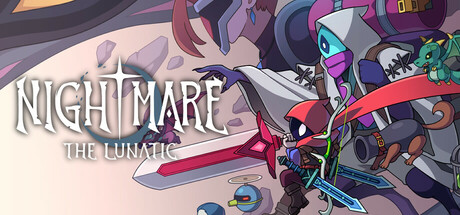
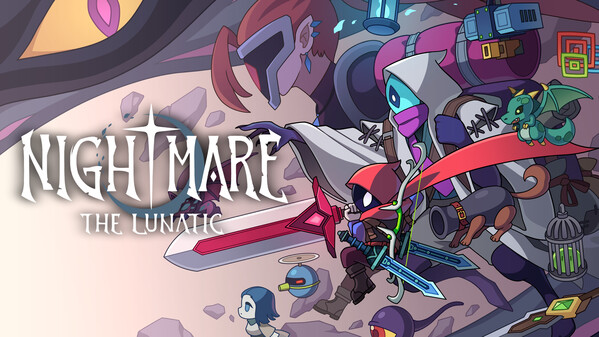
Nightmare: The Lunatic, developed and published by Maetdol Games, is a kinetic action roguelite that leans heavily into speed, adaptability, and a looping sense of progression that mirrors its dreamlike premise. Set within a distorted nightmare world where each failure resets the cycle, the game builds its appeal around repetition that feels purposeful rather than punishing. While the foundation may be familiar to fans of the genre, it quickly establishes its own identity through fluid combat systems and a design philosophy that rewards constant engagement rather than cautious play.
The most defining aspect of the game is its combat system, which revolves around managing and switching between multiple weapons in real time. Instead of encouraging players to commit to a single style, the game pushes them to actively rotate their arsenal, chaining attacks and abilities in a way that keeps every encounter dynamic. Each weapon fills a different role—some excel at close-range burst damage, while others provide safer ranged options—and the act of switching between them becomes just as important as attacking itself. This creates a satisfying rhythm where combat feels less like repetition and more like an evolving sequence of decisions, rewarding players who stay aggressive and adaptable.
Movement and responsiveness play a crucial role in maintaining this flow. Dodging, dashing, and repositioning are all tightly integrated into combat, allowing players to weave through enemy attacks while maintaining pressure. The controls feel intuitive once understood, but the pace of encounters can initially be overwhelming, especially as enemies begin to layer their attack patterns. As players become more familiar with the systems, however, the chaos starts to resolve into something more readable, and the game reveals a strong emphasis on skill expression. Boss encounters, in particular, stand out as highlights, often requiring precise timing, awareness, and effective use of all available tools.
The roguelite structure ensures that each run contributes to a broader sense of progression. As players advance, they unlock new weapons, abilities, and upgrades that expand their tactical options. The variety of enhancements allows for different build paths, encouraging experimentation across multiple runs. Some combinations can significantly alter how combat feels, giving players the opportunity to tailor their approach to their preferred playstyle. This long-term progression loop is one of the game’s strongest elements, providing a steady sense of growth that keeps players invested even after repeated failures.
Visually, the game embraces a stylized pixel art aesthetic that complements its surreal premise. Environments often feel fragmented and otherworldly, reinforcing the idea of navigating through a distorted dreamscape. Character animations are smooth, and the clarity of combat effects ensures that even during intense moments, the action remains readable. While the art style may not be groundbreaking, it is cohesive and effective, supporting the game’s tone without distracting from its mechanics. The audio design follows a similar approach, reinforcing the pace and tension of encounters without becoming a central focus.
Where the game occasionally falters is in its balance between depth and repetition. While the core combat loop is engaging, extended play sessions can reveal a degree of sameness in enemy behavior and encounter structure. The early hours can also feel dense, as the game introduces multiple systems in quick succession, which may be intimidating for newcomers. Additionally, while the narrative framework provides an intriguing backdrop, it remains relatively understated, offering only glimpses of a larger story rather than a fully developed narrative.
Despite these limitations, Nightmare: The Lunatic succeeds in delivering a compelling and highly replayable experience. Its strength lies in how it encourages players to improve—not just through numerical upgrades, but through a deeper understanding of its mechanics. Each run becomes an opportunity to refine strategies, experiment with new combinations, and push further into the nightmare. The sense of progression feels earned, and the game’s pacing ensures that there is always another challenge waiting just ahead.
In the end, the game stands as a strong example of how familiar systems can be elevated through thoughtful design and execution. It doesn’t attempt to radically redefine the roguelite genre, but it refines its core ideas into something polished and consistently engaging. For players who enjoy fast-paced combat, layered progression, and the satisfaction of gradual mastery, it offers an experience that is both challenging and rewarding, even if it occasionally leans on repetition.
Rating: 8/10