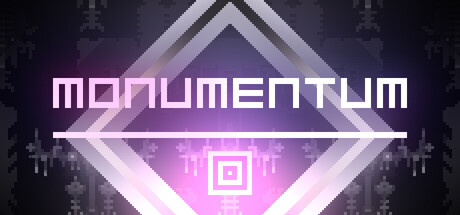
Take control of a small rolling square and utilize long dormant mechanisms to ascend to the top. Watch your step!
Modeled estimate, not a reported figure. How we estimate →
Media

About
DISCLAIMER: This game requires a gamepad controller and utilizes sustained button presses. If you feel that holding a button down for longer than 10-15 seconds at a time will be uncomfortable, you may want to try the demo before purchasing. Thank you!
MONUMENTUM is a metroidvania-rage-puzzle-platformer-pinball-like where you control both the environment and the player character. Overcome platforming challenges, climb upwards, and activate new mechanisms of movement to reach the top!
1-2 hours of playtime
100+ platforming challenges
5 mechanism abilities to discover and activate
Activate and utilize long dormant mechanisms to reach new heights. Enjoy an immersive, diegetic experience. Play without forced UI or tutorial interruptions. Experiment and forge your own path upwards! You can't die but you can and will fall. Try not to fall though. But you will, probably.
Stats
All-time low is the lowest price we've recorded for this game since we started tracking it.
Languages: English
Engagement
Reviews
Themes across 40 recent reviews and how positive each mention is. A keyword signal, not full sentiment analysis.
Reviews
its good
Great innovative platformer
saw this on a highly-upvoted r/godot post and was very impressed by the atmosphere and sound of the clip I saw. i bought this personally as a game dev in part to examine how an indie momentum platformer can effectively use a controller-only scheme... and also because it looks freakin' cool. aesthetically, it is very impressive. the barren, abandoned feel of the game world contrasted with the glowing neon effects instantly hooked me in, and the game does a good job of being visually interesting without making it unclear what you're supposed to interact with. the sound design is also really excellent: the hums and whirs of each element combined with the noises your character makes rolling on the ground sells the movement well. I was pretty engaged through the entire game, with the one notable exception where the challenge kinda plateaus at the end after you pick up all the movement upgrades. I was really waiting for something fiendish, and I was surprised that the game just kinda ended. i do think the two biggest issues I have with the game are the fact that it just ends without a final hard-but-satisfying challenge, and that it has all the opportunity to build intrigue with the world but chooses not to. overall, this was a very impressive first game from this developer! it seems like there's a spiritual successor to this game in the works, so I'm excited to see how that game builds on this proof-of-concept. personally I feel that this game was worth my money in its current state, but i will say its short (finished in 0.7 hours), so make of that what you will.
Related
Related
Trends
Concurrent players on Steam, sampled daily since tracking started.
Hours played at review time, across 40 reviews with recorded playtime.
positive critical· bar length = how often the theme comes up
Excellent <3
neat
MONUMENTUM is a precision-focused indie platformer developed and published by Jakob Scott, built around a simple yet demanding concept: climb upward using momentum, physics, and carefully timed inputs, or fall and try again. It strips away narrative excess and decorative mechanics to concentrate almost entirely on movement mastery. The result is a compact but intense experience that channels the spirit of modern “rage-platformers” while incorporating subtle puzzle elements and evolving traversal abilities that deepen its core mechanic. At the center of MONUMENTUM is a vertical ascent. Players control a small, weighty square navigating a towering structure filled with mechanisms, shifting platforms, and physics-driven obstacles. Unlike traditional platformers that revolve around jumping arcs and enemy avoidance, MONUMENTUM emphasizes momentum as both tool and obstacle. Movement feels heavy and deliberate, with each action affecting speed and trajectory in tangible ways. Success requires careful control of acceleration, positioning, and timing. A mistimed press or misjudged leap can send the player tumbling back down, sometimes undoing several minutes of progress in seconds. This ever-present risk of setback forms the emotional core of the experience. Falling does not end the run, but it imposes meaningful consequences. The absence of frequent checkpoints means that every climb carries tension. This design choice transforms even small victories into significant achievements. Reaching a new height feels earned, and maintaining composure after a fall becomes part of the challenge. MONUMENTUM thrives on that delicate balance between frustration and triumph, rewarding persistence and adaptability. As players ascend, they encounter new mechanisms that expand the range of movement possibilities. These abilities subtly alter physics interactions, allowing for different approaches to platforming challenges. Rather than introducing lengthy tutorials, the game encourages discovery through experimentation. Environmental cues hint at potential uses, but understanding often comes from trial and error. This hands-off design philosophy enhances immersion but also demands patience. Players who enjoy learning systems organically will appreciate the design, while those who prefer structured guidance may find the learning curve steep. The control scheme plays a critical role in shaping the experience. Designed primarily for controller input, MONUMENTUM emphasizes sustained button presses and precise analog movement. The tactile feel of holding momentum and adjusting direction mid-ascent creates a strong sense of physicality. Movement never feels automatic; it requires intentional engagement. This commitment to deliberate control reinforces the game’s central theme of mastery through repetition and refinement. Visually, MONUMENTUM adopts a minimalist pixel-art aesthetic that prioritizes clarity. The environments are clean and readable, ensuring that players can quickly interpret hazards and traversal opportunities. Subtle lighting and atmospheric effects add mood without distracting from gameplay. The soundtrack complements the tone with understated ambient elements, maintaining focus on the climb rather than overwhelming the player with dramatic cues. Despite its brevity—many players can complete the main ascent within a few hours—the experience feels dense and concentrated. The difficulty curve ramps steadily, introducing increasingly complex sequences that combine momentum management with environmental awareness. Later sections demand near-perfect execution, pushing players to internalize movement physics at a granular level. For fans of precision platformers, this escalation provides a satisfying test of skill. However, the same qualities that define MONUMENTUM’s appeal may also limit its accessibility. The unforgiving nature of long falls and limited safety nets can be discouraging for some players. The heavy reliance on controller input may also exclude those who prefer keyboard-based platforming. Additionally, the absence of narrative context means that motivation is entirely intrinsic—the reward is mastery itself rather than story progression. Ultimately, MONUMENTUM succeeds as a focused and disciplined platforming experience. It embraces its minimalist identity and commits fully to its core mechanic: the art of controlled ascent. Through physics-based movement, strategic risk-taking, and iterative learning, it delivers a concentrated challenge that rewards perseverance. For players who enjoy precision, momentum-driven gameplay, and the thrill of conquering a towering obstacle through skill alone, MONUMENTUM offers a memorable climb that is both punishing and profoundly satisfying. Rating: 7/10
Fun game. This is actually a genre confused rhythm game without music disguised as a precision platformer.
Bon jeu de plateforme puzzle, très court mais amusant.
This abstract precision platformer is a remarkably original video game. You play as a tiny square, but you also control the environment, operating a series of mechanisms to move your little square buddy up (it’s quite a vertical game) through the silent, mysterious world. The brilliant level design and ingenious gameplay thus merge into a harmonic whole. It’s highly impressive stuff. I notice that the game’s Steam page describes it as a ‘metroidvania-rage-puzzle-platformer-pinball-like’, which makes it sound scarier than it is. It certainly has some metroidvania-like attributes, most notably the gradual introduction of new environmental movement mechanics; and, like all good precision platformers, there’s plenty of traversal puzzles to solve (but nothing like, say, the puzzles in the Planet of Lana games). And the movement can sometimes feel a little like a highly-sophisticated form of pinball. But although it is indeed a difficult game, I never felt rage, I was too busy marvelling at the brilliance of the game’s design. Also, the punishment for platforming failures is not as harsh as the likes of Getting Over it With Bennet Foddy. However, it will require you to reacquaint yourself with ALL the buttons on your controller. I don’t remember playing a game that has so many different button inputs. Like Ambidextro from last year, it asks you to use your gaming brain in a slightly new way. And it’s glorious! I also love the way it looks. The developer has used pixel art to create a strangely elegant-looking world of monumental technology. The use of colour - when you activate one of the mechanisms - brings beautiful flashes of light to an otherwise dark, monochromatic world. It’s a short, but dense, game. There’s so many inventive platforming challenges packed into its short, well-judged, run time. But if you want more, the developer, Jakob Scott, has a new game coming out in July called Chasm Shift. I’ve played the demo, which is tremendous. It’s another precision platfomer with metroidvania elements, only a larger scale. Like the wondrous Monumentum, it felt fresh and original, and is one of my most anticipated games of the year, even more so after playing this one (which plays beautifully on Steam Deck, by the way).
I enjoyed this game, it was fun using the different mechanics to bounce around and platform to the top. I think it had more promise than it used, and could have been better. But I don't know many games that utilize mechanics like this and still enjoyed myself.
Momentum
Pace estimated from the game's recent review growth (our daily snapshots) at its own sales-per-review ratio — a momentum signal, not booked sales.
Audience
Estimated from the language of this game's reviews — a proxy for where players are, not official Steam demographics.
Related
| DoomAI | $6.4K | 59 | 83% | $4.99 |
| Seven Doors | $6.4K | 101 | 65% | $4.99 |
| Hold The Fort | $6.4K | 59 | 81% | $4.99 |
| Glad Valakas: Cyberban | $6.4K | 115 | 97% | $2.99 |
| 7th Floor | $6.4K | 56 | 98% | $4.99 |
| Mystery Of Rivenhallows | $6.4K | 133 | 39% | $2.99 |
Related
| House Flipper | $65.8M | 110.8K | 94% | $24.99 |
| The Scroll of Taiwu : Beyond The Dome | $62.3M | 69.6K | 66% | $29.99 |
| Papers, Please | $27.2M | 79.7K | 97% | $9.99 |
| Golf With Your Friends | $23.7M | 74.7K | 87% | $14.99 |
| Coral Island | $20.8M | 27.2K | 89% | $29.99 |
| Plants vs. Zombies GOTY Edition | $16M | 154.2K | 98% | $4.99 |