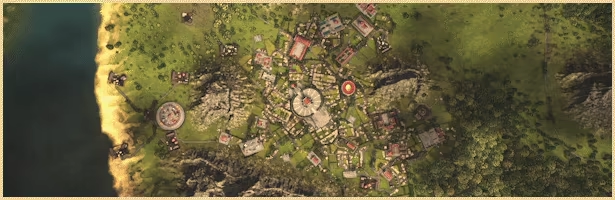
Memoriapolis is a historical city builder where your city grows organically across 5 ages, from Antiquity to the Industrial Revolution. Manage resources, interact with factions, and shape your dynasty toward building a final Wonder with easy, normal, or hard difficulty levels.
Modeled estimate, not a reported figure. How we estimate →
Media

About

Place the buildings. The city grows organically and districts expand. Manage resources, navigate faction demands, and guide your dynasty to its final goal : building one of three Industrial Revolution Wonders — the Eiffel Tower, Neuschwanstein Castle, or the Statue of Liberty.
Relaxed or challenging : difficulty settings adjust objectives, faction pressure, and resource balance to match how you want to play.

Factions now have personalities: Altruist, Warrior, Expansionist, and more. They don't all want the same thing, and they won't all negotiate the same way.
Your dynasty's goal : reach the Industrial Revolution and build one of three final Wonders — the Eiffel Tower, Neuschwanstein Castle, or the Statue of Liberty.
The city is more open than before. No more cycle limits. No more closed districts. New maps, Steam achievements, difficulty levels have also been added and more!
At the heart of it all : the Dynastic House that grows with your city across every age.

Memoriapolis spans five historical eras : Antiquity, the Middle Ages, the Renaissance, the Age of Enlightenment, and the Industrial Revolution. Each age transforms your city with new architecture, new challenges, new Monuments to unlock.
No rigid grid. Your city develops naturally, expanding through districts shaped by your choices and your citizens. No two playthroughs look the same.
Construct iconic landmarks like the Library of Alexandria, Windsor Castle, Leaning Tower of Pisa, Palace of Versailles and more to give your city a unique identity through time.
Factions have personalities — Altruist, Warrior, Expansionist, and more — and they have demands. You can accept proposals directly, negotiate terms, or choose to favor one faction over another. Engage as much or as little as the game calls for.
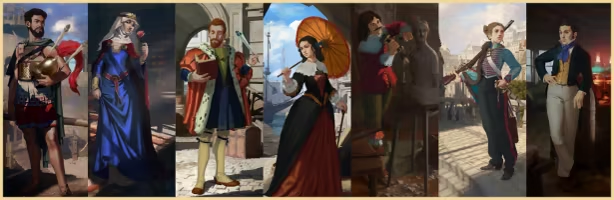

Your city grows organically and you guide your dynasty across the ages. Factions add depth but you are free to engage with these systems at your own pace.
Banners & Wonders is the biggest update since launch. Factions now have personalities, construction is more open, new maps have been added, and your dynasty now has a final goal : build one of three Industrial Era Wonders.
Yes and no! Select your difficulty at the start of a run: resources, faction pressure, objectives and more… all vary depending on the level you choose.
Each playthrough is different thanks to different maps, different factions, different Wonder to build at the end. The organic growth of your city means no two runs look the same.
Genres
Stats
All-time low is the lowest price we've recorded for this game since we started tracking it.
Languages: English, French, German, Spanish - Spain, Russian, Simplified Chinese, Polish, Portuguese - Brazil
Engagement
Hours played at review time, across 41 reviews with recorded playtime.
Reviews
Themes across 41 recent reviews and how positive each mention is. A keyword signal, not full sentiment analysis.
positive critical· bar length = how often the theme comes up
Reviews
Interesting concept. This is a city builder where you build no roads, no housing; many portions of the game are organic. Maybe I (and others) aren't ready for a fully organic approach. The developer can do a better job of translating 'if i build here, X could happen'. Due to multi-eras and policies, the impact evolves, and causes friction for your different factions. If you try to negotate with factions, it leads to negative affects. Therefore, I don't negotiate anything and accept everything with what seems no to little impact. The areas are milestone driven. Nothing creates urgency to meet the timeline; just put the speed on high and come back when you have enough of X. Utlimately, that is what leaves me with a not recommended, the game feels meaningless.
Memoria Polis is a game that looks really good, but that's about it. I didn't run into any issues getting it to run and it seemed pretty smooth, but as a city-builder or a strategy game it feels like a city-painter with extra steps. The game is so devoid of meaning. It's not strategic enough to be interesting like a more survival focused city-builder. The tech is impressive to look at but it doesn't give you the level of control a la Cities Skylines to make it so you can experiment deeply with some kind of logistical issues or novel ideas. It's just... get the roads and attractiveness up in the areas you want and people move in, make sure you have plenty of food. I felt zero challenge on medium difficulty, but I also struggled to feel creative. Just plop down buildings that all basically do the same thing but are different colors. There's never any pressure to do ANYTHING. The biggest disappointment is the age-transition mechanic though. Maybe if it mattered it would be something to write home about, but it's as pointless as the rest of the game feels. Some of the buildings evolve and they can the bare minimum of wrinkles, but I am not being the least bit hyperbolic when I say that if you know Civilization 7, regardless if you like that game or don't, Civ 7 has a more interesting and more strategic age transition mechanic. The ancient cities losing prestige, having to be careful about your ageless buildings, but also getting overbuild older buildings and revitalize them is way better done and more engaging than Memoria Polis. Memoria Polis is basically just keep doing what you did in the first age but it's medieval flavored now. No urban renewal, no problems, no fires gutting your city. Just plopping down more and more buildings. Basically, the game is a vehicle to show off some of the painting tech behind their district system and I don't want to disparage the work of developers because I don't know the effort that went into it, but as a player, as someone who paid money, it's dull as dishwater. Who cares! The roads don't do anything, there's nothing logistical about it. There's nothing creative. The game is pretty from afar, but it's lifeless. There's no activity, there's some weather (that doesn't matter). It's a city painter. It's bereft of challenge and player creative expression. There are so many better city-builders.
The game is pretty but lacks meaningful choice. On the surface, the game gives you a lot of choices. There's a permanent buff you select at the start of an age, knowledge cards you can slot in starting in the second age (think simplified Civ 6 civics card), and factions with varying personalities that sometimes compete with each other. However, the consequences of these choices are too small for them to matter. I'm told to not let a faction grow too powerful, but even the warlike factions aren't an annoyance, and the misers that hoard gold still pay roughly the same in taxes. There's a council formed out of the two most powerful factions and every now and then they'll propose a law change on their own which costs you political capital to oppose, but... most of the laws are okay. Even if they don't propose my first-choice law, they're all just a question of "which city buff do you want" so there's not a major downside to simply agreeing. The political decrees are also both too expensive to bother with (at least in the first two ages), have questionable AI weights (you require a building permit to build a faction's monument, but said faction only mildly cares), and bribing them to your side costs 100 gold whether their trust score is -1 or -30 from what you need. So if there are any actual consequences to just letting factions grow, I haven't encountered them, and if they only kick in at age 3+ that's too late for a player to strategize around. On the micro level, the main challenge of the game is dealing with the constant stream of migrants to your city (outside of a decree, you do not control the rate you expand, unlike most city builders) and ensuring there's enough service supply for the five services. There are six lines of buildings to provide services, one for each faction, with five of them primarily specializing in a specific service while sometimes offering secondary services of your choice. You choose which buildings to build and where to place them, but this doesn't really seem to matter. The flexible service slots are ironically too flexible to the point where you don't have to focus on a faction's buildings because you can get services from most of the others, so there's technically a choice there, but as there's no downside to the factions gaining power, you can just build whatever. Even then, you're encouraged to build at least one of every building in an age to unlock the technically optional monuments. They're not required to advance, but they expand your city, provide massive service boosts, and offer missable permanent bonuses to the city, so there's literally no reason not to build them all. This means every city ends up with every building, and where you put them is largely unimportant. In the end, there's a lot to the game, but it's lacking consequence. In particular, everything seems tied around balancing the factions, but you're also given so much flexibility to not engage with mechanics that it doesn't really matter. The final result is a game that looks pretty but is sadly dull.
The saying that you shouldn’t judge a book by its cover almost perfectly describes the indie game Memoriapolis. At first glance, the debut project from the French studio 5PM looks like something you would play while waiting in line or trying to kill a few boring minutes - the kind of title that justifiably earns the somewhat pejorative label of a “little casual game.” Even after checking out the screenshots and short description on Steam, it still gives off the impression of a pointless idle game, albeit one with charming visuals. The truth, however, is very different. Beneath its surface lies a surprisingly deep and addictive city-building system. Memoriapolis is a surprisingly complex and engaging game that hides an intricate city management simulation under the hood. The player’s task is to establish a Mediterranean city-state in ancient times, develop it, and guide it through the Dark Ages, the Renaissance, and eventually into the Industrial Era. The first step is constructing a family estate, which serves as a gathering place and a kind of magnet for attracting new citizens to the city. The player only has direct control over industrial and public buildings, while residential districts grow organically as newcomers arrive. At first, these will consist of clusters of shabby huts connected by muddy alleyways, but over time, in line with the social rise of their owners, they will evolve into magnificent marble villas. The game features six natural resources, plus food as the only renewable resource, while two additional resources only become available once you reach the Middle Ages. In this regard, the gameplay is not too different from standard management simulations such as the Anno series. Since people are social and political creatures, they will soon begin organizing themselves into various factions and pushing their own agendas, demanding that you shape the city according to their preferences. This primarily revolves around issuing short-term decrees, often bitter pills to swallow when it comes to the city’s long-term progress, but necessary to maintain social stability. Craftsmen, politicians, officers, merchants, clergy, and intellectuals all compete for influence, and it is up to you to maintain balance between the social classes and ensure that no group feels neglected. If one of the factions becomes too dissatisfied, it will barricade itself inside its district and withdraw from the city’s social life - the first step toward a game over screen. Each era lasts for a certain number of cycles, although you can trigger an early transition to the next age by upgrading the family estate through five stages. Entering a new era is always turbulent, though thankfully not as destructive as in the latest Civilization VII, meaning not every structure will be wiped out during the transition period. How many buildings survive depends on your success in the previous era. The game periodically evaluates your progress based on stored resources, the number of buildings, and citizen satisfaction, rewarding you with memory coins. The more coins you collect, the smoother the transition into the next era becomes. Ultimately, all of these mechanics must work together as a cohesive whole. Juggling decrees, fitting new buildings together like pieces in a game of Tetris to encourage the growth of specific districts or factions, and positioning structures that generate feelings of safety, belonging, or prestige among the population are all part of a larger puzzle whose proper assembly allows the polis to function harmoniously and progress into the modern age. The first major issue with Memoriapolis is its extremely steep learning curve. The tutorial is short and vague, it explains how to do things, but not why or when you should do them, meaning that trial and error becomes the only way to truly understand how the systems work. The second problem only reveals itself to players persistent enough to survive the ordeal of the first: once you fully grasp all the mechanics, the game becomes painfully repetitive. There are only two maps, one standard and one snowy variant, each offering a few starting locations that barely affect the course of the game. This title desperately needs a random map generator. Memoriapolis demands a significant investment of time, along with watching YouTube tutorials, browsing subreddits, and generally hunting for information across the internet. Play at your own risk! Original from June 2025 in Serbian: https://www.sk.rs/arhiva/clanak/34557/memoriapolis
I love everything about this game, except this one thing.. You're forced to play a certain way when it comes to making decisions. Very clear with it's biases, feels 1 dimensional in that aspect. Other than that the visuals are nice and the city building side is very relaxing. I would definitely change my mind if more options were available with BALANCED penalties, not arbitrary.
I've always wanted a city builder where you have to deal with the decisions of the past. You know? In nearly all city builders you can design the city from the start, pretty much and just get building. If you have to redesign a section of the city, it's pretty easy. I always thought: wouldn't it be a good challenge, like a real city planner, to have to try and work within the constraints of the way the city naturally evolved over time? Narrow roads from before cars, the city centre's location used to make perfect sense in old times, but now you need to work out how to move millions of people around. That sort of thing. I thought Memoria Polis would be that game. It appears to be at first, with some other interesting mechanics. It looks great, the city evolves naturally. You play more of the "public figure" building, basically, just public buildings and the citizens themselves will build the city influenced by your decisions. You really spend most of your time dealing with the factions that form in the city. You can just drop the "public" buildings kind of wherever you want. Which brings me to why I don't recommend it. It turns out with that sort of set up there really isn't much to do. You slap down the production buildings (wood cutter, farms, stuff like that) - there's not much to limit you from putting down as many as you want. Once the products are streaming in you just want for the next building to unlock, and slap it down. There's lots of the factions coming to you to negotiate this and that - and at first I thought "I see, I don't design roads and so forth, I influence the shape of the city a bit but mostly it's like a political sim." To be honest, once I had production humming along, I just ignored the negotiations. They'd pop up, I'd click "accept" it would *double-check* "Are you sure you want to just accept without negotiating?" -- which really makes me think I'm missing something but I'd check, fiddle with the negotiation a bit, usually end up pretty much undoing it all and accepting the original negotiation. So... to avoid the second "are you sure" I just started ignoring them altogether - they'd time out after a bit and solve themselves. So by the middle of the Middle Ages I basically sit there, waiting for the resourcing to get to a pre-set number then slap down the next building. Missed opportunity, or perhaps I'm missing something.
This game deserves more positive reviews. It is visually stunning, and the idea of building a single city through several ages is great. Seeing the city grow is beautiful, and I personally love the cultural evolutions - that is, whenever a building from an earlier age "merges" with one from a later age. This is exactly what happened historically, and it is great to see it reflected here. It is true that some of the mechanics are still a bit janky. Faction negotiations are a bit of a hassle - they keep popping up but 99% of the time I just approve them, it does not seem to be particularly worth it to tweak them. However, the devs have really listened to feedback and have significantly reworked the game with the latest update (at the time of writing), Banners & Wonders. I played the first version - now it is quite different. There is more freedom, some unclear mechanics (looking at you, Collection) were scrapped, and factions are more streamlined (although not perfect - but most city-builder and strategy games have lacking internal politics simulations). All in all, this game deserves more love. It is beautiful, has an original vision, and its devs are still actively working to improve it and expand it. I would recommend it to city-builder fans looking for a more historical and relaxing experience
I wanted to love this game but it's just not that interesting or polished. Ignoring user feedback in early access led to a bungled launch, and a lackluster rebuild didn't do enough to make this one stand out above the group.
I posted this as a reply in the forum but decided it could serve well enough as my review too, and why I refunded this. It's not a bad game, its quite pretty and looks interesting but it is almost indecipherable in its current iteration. I'm no stranger to this type of game, or complex games in general, but I have to tell you I agree with the overall sentiment here and I bounced off of this game hard. I gather that this is a result of a recent change in the mechanics? Either way, it is not at all evident what you are supposed to do when you start. You're given goals you cannot achieve "research sand.. okay how? It says to do it in the build menu but that's locked by something else that I can't build yet..." You have to self-discover 2-3 mechanics before it even becomes clear what you need to do, and nowhere does it lead you to discover how to actually build a healthy city. Political factions begin popping up with no real reasoning. Okay some military guys want a district of my city. Why would I give them one? It says they'll just take taxes for themselves. The benefit is not evident. Yes it says they will unlock a new building but it's not obvious why I would care about that over the loss of tax revenue. And does the district I give them matter? Can I give them this outskirts district with 2 people? Is it better to give them one in the inner city with 50+? Does that matter at all? None of this is evident, nor is what these new buildings actually provide, without a copious amount of reading dry, bland pages of text in a codex. I'm not even opposed to reading, I play games where reading is the core mechanic, but it has to be INTERESTING. You need to hook the player before you slap them with a book. So this one got a pass and a refund from me because at no point was I hooked or interested, and this is from someone who has hundreds and hundreds of hours in city builders and esoteric games.
It's a difficult one: overall 'yes' but like anything there's caveats, good and bad. First: it's NOT an annon style city builder 'YAY' for me. The graphic style is an organic, odd thing that I personally really love, and it's the sort of game you can play while eating, if that makes any sense. Chill game wth chill music. You'll make decisions, sure, but you're nudging and selecting general areas. No picking up citizen X and dropping them on building Y or wondering why an individual worker won't do a specific assigned task. For me amazing positives. Second: And it's huge negative for me: no attempt to explain or put in a tutorial, zero. Pop ups that don't make sense: I'm low on food yet I have a warehouse full and can't make any more because there's nowhere to store it. So... at this stage I should have more in store? Higher waste for safety? More storage areas? What is going on in your head that you're trying to tell me person who made this? An interactive wiki in game really isn't what anyone needs... The whole game is a bit like this beyond 'a farm will produce food and you'll need faction characters to upgrade it' I think anyway, I'm not sure how you get extra ones.. By rights I should hit thumbs down becausehere's no point in making all these systems if you can't explain how to use them. BUT the end product - for me - is so charming and I WANT it to be good, but it's another project that fails to communicate with the player. So buy it on sale and see if you want to figure it out. I'm running this through Steam proton and it runs 'fine' Not the greatest PC by any means.
Related
Related
Trends
Modeled estimate over time, reconstructed from Steam's monthly review histogram.
Audience
Estimated from the language of this game's reviews — a proxy for where players are, not official Steam demographics.
Related
| Terminus: Zombie Survivors | $2M | 4.5K | 94% | $13.99 |
| Sephiria | $2M | 6.1K | 94% | $14.99 |
| Chorus | $2M | 4.6K | 82% | $24.99 |
| I Am Fish | $2M | 3.8K | 73% | $19.99 |
| MMORPG Tycoon 2 | $2M | 3.1K | 86% | $24.99 |
| Warlock - Master of the Arcane | $2M | 2.6K | 86% | $6.24 |