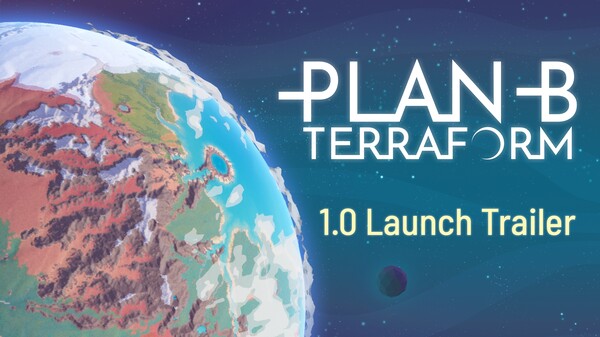
Terraform a lifeless rock into a lush and habitable world. Build trucks, trains, and sprawling factories on an enormous hexagonal planet. Grow its population to millions. Enjoy a dynamic simulation of atmosphere, temperature, water, and forests.
Modeled estimate, not a reported figure. How we estimate →
Prices
Each in the currency that store quoted — not converted: the gap between two rows is the publisher's pricing, not an exchange rate.
Every market we collect.
Discounts
Every price cut of more than 20% we have observed, in each market that quoted one, with this game's chart position on either side of it. These are episodes, not a model: a sale is one event, and one event cannot tell you what the next one will do.
Reviews, worldwide (the counter carries no country): 0.38/day in the week to Jul 21 → 0.8/day in the week after.
For scale, across Steam · Top Sellers · Brazil over the last 30 days: the 25 chart moves that followed a price cut of more than 20% went a median of 10 places towards #1, and the 2,413 moves with no price cut behind them went 2 away. One store, one chart, one country — it is the only place we have enough observations to say even that.
Prices outside the United States have been collected since 6 August 2026 and chart positions since 19 July 2026, so a cut older than that has no market to compare and a market that joined later has no history yet. Nothing here is converted between currencies.
About
Transform a Barren World into a Thriving Planet
Plan B: Terraform is a calm and contemplative sci-fi simulation game set in a near future where humanity must look beyond Earth for survival. Your mission: shape a newly discovered planet into a habitable world. Explore a vast, hex-based terrain with over a million tiles and harness a full ecosystem simulation.
Shape Climate, Water, and Life
Raise global temperatures with greenhouse gas generators, unlock underground ice to form flowing rivers and vast oceans, and restore vegetation across the land. Experience dynamic weather systems, including evaporation, wind patterns, and rainfall. Turn a lifeless rock into a living world covered in forests, rivers, and oceans.
Build Supply Chains and Grow Cities
Extract minerals, manufacture goods, and move them with trucks, trains, drones, and ships. Establish automated supply lines to support expanding cities, transforming small outposts into thriving metropolises with populations in the millions. Every stage of growth depends on your ability to manage logistics, optimize infrastructure, and keep automation running smoothly.
Genres
Add-ons
Each DLC is estimated with the same model as a game, then summed — a modeled figure, not reported DLC sales.
Updates
Build ids and update times come straight from Steam's PICS — the same source SteamDB reads. Patch history grows as we record new builds.
Engagement
Reviews
Themes across 111 recent reviews and how positive each mention is. A keyword signal, not full sentiment analysis.
Reviews
Another indie game that I like far more in theory than in practice. It has a pleasant visual style, and the terraforming system is both meaningful and satisfying. The problem is that much of the gameplay revolves around fixing mistakes you made hours earlier. Mistakes you had no way of knowing would become problems in the future. I guess that's realistic, but it often feels more frustrating than rewarding. As your colony grows, the game becomes less about building something new and more about untangling old logistical issues. Eventually, it starts to feel like a chore. I reached a point where I'd rather watch an experienced player build a perfectly optimized planet than spend more time wrestling with the consequences of my own early decisions :(
This is really quite a phenomenal and cathartic game for logistics nerds. It's incredibly simplistic, but it only uses that to build a large and fun scale and complexity through that. It's not as heavy as Factorio, but it's by no means less for it and is quite easy to pick up. You get ores, you make products, you turn products into more products. You feed the city with those products. Those cities make basic waste of slightly less than what you supplied them, and you figure out how to recycle them back into the production chain. You do this with drone ports that just pick up and ferry resources within their range. This simplifies, but doesn't eliminate, a lot of micromanagement. All of this is mostly a logistics problem and production location. 3 ore turns into 1 steel, don't transport the ore. You need to carry a ton of resources across the entire planet. And eventually need to connect all three cities across the planet to each other in order to supply each other with the higher tier resources to grow them bigger. 1 million is the goal, and it's not the simplest one to accomplish. You are in just a map view, not a character, so you have full freedom around the planet. Everything can be freely and instantly constructed and demolished to inventory at a whim once you produce it in the first place. Every building or selection of them can be literally cut, copy, and pasted around, or click-dragged around easily. And you'll need it, because the planet changes. Whether it's the cities you're growing or the oceans and jungles you're creating. Both of these offer profoundly cathartic reasoning to play. The cities scale but don't get too out of control, in size or resource usage. At the same time, the urban planning I'm forced to do around the massive growing river down the middle of one of my cities, or stopping their expansion into a O2 critical Jungle biome, is a marginally annoying but ultimately fun and unique experience to play-through. It's nice as well that most of the population of cities are moved around to other parts of the city when they are flooded. Not all of them, but the city also just ends up developing denser in more stable areas. It feels bad at first, but once you realize it didn't actually set you back much, you can just accept it and think about how you want to work with it. All of which offer such fun and creative world-building and role-playing. And world-building is the name of the game. The terraforming aspect is simple, but this isn't to its fault either. It scales to a huge hex-tiled planet with varying heights and water availability and rivers that naturally create different climate regions on your unique planet. Seeing your planet naturally green and where various types of trees and biomes naturally develop is really cathartic. You do need to seed a lot of these regions with your own produced trees, but they do grow very quickly and exponentially on their own beyond that in their viable areas. My main complaint is I wish this game had more types of vegetation options and oceanic biomes that formed. It'd be really cool to see some of that form on your planet. I have some cool atoll/reefs that ended up forming from some craters I'd like to see coral form on. There's also a spoiler thing that happens partway into the game that I wish would return again and become relevant. In the end though, very worth a good playthrough. Your industrial areas will be flooded. You can literally cut and paste the entire thing somewhere else. It's more important how you connect it and develop new areas for it. And where you source it to not have an ocean flood it. Or fight back the 90m tall ocean with tons of dam pumps while you mine out the iron/aluminum there.
Media

Related
Related
Price dynamics, follower growth, revenue and sales trajectories with interactive tooltips
This and every other Pro feature is free until October 20, 2026. A free account is all it takes.
Stats
All-time low is the lowest price we've recorded for this game since we started tracking it.
Languages: English, French, German, Japanese, Korean, Russian, Simplified Chinese, Portuguese - Brazil, Spanish - Spain, Italian, Czech, Polish +4 more
Hours played at review time, across 111 reviews with recorded playtime.
positive critical· bar length = how often the theme comes up
Solid title. Very well designed randomized worlds with a great visual aesthetic. For those like me coming from Factorio, the depth of this game is more shallow and less polished. This is mostly a good thing and It still provides about 100 hours of fun so it is well worth the price. It is well differentiated from other automation games. Plan b focuses on environmental engineering and there is plenty to build. Only negatives are an over-emphasis on rebuilding and rebalancing due to environmental changes / tech requirements. The first playthrough will have some tedious and repetitive moments. There were a few small UI quirks like not having build hotkeys and terrain leveling being a total bearcat to master. I definitely sunk over several hours using trial and error to make new waterways and not drown my cites. This is due to an amazing mechanic of the water being very complex, but it's very tedious to control because it responds slowly and unpredictably. Can't wait for a sequel or future title from the dev.
if you're anything like me, you play automation games like factorio and shapez in "test runs" where you start a low-risk save and restart having a better understanding of the mechanics and what to do and what not to do. if this is true then do not buy this game; the progression is rigid and you will not make any short-term decisions outside of logistics. it's not much of a problem if you're not looking for replayability or if you have actual patience to get back to where you were in the game during the last save.
Wow! I don't often write Steam reviews, but this game is an underappreciated gem that deserves much more highlight. I would describe this game as Transport Tycoon meets Factorio with a terraforming theme. Where you as a player are really the one driving the terraforming to the benefit of your cities. The game is really well balanced and leaves many annoying aspects (like managing electricity) aside, to let you focus on the more fun elements of managing logistics and builds. It has some very novel gaming mechanics. For example, the water dynamics are done very well and very gradually change your game world with new opportunities and challenges. Highly recommended, this developer deserves much more spotlight!
A simplistic but beautiful logistics game with cool evolving landscape+gamplay. Keep in mind that you are always building for scale and the game becomes easy, at least in comparison with some of the more hardcore logistics games out there. Pathing is kept simple (There is no vehicle collisions here, so no need for the complicated TTD signals), so linear scaling is easy to accomplish.
The trailer had me at boats! Trains are cool and all, but if you're going to melt the icecaps and make an ocean... It's a simple, polished factory/logistics game. About as simple as it can get -- if you're new to factory games, I think this is the one to start out on. It has a minimum viable number of buildings and resources, but they are well-chosen for meaningful progression. I always felt mildly challenged without it getting too repetitive. The UI and quality of life is quite forgiving. Have fun copy-pasting! It's quite emotional for the genre. The factory must grow to support growing cities! I got warm fuzzies looking at buildings pop up and evolve. Terraforming is a lot more visceral when not only do trees spread, but rivers flow and the ocean rises. (I'm looking at you, Surviving Mars.) There's a simple story with cute NPCs that guides the gameplay nicely. I enjoyed making city blocks with roads, just for the aesthetics. You can guide the city's shape and even make parks. The oceans are what makes this game shine. You can dam rivers, plan your city's coast and ports - and oops, all your stuff's flooded. The loading tips recommends you don't fight the ocean, but I totally did. Even if it's not quite Timberborn, there are some subtle groundwater mechanics you can play with for that megafarm. (And hey, it's not like Beaver Game has boats on a space ocean!) Arguably play this one first if you're getting into factory games! Experienced factory builders can enjoy the aesthetic, the story, and the water -- definitely crank mountains to maximum... and oceans too, if you dare. I found it had just enough replayability with achievements, but I think this is a stepping stone to a deeper, 1000-hour factory game. I enjoyed it and I'm done with it.
I’ve put around 40 hours into Plan B: Terraform, and I’ve had a mostly positive experience. The core idea is fantastic: taking a barren planet and slowly turning it into a functioning civilization is incredibly satisfying. Terraforming is not just a progress bar either. It becomes part of the logistics puzzle. Digging canals through mountains, reshaping terrain for infrastructure, and building massive industrial networks are some of the most memorable moments the game offers. The logistics are surprisingly deep too. Trains, trucks, and ships each have their own strengths, and building a centralized industrial hub that supplies cities across the planet feels great. The biggest weakness is that many systems are more opaque than they need to be. It is difficult to know how to design things "correctly" without a lot of experimentation. Transport capacity numbers can be misleading because loading times, unloading, and travel distance all matter. Ship docks and drone logistics are especially tricky to optimize. Late-game scaling is also a mixed bag. The planetary scale looks incredible, but growth is almost entirely horizontal. If you need twice as much steel, the answer is usually to build twice as many steel plants. Watching your industrial footprint spread across the planet is cool, but eventually expansion starts to feel like maintaining more of the same rather than finding new ways to improve efficiency. Rebuilding infrastructure is another pain point, since moving large transportation networks is tedious. Performance has also started to become a concern on larger worlds. My planet is around 400k population, and while that is not even the game's intended endpoint of 1 million population, moving around the world can become unpleasant due to stuttering and lag while panning around the map. For reference, I am playing on a fairly capable system (Intel Core i5-12600K, NVIDIA GeForce RTX 5070 Ti), so I do not think the game is not performant, but the late-game experience could use more polish. Overall, I really enjoyed Plan B: Terraform and think it has a unique sense of scale. I just find myself losing motivation to push all the way to the end, partly from the natural fatigue of a long factory game and partly from the friction of managing such a large world.
Мне кажется я путен
Great game for what’s here already. Eagerly waiting for the major update. I’ll definitely sink many more hours into this.
Active players
Estimated daily and monthly active players (DAU/MAU) modeled from peak concurrency.
Players by region
Where this game's players are, estimated from review languages.
Players also reviewed
The games this title's players most often review too — audience affinity.
Related
| Game | Estimated lifetime revenue | Reviews | Review score | Price |
|---|---|---|---|---|
| $602.9K | 801 | 81% | $19.99 | |
| $311.5K | 592 | 85% | $12.99 | |
| $170.5K | 160 | 90% | $24.99 | |
| $447 | 2 | 0% | $7.99 | |
| $0 | 1.5K | 77% | Free | |
| $3.4M | 4.5K | 91% | $19.99 |
Related
| Game | Estimated lifetime revenue | Reviews | Review score | Price |
|---|---|---|---|---|
| $2.3M | 2.5K | 75% | $44.99 | |
| $2.3M | 2.6K | 66% | $29.99 | |
| $2.3M | 1.8K | 76% | $32.00 | |
| $2.3M | 6.9K | 66% | $19.99 | |
| $2.3M | 2K | 77% | $44.99 | |
| $2.3M | 1.9K | 94% | $59.99 |