LORED is an incremental resource-management game that takes the familiar pleasure of watching production numbers climb and surrounds it with strange humor, expressive stick figures, and an increasingly elaborate network of automated systems. Developed and published by Dillon Simpson, it initially appears simple, but that simplicity quickly gives way to a surprisingly involved economy. The objective is essentially to recruit and improve specialized workers known as LOREDs, have them generate resources, and use those materials to strengthen the operation until production becomes dramatically more efficient. It is an idle game at heart, yet there is enough management and optimization involved to make progression feel more deliberate than simply waiting for a counter to increase.
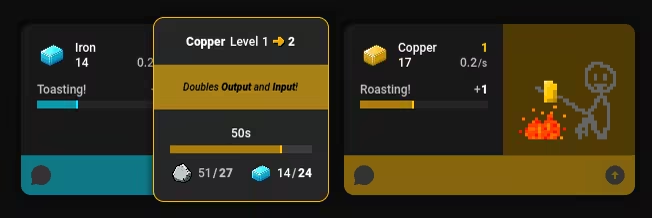
The early stages introduce basic resources such as iron and copper while teaching the relationship between production, consumption, and upgrades. Individual LOREDs perform specific jobs, and their outputs frequently support other parts of the economy. This creates interconnected production chains where improving one worker can have consequences elsewhere. Fuel and resource availability must be considered when expanding, preventing the player from thoughtlessly upgrading everything at once. Eventually, what started as a small collection of workers develops into a busy automated operation where numerous resources are being created, consumed, and multiplied simultaneously.
Automation is one of the most satisfying parts of the experience. Instead of turning progression into constant manual clicking, the game encourages players to construct systems that increasingly function on their own. The player's role gradually changes from actively pushing production forward to supervising a machine that has become capable of generating substantial resources independently. Returning after allowing the operation to work and discovering that enough materials have accumulated for several significant upgrades captures the classic appeal of the incremental genre particularly well.
Progression also benefits from being organized into Stages. New sections introduce additional mechanics and complications instead of revealing every system immediately. This gives players time to understand how one economy works before another layer is placed on top of it. Advancing therefore feels more meaningful than merely unlocking another percentage bonus. New workers, currencies, production relationships, and upgrades can force the player to reconsider priorities that previously seemed obvious. The result is a progression structure that remains interesting because complexity expands alongside the player's understanding of the game.
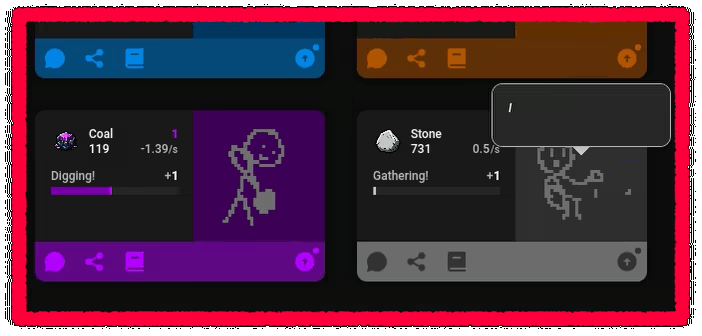
The LOREDs themselves prevent the experience from feeling like a collection of anonymous statistics. These peculiar stick-figure workers have animations and dialogue that inject personality into what could otherwise have been a very dry optimization game. The visual style is deliberately uncomplicated, but it fits the concept extremely well. Watching a growing workforce perform different jobs gives the production system a physical presence, while the colorful and exaggerated presentation makes it easy to distinguish the game's various elements. It proves that an incremental title does not require elaborate graphics to establish a recognizable visual identity.
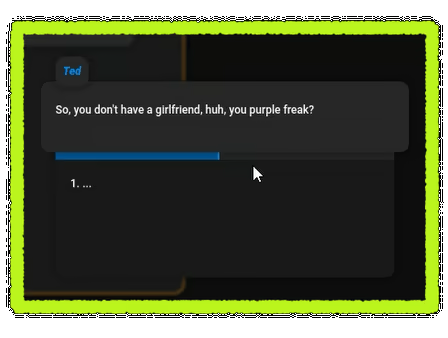
Its comedy is similarly distinctive, although considerably less innocent than the simplistic characters might suggest. The writing contains profanity, absurd situations, dark jokes, and deliberately irreverent material. Some concepts become increasingly ridiculous as progression continues, including unusual resources such as Malignancy. The humor contributes significantly to the game's character, but its particular style will naturally be more appealing to players comfortable with crude and unconventional comedy. Those expecting a completely wholesome idle game based solely on the cute stick figures may be surprised by the tone.
The strongest aspect of LORED is the way progression repeatedly provides another objective just as the existing routine begins becoming predictable. There is almost always another upgrade to pursue, another efficiency problem to solve, or another milestone that promises greater production. This creates the dangerous "one more upgrade" effect that successful incremental games thrive upon. Optimization-minded players can spend considerable time analyzing which improvements provide the best returns, while less demanding players can allow automation to handle much of the workload and periodically return to spend accumulated resources.
There are limitations to the formula. Anyone who fundamentally dislikes idle games is unlikely to be persuaded by the presentation because waiting, accumulation, repetition, and numerical escalation remain central to the experience. Its growing number of interconnected mechanics can also become confusing, particularly when several resources and production requirements need attention simultaneously. Since the game remains in Early Access, balancing and features may continue evolving as development progresses. Players should therefore expect an experience that is substantial but still subject to refinement rather than something permanently fixed in its current form.
Steam Deck compatibility is officially classified as Playable rather than Verified. The game can run on Steam Deck and is generally well suited to shorter portable incremental sessions, but the handheld experience has some inconveniences. Certain interactions may require touchscreen input or adjustments to the controller layout, text entry can require manually bringing up the virtual keyboard, and some interface text may be relatively small on the Deck's display. Keyboard or mouse prompts can also appear in places. None of these issues necessarily prevents playing it on the handheld, but players wanting a completely controller-native experience should expect some compromises.
Overall, LORED offers much more depth than its minimalist stick-figure appearance initially implies. Its interconnected production chains, expanding automation, staged progression, numerous upgrades, unusual characters, and increasingly absurd humor combine into an incremental game with a clear personality of its own. The core satisfaction still comes from transforming modest production into an enormous automated economy, but the journey is entertaining because new mechanics continue complicating that seemingly simple objective. With further Early Access refinement, particularly around usability and handheld controls, it has considerable potential to become an even stronger incremental experience.
Rating: 8/10