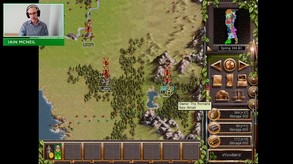
Legion Gold, developed and published by Slitherine Ltd., is a historically grounded turn-based strategy game that revisits and expands upon the studio’s earlier title Legion. Set during the turbulent era of the Roman Republic and its surrounding civilizations, the game places players in command of emerging powers across the ancient Mediterranean. Its design philosophy leans heavily into methodical planning, empire management, and tactical foresight, offering a deliberate and cerebral strategy experience that prioritizes preparation over spectacle. Rather than focusing on cinematic presentation or real-time micromanagement, Legion Gold embraces classic wargaming sensibilities rooted in patience and long-term decision-making.
The strategic layer forms the backbone of the experience. Players control cities, oversee economic production, and manage population growth while balancing military expansion with infrastructure development. Resource allocation is critical; constructing buildings, training units, and maintaining stability all depend on careful economic planning. The map spans multiple historically inspired regions, and each faction presents unique starting conditions that influence early-game strategy. Expansion through conquest or diplomacy requires calculated risk assessment, as overextension can quickly destabilize an empire. The interplay between economic growth and military capability becomes the central tension driving each campaign.
When armies clash, the game transitions into tactical battle mode. Here, players deploy units, arrange formations, and determine engagement speeds before combat unfolds. Unlike many modern strategy games that allow real-time intervention during battles, Legion Gold limits direct control once fighting begins. Outcomes are shaped by initial positioning, terrain advantages, morale levels, and unit composition. This approach reinforces the importance of preparation rather than reaction. Success depends on understanding the strengths and weaknesses of infantry, cavalry, and specialized units, as well as anticipating how formations will interact once engagement begins. For players accustomed to hands-on battlefield micromanagement, this system may feel detached, but for those who appreciate pre-battle planning as the primary test of skill, it provides a uniquely strategic challenge.
Historically inspired design is one of the game’s defining strengths. Unit names, geographical locations, and faction identities reflect ancient Mediterranean cultures, lending authenticity to the campaigns. The inclusion of multiple playable nations expands replayability, as each faction demands different strategic priorities and battlefield tactics. Roman legions behave differently from tribal armies, and these distinctions influence both recruitment strategies and combat outcomes. The historical framing enhances immersion for players interested in classical warfare and the rise of empires during antiquity.
Visually, Legion Gold reflects its early 2000s origins. The graphics are functional rather than flashy, featuring straightforward terrain textures and unit representations that prioritize clarity over modern visual fidelity. While the presentation lacks contemporary polish, it remains readable and consistent. The interface, however, can feel dated and somewhat unintuitive by modern standards. Information is present but not always clearly organized, and new players may require time to understand various systems without extensive in-game guidance. This learning curve reinforces the game’s niche appeal among dedicated strategy enthusiasts.
Artificial intelligence and diplomacy systems contribute to the broader strategic experience, though they exhibit limitations characteristic of their era. AI opponents provide reasonable resistance but may lack the adaptability found in more modern grand strategy titles. Diplomatic interactions, while functional, are relatively straightforward and sometimes lack the nuance that contemporary players might expect. Even so, the challenge often emerges not from unpredictable AI behavior but from managing internal pressures and maintaining military strength over extended campaigns.
One of Legion Gold’s enduring strengths lies in its replayability. Multiple scenarios, varied starting positions, and differing faction attributes create opportunities for experimentation. Players can attempt rapid military domination, cautious territorial consolidation, or balanced economic expansion depending on their preferred style. Because victory hinges on long-term planning rather than short bursts of action, each campaign unfolds differently based on early decisions and mid-game adjustments. The pacing rewards players who enjoy slow-building strategic arcs rather than immediate gratification.
Despite its depth, the game’s age is evident in occasional technical quirks and dated design conventions. Modern players may encounter compatibility issues or interface friction that require patience. However, these shortcomings are often outweighed by the thoughtful strategic systems that underpin the experience. Legion Gold does not attempt to compete with contemporary grand strategy epics; instead, it preserves a classic wargame identity that emphasizes calculated command over spectacle.
Ultimately, Legion Gold stands as a testament to Slitherine’s early contributions to the strategy genre. It offers a historically themed, tactically focused experience that rewards foresight, discipline, and long-term empire planning. While its presentation and mechanics reflect an earlier era of PC gaming, its strategic core remains engaging for players who appreciate methodical warfare and classical setting immersion. For enthusiasts of traditional turn-based strategy rooted in ancient history, Legion Gold provides a challenging and thoughtfully constructed campaign experience that continues to hold relevance within its niche.
Rating: 7/10