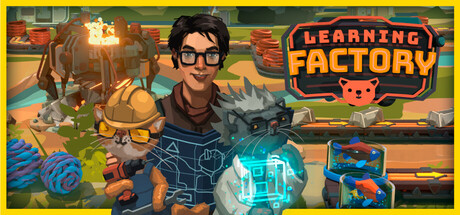
Build intricate supply chains to meet your feline customers' needs. Discover underground and air transport layers, a vast research tree, procedural worlds, machine learning, and endless automation in this relaxing, enemyless game.
Modeled estimate, not a reported figure. How we estimate →
Media

About
Learning Factory is a relaxing automation game, which lets you concentrate on the most important task in the Universe: making cats happy again.
You're a humble genius scientist who gets invited to become the chief engineer at an abandoned Factory on Mars, designed to produce and sell exquisite goods for cats. It was conceived to learn everything about cats and make them happy, but it is desolated now, and cats are leaving Factory Stores unhappy and empty-pawed.

Now you have a chance to continue the research and development of goods that feline hearts long for! Simply follow these steps on your way to a scientific breakthrough:
Renovate an abandoned factory on Mars
Design and automate production chains
Produce and sell exquisite goods to cats
Collect and analyze data with Machine Learning
Scale and make the factory more efficient
Make cats happy!
Rebuild the ancient Monument
Establish Catopia in the feline society!
Sales at the Factory Stores generate tons of data which is later analyzed by real-life machine learning in order to unlock the in-depth nature of the feline mind.
But hey: no pressure! In this fail-safe environment, the key to success is to keep trying and stay curious. Experiment, optimize, automate - and keep creating a giant cat-catering factory on Mars. Eventually you will find the key to a better future for humans and cats (and also maybe dogs, dogs are kinda ok, too)!
The game is backed up with real Machine Learning, links to handpicked educational videos, and an in-game wiki to be used as learning material.
Genres
Stats
All-time low is the lowest price we've recorded for this game since we started tracking it.
Engagement
Hours played at review time, across 41 reviews with recorded playtime.
Reviews
Themes across 41 recent reviews and how positive each mention is. A keyword signal, not full sentiment analysis.
positive critical· bar length = how often the theme comes up
Reviews
Factorio with cats. No enemies, only cat(?) customers that you want to sell your goods for and satisfy them. There are some Machine learning component that the game tries to teach you (This area needs some improvement in my opinion). Is it well optimized? To a point yes, but expect fps drops in late game. Do I recommend it? Yeah it's quite fun.
It's playable. It's an interesting spin on this genre. I think it starts of way too quickly and piles way too many features on top of the player. It took me very long to figure out some of the early stuff that I managed to skip "thanks" to that. The machine learning is something I don't understand the point of at all, and it makes the game kinda random and it's difficult to figure out what I'm doing wrong to make the cats unhappy. It feels like it was a core idea to the game, but then it fell flat on its' face and was just left in. The UI probably doesn't help. It's the worst UI I saw in a game that wasn't just a cash grab. Can we give it a game award for this? It's so bad there would be a new kind of mental illness if more people played this game. Also, what is the point of having a character? It doesn't add anything and it just substracts. You bump into everything and get slowed by everything and even with the upgrades it doesn't feel good moving around. In satisfactory, the character is really well connrected to the story, and playing a 3D game with just a camera would be dissorienting. In factorio, you can die and shoot. But for example shapez was doing fine without a playable character. In this game the story is nonsensical and it just feels like we have it because factorio did it. As a last point, it seems to have a lot of educational stuff? I don't think there's much to learn. It couldn't even teach me how to play the game, how am I supposed to learn anything else from it. I know some basics of how machine learning works, but the UI didn't allow me any of my basic knowledge to what is happening, so in the end I probably unlearned a few things. And why teach what a fish is, in a game like this? It could work if we we're hundreds of years post apocalypse, but as of writing this, we're not. This is a game where I really struggle with the steam review system. Would I recommend this game? No. But is it so bad I want people to stay away from it? Also no.
Déroutant au début, puis fun
Nettes Spielchen um etwas mit einfachem Machine Learning rumzuspielen. In Teilen mehr symbolischer Natur, aber es gibt auch vertiefende Weiterleitungen falls man sich dafür interessiert.
Learning Factory is an automation and management simulator developed and published by Luden.io that takes familiar factory-building concepts and gives them a surprisingly creative purpose. Rather than building massive industrial empires solely for expansion or profit, players are tasked with understanding one of humanity’s oldest mysteries: what cats actually want. By combining logistics management, production chains, machine learning concepts, and lighthearted humor, the game creates an experience that feels educational, relaxing, and mechanically rewarding at the same time. The premise immediately gives Learning Factory its identity. Players arrive on Mars to restore a neglected manufacturing facility originally designed to study feline preferences and produce products that satisfy cat consumers. The abandoned operation no longer functions properly, customer satisfaction has declined, and rebuilding the entire system becomes the central objective. Success depends not only on creating efficient production networks but also on gathering information, analyzing behavior patterns, and improving understanding of customer demand. At its heart, Learning Factory follows many principles familiar to automation genre veterans. Resources must be extracted, machinery carefully positioned, and transportation systems optimized to maintain smooth production flow. Early progression begins simply with manageable factory layouts and straightforward manufacturing chains. Over time, additional complexity appears naturally as expanding operations introduce larger logistical challenges and greater demands for efficiency. Designing production lines becomes one of the game's strongest features. Conveyor belts, assembly systems, and resource routing create satisfying optimization puzzles where small adjustments often generate significant improvements. Players constantly refine layouts, eliminate bottlenecks, and redesign infrastructure to improve performance. Few experiences in management games remain as consistently satisfying as watching disconnected machines slowly evolve into a highly efficient operation running with minimal intervention. The production mechanics remain engaging because Learning Factory steadily introduces additional systems rather than overwhelming players immediately. New technologies unlock gradually, expanding factory possibilities while encouraging experimentation. Research progression feels meaningful because upgrades significantly reshape how facilities operate. Early designs that initially appear effective eventually become outdated, encouraging players to rethink layouts and discover more advanced solutions. What separates Learning Factory from many factory simulators is how heavily it emphasizes information analysis. Data gathered through cat purchasing behavior influences production decisions directly. Understanding consumer preferences becomes equally important as manufacturing efficiency. The game cleverly transforms customer analytics into an interactive gameplay system where players gradually uncover patterns that shape future planning. Machine learning concepts further strengthen the experience's uniqueness. Rather than existing purely as background flavor, analytical systems play active roles in progression and factory management. Players collect information, interpret trends, and improve understanding of demand patterns over time. The educational ideas remain approachable even for players unfamiliar with technical subjects, allowing Learning Factory to introduce interesting concepts without becoming intimidating. The game's atmosphere also deserves recognition. Unlike many automation titles that introduce survival pressure or external threats, Learning Factory embraces a calmer pacing focused entirely on optimization and experimentation. There are no hostile forces disrupting progress or forcing defensive preparation. Challenges emerge from organization, scaling operations, and improving efficiency rather than reacting to danger. That design decision creates a more relaxed experience well-suited to players who enjoy thoughtful planning. Mars serves as an effective backdrop for progression. Expansion opportunities steadily increase as operations grow larger and more ambitious. The setting supports exploration while reinforcing the game's unusual scientific identity. Additional systems introduced later create greater opportunities for players who enjoy building increasingly sophisticated industrial networks. Visually, Learning Factory favors readability and function over technical spectacle. Factory management games naturally become more complicated over time, but the interface and presentation remain manageable even as production networks expand dramatically. Machines remain visually clear, transportation systems stay understandable, and information presentation supports long-term planning effectively. The art style also reinforces the game's lighter personality. The focus on cats and humorous presentation prevents the educational aspects from feeling overly serious or clinical. Despite involving logistics optimization and machine learning ideas, the experience maintains an approachable and charming tone throughout progression. Audio design complements the slower pacing effectively. Music supports longer play sessions comfortably without becoming distracting, while sound effects provide useful feedback that reinforces factory activity. Since optimization games often encourage extended sessions focused on planning and refinement, maintaining an unobtrusive presentation becomes especially important. The progression pace occasionally slows as factory demands increase. Larger operations require more planning, redesign work, and logistical improvements that may feel demanding for players unfamiliar with automation-heavy experiences. However, those who enjoy factory simulators will likely appreciate the deeper optimization opportunities introduced during later stages. Learning Factory succeeds because it balances education, creativity, and management systems exceptionally well. Luden.io created a factory-building experience that feels distinctive without sacrificing accessibility. The unusual objective gives the game personality, while its automation systems provide enough depth to satisfy players looking for meaningful optimization challenges. For fans of logistics simulations, factory-building games, management systems, and relaxed optimization experiences, Learning Factory delivers an intelligent and rewarding experience that stands out through originality and thoughtful design. Rating: 8/10
5/5 cats!
Ok.
Неплохой вариант Факторио со своими идеями. С удовольствием провел в игре десятки часов, удовлетворяя потребности котиков.
Классыной завод с котами) Мурчалово 10 из 10
Почти 100 часов удовольствия для любителей Факторио
Related
Related
Trends
Modeled estimate over time, reconstructed from Steam's monthly review histogram.
Momentum
Pace estimated from the game's recent review growth (our daily snapshots) at its own sales-per-review ratio — a momentum signal, not booked sales.
Audience
Languages: English*, Russian*, Simplified Chinese*, Traditional Chinese*, German*, French, Italian, Spanish - Spain, Portuguese - Brazil*, Korean*, Japanese, Polish +20 more
Estimated from the language of this game's reviews — a proxy for where players are, not official Steam demographics.
Related
| Moon Mystery | $278.5K | 541 | 67% | $11.99 |
| Red Wings: Aces of the Sky | $278.6K | 792 | 70% | $19.99 |
| Monster Slayers | $278.4K | 1.3K | 79% | $8.99 |
| 吞食孔明传 Tunshi Kongming Legends | $278.4K | 1.2K | 72% | $9.99 |
| Septerra Core | $278.4K | 1.3K | 77% | $7.99 |
| Nine-Ball Roulette | $278.7K | 2.3K | 88% | $3.99 |