Gary Grigsby’s War in the East is a monumental operational-level World War II wargame that stands as one of the most detailed and demanding strategy simulations ever released on Steam. Developed by 2by3 Games and published by Matrix Games, the game focuses entirely on the Eastern Front conflict between Nazi Germany and the Soviet Union, spanning from the opening stages of Operation Barbarossa in 1941 through the final collapse of German forces in 1945. Rather than offering a streamlined or cinematic interpretation of history, the game commits to a near-academic level of simulation, presenting warfare as a vast, exhausting contest of logistics, manpower, terrain, weather, and long-term planning. From the very first turn, it makes clear that this is not a casual strategy title but a deep, uncompromising war simulation designed for players who want to engage with history at a granular operational scale.
The scope of War in the East is staggering. The map stretches across thousands of hexes, covering nearly the entire Eastern European theater, with each hex representing roughly ten miles of terrain and each turn equating to a week of real time. Players command thousands of units at the division and brigade level, managing armies that can number in the millions of soldiers. Movement, combat, and positioning all require careful consideration, as even small mistakes can cascade into large-scale disasters weeks later. Unlike many strategy games that reward constant aggression, War in the East emphasizes patience and realism; overextending forces, neglecting supply lines, or ignoring seasonal weather effects can cripple even the strongest offensives. Every decision feels heavy, and the long campaign structure ensures that early choices echo far into the future.
One of the defining strengths of the game is its logistics and supply system, which plays a central role in shaping the entire experience. Armies do not simply advance because they have strong units; they advance only if rail networks are repaired, supply depots are functioning, and fuel and ammunition can reach the front lines. This creates a constant tension between ambition and practicality, especially for the German side, which must balance rapid advances against the risk of logistical collapse. Weather further complicates matters, with mud seasons and harsh winters dramatically reducing movement and combat effectiveness, often forcing players to pause or regroup at historically accurate moments. These systems combine to create a simulation that feels authentic and punishing in equal measure, reinforcing the idea that victory is earned through preparation as much as battlefield success.
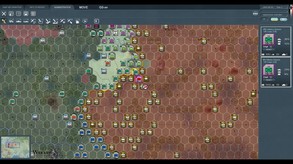
The presentation of War in the East is functional rather than inviting, reflecting its priorities. The interface is dense with information, tables, and nested menus, and while everything is there for a reason, it can be overwhelming to new players. Learning how to interpret combat odds, unit readiness, morale, and supply status requires time and patience, and the game’s infamous manual is often as challenging as the game itself. However, for those willing to invest the effort, the clarity of information eventually becomes a strength, allowing experienced players to make informed, deliberate decisions based on a wealth of data. This learning curve is steep, but it is also part of the game’s identity, rewarding dedication with a level of strategic control rarely found elsewhere.
Single-player campaigns offer a formidable challenge, with AI opponents capable of mounting credible offensives and defensive operations across the massive map. However, the game truly shines in multiplayer, particularly through its play-by-email system, where two human commanders can wage a campaign over months or even years of real time. Facing another player introduces unpredictability and psychological warfare that elevate the experience beyond scripted behavior, turning each campaign into a unique historical what-if scenario. These long-form matches capture the exhausting, attritional nature of the Eastern Front better than almost any other digital game, as both sides slowly adapt, counter, and exploit weaknesses over hundreds of turns.
Ultimately, Gary Grigsby’s War in the East is not a game that tries to appeal to everyone, nor does it need to. It is a definitive, uncompromising simulation aimed squarely at dedicated wargame enthusiasts and history buffs who appreciate complexity, realism, and long-term strategic thinking. Its age shows in its interface and presentation, but its systems remain remarkably deep and relevant, even years after release. For players willing to commit the time and mental energy required to master its mechanics, the game offers an unparalleled portrayal of the largest land war in human history, delivering a sense of scale, consequence, and historical immersion that few strategy titles have ever matched.
Rating: 8/10