Frozen Synapse, developed and published by Mode 7, stands as one of the most cerebral and elegantly designed tactical strategy games of its generation. It trades spectacle for intellect, opting for a minimalist presentation that places every ounce of attention on precision, planning, and psychological warfare. At its heart, the game is a simultaneous turn-based tactics experience, where both players plot their moves at the same time and then watch them unfold in brief, tense five-second bursts of action. Every round becomes a battle of foresight rather than reflex, with victory hinging not on luck or chance, but on one’s ability to predict and outthink the opponent. The setting—a cold, neon-tinged cyberpunk world—reflects the game’s mentality: efficient, calculating, and deeply focused on strategy over style.
The premise is simple but deeply effective. You control a small squad of units, each with specific weapon types and movement capabilities, in confined maps filled with walls, cover, and choke points. You carefully plan each soldier’s trajectory, aim direction, and stance, considering what your opponent might do in the same instant. Once you commit your plan, the turn plays out simultaneously for both sides, revealing whether your assumptions were right—or fatally wrong. There are no dice rolls or probability-based outcomes here; success and failure come down entirely to tactics and anticipation. It’s a rare kind of purity in game design, one that turns every decision into a matter of life and death. Each turn feels like a chess move in a high-stakes cybernetic duel, where reading your enemy’s mind is just as vital as positioning your troops.
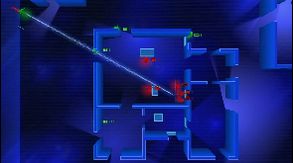
The minimalist art direction reinforces this tension beautifully. The battlefield is presented through abstract geometric spaces, with vibrant neon outlines and clean, uncluttered visuals that make readability paramount. It’s not flashy, but the simplicity enhances focus, giving every wall, angle, and line of sight tangible significance. The game’s soundtrack, composed by nervous_testpilot (Paul Taylor), deserves particular praise—its blend of ambient electronic tones and pulsating rhythm captures the mood perfectly, reflecting the mixture of control and anxiety that defines each encounter. Together, the visuals and audio immerse players in a world that feels sterile yet charged, futuristic yet intimate. It’s a design that understands how less can often mean more.
Frozen Synapse’s brilliance shines most in its multiplayer mode, where the psychological element of prediction reaches its peak. Facing human opponents transforms the game from a mechanical puzzle into a contest of wits. Every match becomes a duel of deception—will your opponent take the obvious shot or feint to lure you into a trap? Because turns resolve simultaneously, you’re always forced to make assumptions, layering fake-outs and counter-maneuvers like a digital fencing match. The asynchronous online structure means matches can unfold over hours or even days, allowing players to take their time with each decision. Even after years, the multiplayer system remains one of the game’s strongest features, supported by leaderboards and a loyal niche community of tacticians who thrive on its unforgiving logic.
The single-player campaign, while secondary to the competitive side, still offers a compelling framework for experimentation. It follows a loose cyberpunk narrative involving rebellion and digital control, but the real appeal lies in its variety of mission objectives. You’ll be tasked with rescuing hostages, escorting units, and surviving ambushes—all within the same tactical sandbox. Each map forces you to rethink your approach, testing your adaptability and spatial awareness. The AI is competent, aggressive, and unpredictable enough to keep players on edge, though it occasionally suffers from the same rigidity that defines the game’s deterministic systems. Even so, the campaign serves as an excellent training ground, easing players into the rhythm of thought and counterthought that defines Frozen Synapse at its best.
Not every aspect of the experience is without friction. The learning curve is steep, and the interface, though powerful, demands patience to master. The game’s emphasis on precision can make early mistakes feel punishing, especially for players new to simultaneous-turn systems. Randomly generated maps sometimes favor certain starting positions, introducing moments of imbalance in what is otherwise a rigorously fair design. The story, while serviceable, often fades into the background against the mechanical brilliance of the gameplay. Yet these flaws feel minor in comparison to what the game achieves. Frozen Synapse is unapologetically demanding—it assumes intelligence from its players and rewards meticulous thinking rather than brute force or grind.
What ultimately makes Frozen Synapse so enduring is how timeless its design feels. It doesn’t rely on graphics or gimmicks to engage; its core mechanics are so sound that they could function in any aesthetic wrapper. It captures that rare essence of strategic purity that few games ever reach—a game of intellect where every decision has weight, every plan carries risk, and every outcome feels earned. The tension of watching your carefully constructed move play out against an opponent’s unseen counterplan is exhilarating in a way no other tactics game replicates.
Frozen Synapse remains one of the most distinctive strategy experiences on PC—a game that fuses logic, anticipation, and creativity into something both cerebral and thrilling. For those willing to invest the time to understand its systems, it offers unmatched satisfaction. It’s not just about commanding soldiers; it’s about commanding thought itself. Mode 7 crafted an experience that distills strategy to its most essential elements, transforming combat into a mental duel of perfect information and imperfect prediction. It is as much about psychology as tactics, and for that reason alone, it continues to stand as one of the finest examples of minimalist design meeting maximal strategic depth.
Rating: 8/10